Counties and Ancestry
County Donegal Emigration History
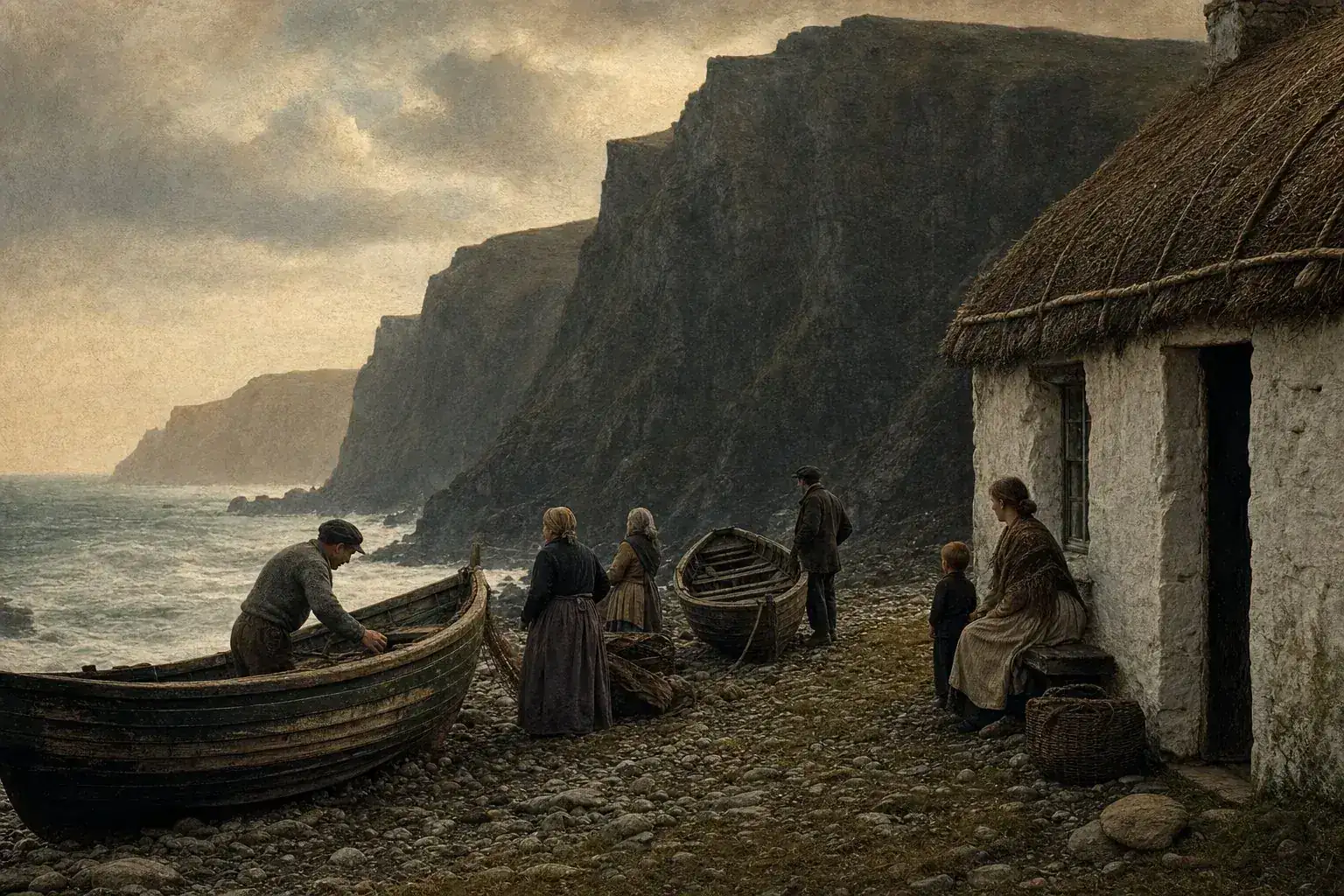
Every spring, in the Donegal Gaeltacht, whole townlands emptied out. Boys and girls barely into their teens tied a bundle and took the boat from Derry to Scotland, to the potato fields of Ayrshire and Perthshire. They were not leaving for good. They came home in the autumn and did it again the following spring, for as many years as the family needed the wage.
That is the detail that makes county Donegal emigration history different from the rest of Ireland’s. Almost every county sent its people away once, for good, on a ship that did not turn around. Donegal did that too, and lost as much of itself in the Famine as anywhere in the west. But running underneath the permanent emigration was a second current that never really stopped, seasonal, circular, and bound for Scotland rather than America, lasting from the middle of the nineteenth century into living memory.
Poverty before the Famine
Donegal’s worst-hit districts were poor long before the blight ever reached them. Along the coast from Gweedore to Glencolmcille, land was held under the rundale system, scattered strips shared and resubdivided between families until a holding could no longer support the people living on it. The potato was not a preference in these parishes. It was the only crop that would grow enough food on so little ground.
In 1837, a decade before the Famine, a schoolteacher named Patrick MacKye wrote an account of the parish around Gweedore and Cloughaneely for the newspapers, describing a population that owned almost nothing: no shoes on most feet, and not so much as a cart to be found between several townlands. It was reprinted and read outside Donegal, and it raised relief money before a single potato had failed. Ten years later, when the crop did fail, it failed a district that had nothing behind it to begin with.
The landlord Lord George Hill arrived at Gweedore in the 1830s with a scheme to break the rundale strips into fenced, individual farms, and built a pier at Bunbeg, roads and a hotel to go with it. Whatever it did for the estate, it could not outrun what followed. When the blight came, the workhouses at Glenties, Dunfanaghy, Stranorlar and Donegal town filled past what they were built to hold, and the same coastal parishes MacKye had described in 1837 buried their people and watched the rest take the road to Derry.
County Donegal emigration history, era by era
The Famine opened the road out of Donegal the way it did everywhere in the west. What kept Donegal people leaving, generation after generation, had as much to do with the county’s geography as its history.
The 1850s and 1860s: permanent emigration takes hold. Emigrant ships sailed directly from Derry, the nearest deep-water port to most of Donegal, and Derry firms like the McCorkell Line carried tens of thousands of Ulster passengers across the Atlantic through the second half of the century. A family with one member settled in Philadelphia or New York could send for the next, the same chain migration that emptied townlands across Connacht, running here through Derry quay instead of Cobh or Liverpool.
1891: the Congested Districts Board. Donegal was named, alongside Mayo, Galway and Kerry, among the poorest western counties the Board was created to help. It funded piers, better boats for the Gweedore and Rosses fishing fleets, and weaving and knitting schemes meant to give small farms a second income. None of it reversed the underlying arithmetic. Too many people were settled on too little ground, and the boat, in one direction or the other, remained the only real answer for most families.
Partition, and a border through the market town. After 1921, Donegal was cut off from Derry, the city its western half had always looked to for a fair, a market and a boat. A land border now ran between them. Twentieth century Donegal emigration answered this new isolation much as it had answered the old poverty, by leaving, though increasingly now for English cities as much as Scottish or American ones.
Why Donegal went to Scotland as well as America
Ask about county Donegal emigration history in the county itself, and Scotland comes up before America does. From the 1850s through to the middle of the twentieth century, thousands of Donegal people, many of them still children, left every spring for the potato fields and farms of lowland Scotland and came home again in the autumn. It was called tattie hoking, from the Scots word for digging potatoes, and it was not emigration in the sense of one final departure. It was a working year split across two countries, repeated for as long as a family needed the wage.
The season began at the hiring fairs. At market towns like Letterkenny, Raphoe and Strabane, just over the county line, boys and girls as young as ten or eleven stood to be looked over and hired out for six months of farm service, often to a stranger from another parish entirely, before the same fairs sent a second wave onward to the boat for Scotland. The writer Patrick MacGill, born near Glenties around 1890, was hired out this way as a child and later worked the tattie fields himself before he became a labourer on the railways of Scotland and England. His novel Children of the Dead End, drawn directly from that life, remains one of the clearest accounts anyone wrote of what the hiring fairs and the potato fields actually asked of a child.
Whole families went together, which meant whole classrooms emptied. School attendance in Donegal fell every spring for decades, a pattern later inspectors connected directly to the movement to Scotland. It outlasted the Famine by a hundred years, still carrying Donegal families to Ayrshire and Perthshire well into living memory, long after the transatlantic emigrant ship had become a memory itself.
Where Donegal’s people went
America took Donegal’s permanent emigrants to the usual places: Philadelphia, New York, the coal and mill towns of Pennsylvania. But Donegal’s real destination, then and for a century after, was Scotland. Glasgow, Greenock and Dundee absorbed Donegal families by the thousand, first as seasonal tattie hokers and then, as often as not, as permanent settlers once a wage in a Scottish mill or shipyard looked steadier than a smallholding at home. Dundee’s jute mills in particular ran on Irish labour through the second half of the nineteenth century, Donegal women prominent among them.
Donegal’s emigration story also runs a generation earlier than most of Ireland’s, in a direction the rest of the country’s Famine-era story does not touch. The county was part of the Ulster Plantation of the early 1600s, and its eastern Laggan district, around Raphoe and the Finn valley, held a substantial Presbyterian population descended from Scottish settlers. Long before the Famine, in the 1700s, that community fed into the great Scots-Irish migration to colonial and independence-era America, the same movement that filled the Pennsylvania frontier and the Appalachian backcountry. Donegal sent people to America under George III as well as under Victoria, from a different community and for different reasons.
The link to Scotland never really closed. Donegal associations still meet in Glasgow, and Dungloe in the Rosses has held a summer festival built around the emigrant’s homecoming since the 1960s, proof that whatever the century, the road to Scotland stayed a road people expected to travel both ways.
The traces the leaving left
You can read this history on both sides of the water. In Donegal it reads as quiet: roofless cottages along the Gweedore and Rosses coast, an Irish still spoken in Gaeltacht parishes that lost half their people, hiring fairs that vanished from market towns within living memory. In Scotland and America it reads as names. Gallagher, Doherty, Sweeney, Boyle, thick through the parish rolls of Glasgow, Philadelphia and the Pennsylvania coal towns.
If Donegal is the county in your family tree, the records are more reachable than people expect. Civil records of births, marriages and deaths from 1864 onwards are free to search at irishgenealogy.ie. Catholic parish registers, many reaching back before the Famine, are online through the National Library of Ireland and searchable at RootsIreland. Griffith’s Valuation, taken in Donegal in the 1850s, names the head of almost every household and is often the only surviving trace of a family in the famine decade. From the Scottish end, mill and shipyard employment records in Glasgow and Dundee can carry a line back across the water to a single townland, and the same is true of ship manifests into Philadelphia and New York.
And then there is paper of another kind. For most Donegal families, whether the parting was for a season or for good, the relationship between the ones who left and the ones who stayed was carried in letters, written at kitchen tables in the same Gaeltacht parishes this history nearly emptied.