Counties and Ancestry
County Limerick Emigration History
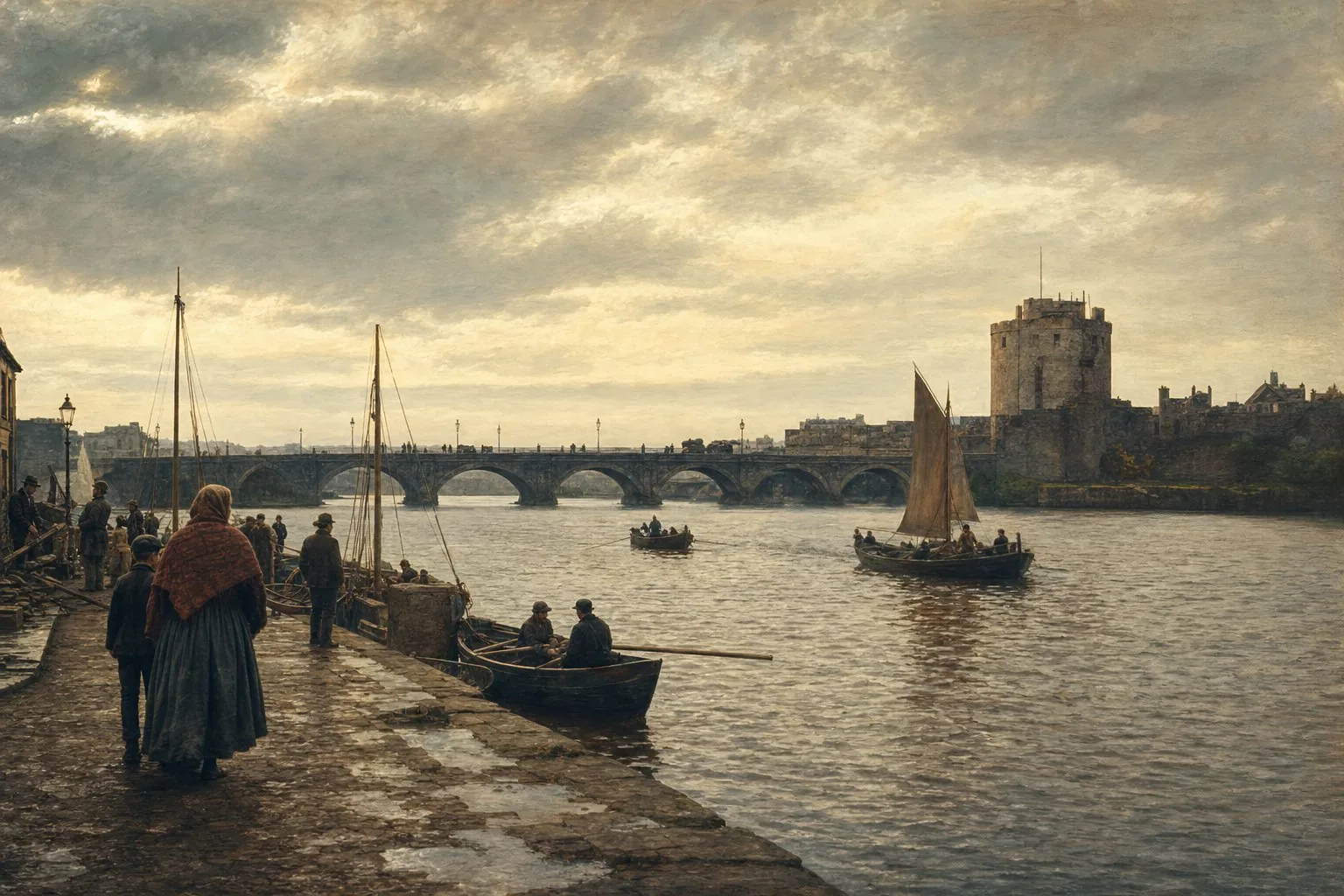
Ask about County Limerick emigration history and the honest answer is that there is no single history to give. The city and the county around it did not leave Ireland in the same way, for the same reasons, or even at the same time. A dock labourer walking away from the Shannon quays in 1850 and a farmer’s second son leaving a good stone house near Bruff twenty years later were both Limerick emigrants, and their stories share almost nothing else.
Most county histories of Irish emigration can treat the whole county as one unit, because for much of the west of Ireland that is close enough to true: poor land, small holdings, one long emergency. Limerick will not sit still for that. It holds a real city, one of Ireland’s oldest ports, and it holds two very different kinds of countryside within a few miles of each other, some of the richest grazing land in the country and some of the poorest hill farms in Munster.
If your family traces to Limerick, the first useful question is not when they left, but which Limerick they left from. The city, the Golden Vale, or the hills toward Kerry point toward three different histories, and mixing them up is the easiest mistake to make.
Why Limerick city and County Limerick are different stories
Limerick city sits where the River Shannon widens on its way to the sea, and it has been a port for the whole of its recorded history, Viking, Norman and modern. By the nineteenth century it was one of Ireland’s larger cities, with working quays, a bacon trade, flour mills, and a lace industry that gave work to thousands of women in workshops around the city. Its emigration was mostly an urban story, dock labourers, servants, tradesmen’s children, the lanes of Irishtown and Englishtown emptying the way city slums emptied across industrial Britain, through poverty and disease as much as through the failure of any one harvest.
Step outside the city and the land itself splits in two. The centre and east of the county lie on the Golden Vale, a belt of rich limestone pasture running on into Tipperary and north Cork, among the best grazing and dairying land in Ireland. Farmers here mostly weathered the Famine on their own ground. The west of the county, toward Newcastle West and Abbeyfeale and the Kerry border, is hillier and poorer, closer in kind to the smallholdings of Clare than to the rest of Limerick. Three Limericks, in effect, and three different reasons to leave.
Black ‘47 in Limerick
The Famine did not spare the rich land, but it struck the city and the poor west hardest. Fever moved through the lanes of Limerick city in 1847 as it moved through every Irish port town that year, and the workhouses built to relieve a few hundred people at a time, in Limerick city, in Rathkeale, in Newcastle West, filled past their doors within months. Entering one was rarely a rescue.
The Golden Vale told a harder truth than most people expect from a Famine story. A strong farmer on good land could weather the blight years and even prosper afterwards, buying up the holding of a neighbour who could not. That neighbour’s children went to the boat. In County Limerick’s richer half, the Famine did not just empty the land, it began quietly concentrating it, years before the evictions of the 1880s made the same process into a political scandal.
County Limerick emigration history, era by era
Before the Famine, Limerick already had one emigration story that belonged to no other county. In 1709 a large group of German-speaking Protestant refugees, fleeing war along the Rhine, were settled by local landlords on estates around Rathkeale and Adare. Their descendants, known ever after as the Palatines, kept their own surnames, Switzer, Ruttle, Teskey and Sparling among them, and largely their own communities, for generations. Some Palatine families left again within a few decades, this time for Pennsylvania and New York. In 1760 a Rathkeale Palatine named Philip Embury sailed for New York, and within a few years he was preaching to a small congregation of fellow emigrants in his own house, a beginning that historians of American Methodism trace directly back to that Limerick settlement. His cousin Barbara Heck, also of Palatine stock, is remembered the same way, and later moved on again to Canada. County Limerick was sending people across the Atlantic while the Famine was still more than a century away.
The 1850s and 1860s: the money starts coming back. Once the worst of the Famine passed, Limerick settled into the pattern that ruled Irish emigration for the rest of the century. A son or daughter with no future on a subdivided holding took the boat, found work, and sent money home. The market towns, Kilmallock, Bruff, Croom, Askeaton, became the places where a passage ticket or a remittance draft changed hands. Limerick city’s own quays saw less of this traffic than they once had, since the steamship lines were concentrating the transatlantic trade at Queenstown in Cork and at Liverpool, and a Limerick emigrant by the 1860s was as likely to travel east to catch a boat as to sail directly from home.
The 1870s and 1880s: west Limerick’s turn. A run of poor harvests at the end of the 1870s hit the hill farms around Newcastle West and Abbeyfeale much as it hit Clare and Mayo, and County Limerick had its own share of the Land War that followed, evictions, boycotts, and agitation for fixed rents and fair sale. Emigration from the poorer west of the county ran hardest in these years, while the Golden Vale, already consolidating into larger grazing farms, sent away fewer people but kept its holdings intact.
Into the twentieth century. Limerick’s road out never closed. It changed direction, toward England as much as America, and it kept running through independence, through the 1950s, and beyond. The city fared a little better than the open county for a stretch, its bacon yards, flour mills and a condensed milk factory giving it work the countryside did not have, but the population of the county outside the city walls kept falling, decade on decade, in the same pattern as the rest of rural Ireland.
Where Limerick’s emigrants went
The Palatines went first, to Pennsylvania and New York, following the same colonial-era routes as other eighteenth-century Protestant emigrants from Ireland. Their numbers were never large, but their story is unusually well documented, since the church they helped found in America kept careful record of its own beginnings.
The nineteenth-century emigration was bigger and less remarkable in its destinations. Boston and New York took the largest numbers, as they did from most of Munster, with smaller streams to Philadelphia and to the mill towns of New England, where Irish labour was in steady demand. England drew a share too, close and cheap to reach, and more important as the century went on, work in Liverpool, Manchester and London standing in for a passage a family could not always afford to make final.
Not every Limerick emigrant left by the same door, and that is worth holding onto. The city sent people from its own quays in the sailing-ship years. The county’s poor left however a passage could be found, increasingly through Cork or Liverpool rather than directly from home. The Golden Vale sent its surplus sons and daughters later, and generally better provisioned, following money their own families had already sent ahead. Three different Limericks, three different roads out, and none of them should be flattened into the other two.
Following your own Limerick thread
County Limerick’s records are good, by Irish standards, and the split at the centre of this history runs through the archive too. Griffith’s Valuation, taken across Limerick in the 1850s, named the occupier of almost every holding in the county, and is often the clearest way to see the difference between a Golden Vale farm and a west Limerick smallholding in the same decade. Civil registration of births, marriages and deaths, free to search at irishgenealogy.ie, begins in 1864. Catholic parish registers for the city and county, many running back well before the Famine, are digitised through the National Library of Ireland and searchable at RootsIreland. The Palatine settlements around Rathkeale kept their own church and burial records, mostly Church of Ireland and Methodist rather than Catholic, which catches out researchers who assume every County Limerick line runs through the same parish door.
And somewhere behind most of those records sits a letter that did not survive, or one that did. Limerick families, in the city and on both kinds of land, kept the same habit as the rest of Ireland. They wrote, and they waited on the post, and an envelope with an American or an English postmark was how a family found out whether the person who had walked to the docks or the railway station was still, in the plainest sense of the word, all right.