Counties and Ancestry
County Mayo emigration history: the Great Emigration
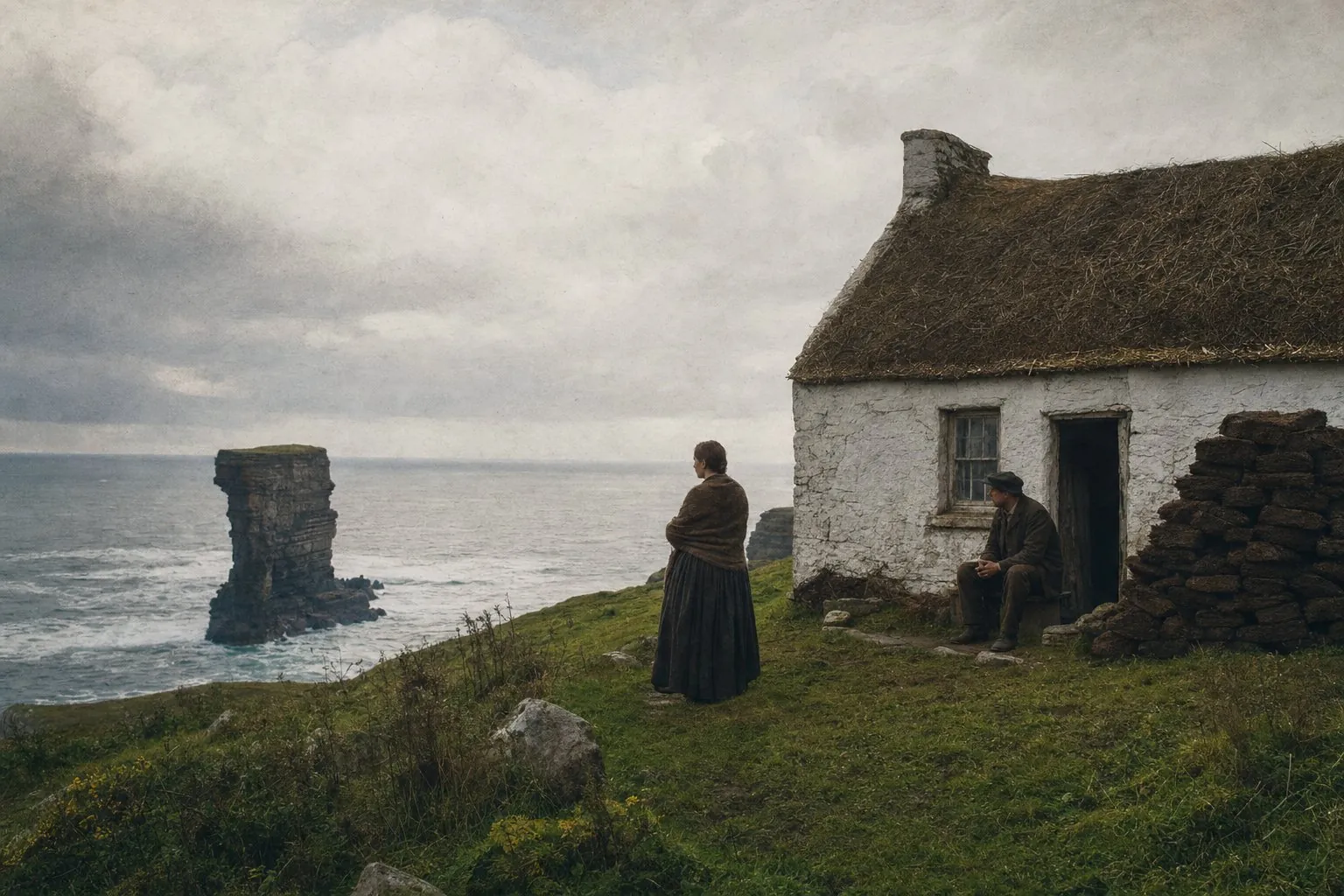
County Mayo emigration history begins with a census collapse: 388,887 people counted in 1841, 274,499 counted ten years later, a fall of close to three in every ten. Death and departure both did that work, in roughly equal measure, and the county never fully recovered. Its population kept falling at every census after 1841 until it bottomed out in 1971.
If your family traces to Mayo, this is the ground that history crossed.
Black ‘47 in the west
No Irish county leaned on the potato more completely. Mayo’s smallholdings were concentrated on poor coastal and bog land where little else would grow reliably, so when the blight took the crop there was nothing behind it. The worst year earned its own name, Black ‘47. Mayo was administered through five Poor Law unions, at Ballina, Ballinrobe, Castlebar, Swinford and Westport, and their workhouses, built for ordinary want, filled far beyond capacity with fever cases. At Swinford, a mass grave later found to hold 564 famine dead sits beside the old workhouse site.
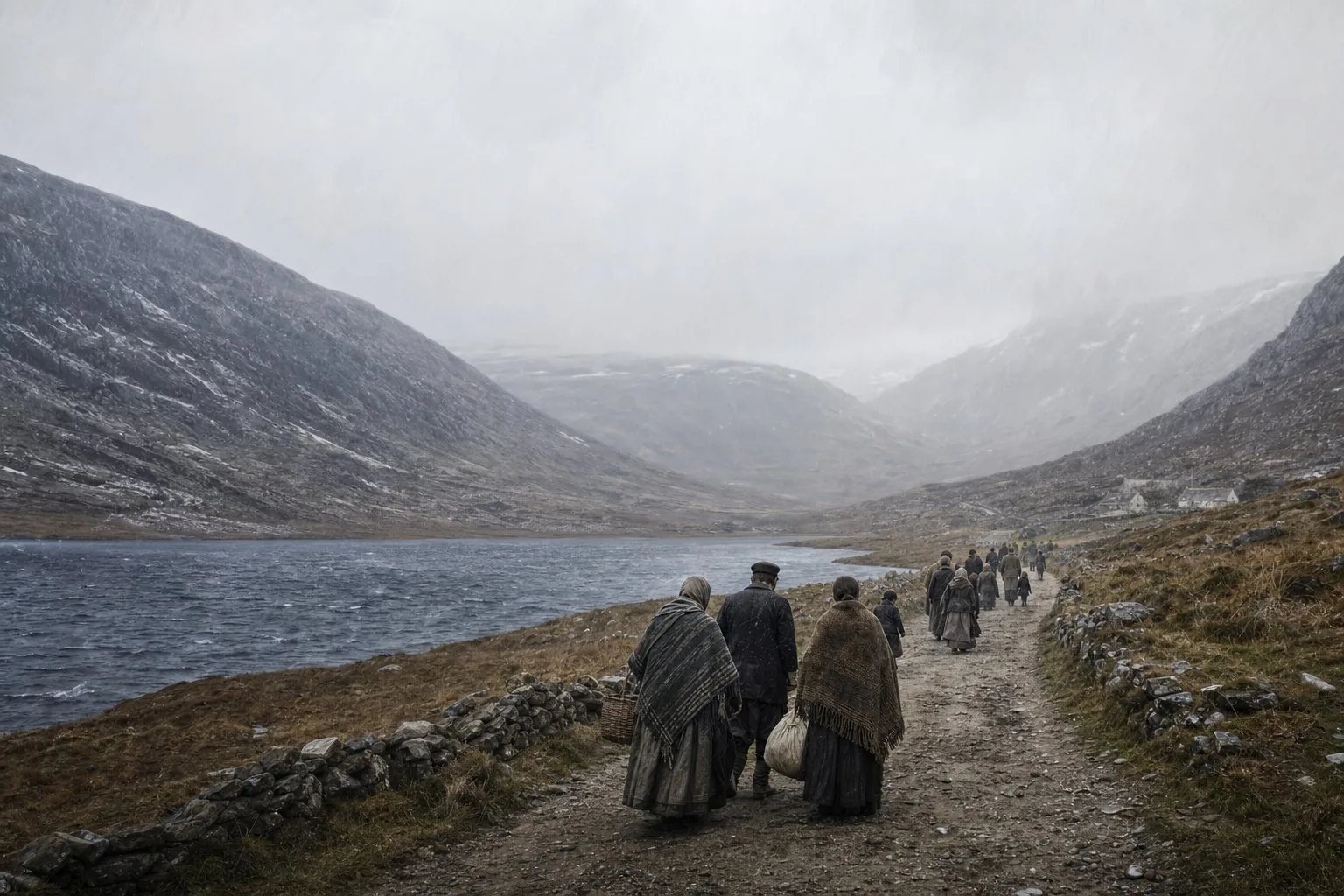
One episode from the spring of 1849 stands for the rest. Poor Law officials due to inspect claimants for relief travelled from Louisburgh to Delphi Lodge and told the destitute crowd waiting there to present themselves at Delphi the next morning or be struck from the relief list. Several hundred people, many already weakened by hunger, walked roughly ten miles each way through the mountains in severe weather. Some did not survive the return journey along the Doolough lakeshore. Action from Ireland has organised an annual famine walk along that road since 1988, and a National Famine Monument by the sculptor John Behan was unveiled nearby at Murrisk in 1997.
Relief policy pushed many Mayo families toward the same choice. Under the Poor Law Extension Act of 1847, a rule known locally as the Gregory clause barred anyone holding more than a quarter acre of land from receiving outdoor relief unless they first surrendered that holding to the landlord. For a smallholder with even a poor patch of ground, the choice came down to starvation on the road, the workhouse, or emigration, and thousands in Mayo took the third option once they had nothing left to surrender.
County Mayo emigration history in numbers
The census is the plainest record of what emigration did to Mayo. After the fall from 388,887 to 274,499 between 1841 and 1851, the county lost people at every count that followed, through the 1860s land crisis, the agricultural depression of the 1880s, and the decades of small farms and large families that came after independence. The population reached its lowest recorded point, 109,525, in the 1971 census, a little over a quarter of its pre-Famine size.
Most of that outflow was not self-funded. Mayo County Council’s own local studies material cites an 1864 estimate that no more than five in every hundred Mayo emigrants paid their own passage. The rest travelled on tickets and money sent from relatives already in America, a mechanism historians call chain migration: one person’s wage bought the next person’s crossing. On the same estimate, as much as nineteen million dollars in remittances passed from Irish emigrants in America back to Ireland between 1845 and 1854 alone, much of it as prepaid passage tickets rather than cash.
Mayo’s fall was steeper than the national pattern. Ireland’s population as a whole dropped from about 8.2 million at the 1841 census to roughly 4.4 million by 1911, a decline driven by the same combination of Famine mortality and sustained emigration that hollowed out Mayo more severely than most counties. Historians of the period have also found that women left Mayo in numbers equal to or greater than men, an unusual pattern in European emigration generally, attributed to the shortage of dowries and farm inheritances for daughters once a family’s land was settled on one son.
Where Mayo’s people went
Mayo emigrants rarely scattered at random. Parishes tended to empty into the same few American streets, because a bed and a promise of work could be arranged before the ship sailed, through a relative already settled there.
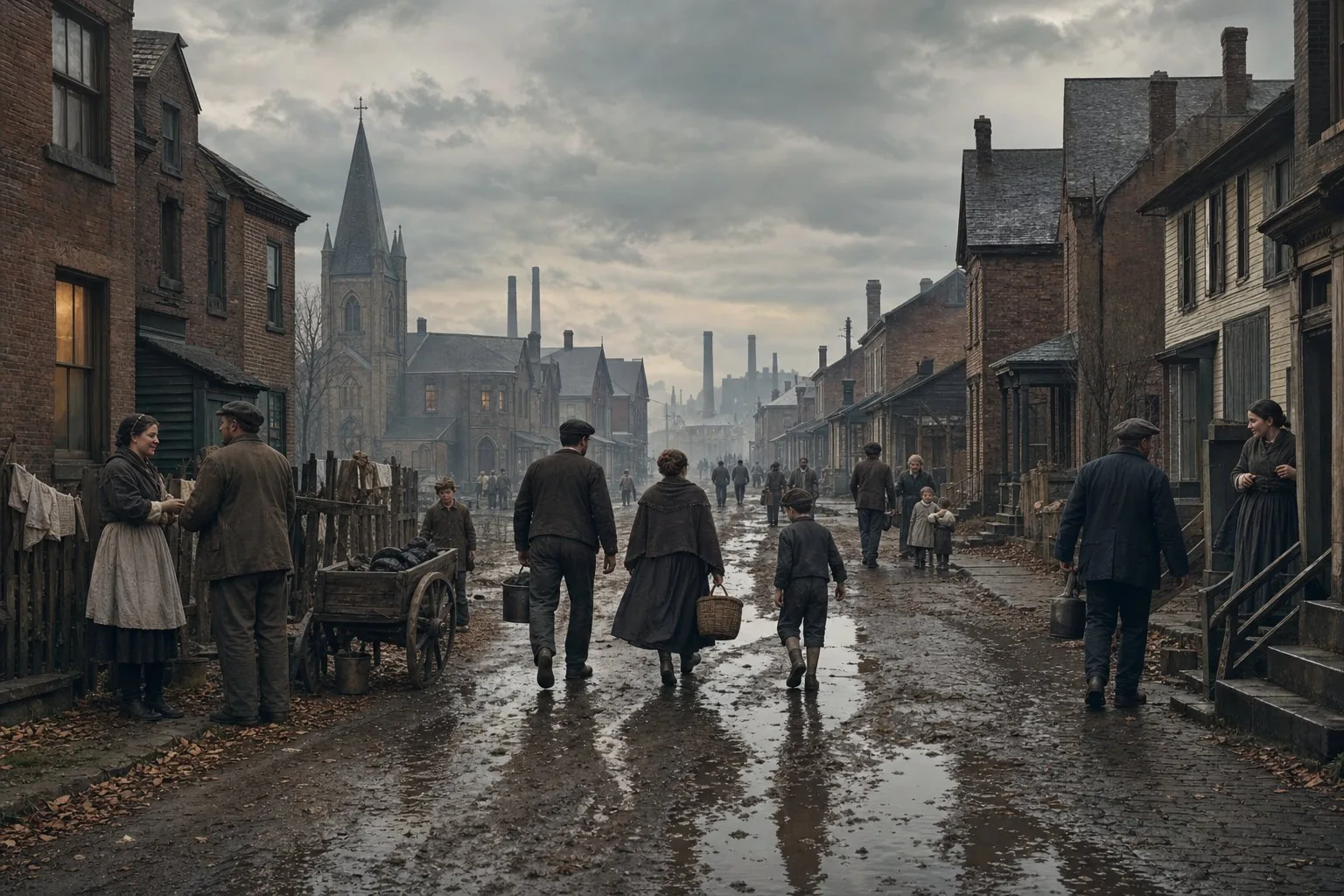
Ballina and the surrounding area sent enough people to Scranton, Pennsylvania, that the two towns became sister cities in 1990, a link researchers there attribute to Ballina families such as the Blewitts who arrived to work the anthracite mines and the Lackawanna railroad in the mid to late nineteenth century. Emigrants from Louisburgh, on Clew Bay, are recorded settling in Clinton, Massachusetts, in numbers strong enough that Clinton keeps a distinct Irish character to this day.
The clearest single thread runs from Achill Island to Cleveland, Ohio. Irish arrivals reached Cleveland from the 1820s, and the Irish population there grew from roughly 500 in 1826 to more than 1,000 by 1848 and past 10,000 by 1870. Achill migrants settled in a riverside district that became known locally as the Achill Patch, part of a wider Irish neighbourhood called the Angle, bounded by West 28th Street, Division Avenue and River Road. St Malachi’s parish, founded in 1867, served as its centre and counted around 2,000 Irish families at its height. The connection stayed active for a century and more, and County Mayo and Cleveland were formally twinned in 2003.
Not every Mayo family went for the docks and building trades of the east coast. Erris and Achill emigrants also travelled to the copper mines of Butte, Montana, a town with such a concentrated Irish population that historians have described it as Ireland’s fifth province, and Mayo surnames still turn up in Butte’s cemetery and parish records from the 1880s onward.
The American wake
Departure had its own ritual before a single mile of the journey was covered. Neighbours gathered at the emigrant’s house on the last night, brought what food and drink they could spare, and stayed for music, dancing and talk that often ran until first light. Local custom called the gathering an American wake, the same word used for a funeral, because in an era when the fare home cost more than most families would ever save, a son or daughter who sailed was, in every practical sense, gone for good. The mood mixed both registers at once: a party for the living and a farewell to someone the room might never see again. A letter crossing the Atlantic might be the only news a family received for months at a stretch.
Mayo emigration to Boston
Boston was one of the three main American ports for Mayo emigrants, alongside New York and Philadelphia, and Irish arrivals reshaped the city faster than almost anywhere else. By 1850 the Irish had become Boston’s largest immigrant group. Newly arrived families crowded first into the North End and Fort Hill, then into the West End and South Cove, before later generations moved out to South Boston, Charlestown, East Boston and Cambridge as work and money allowed.
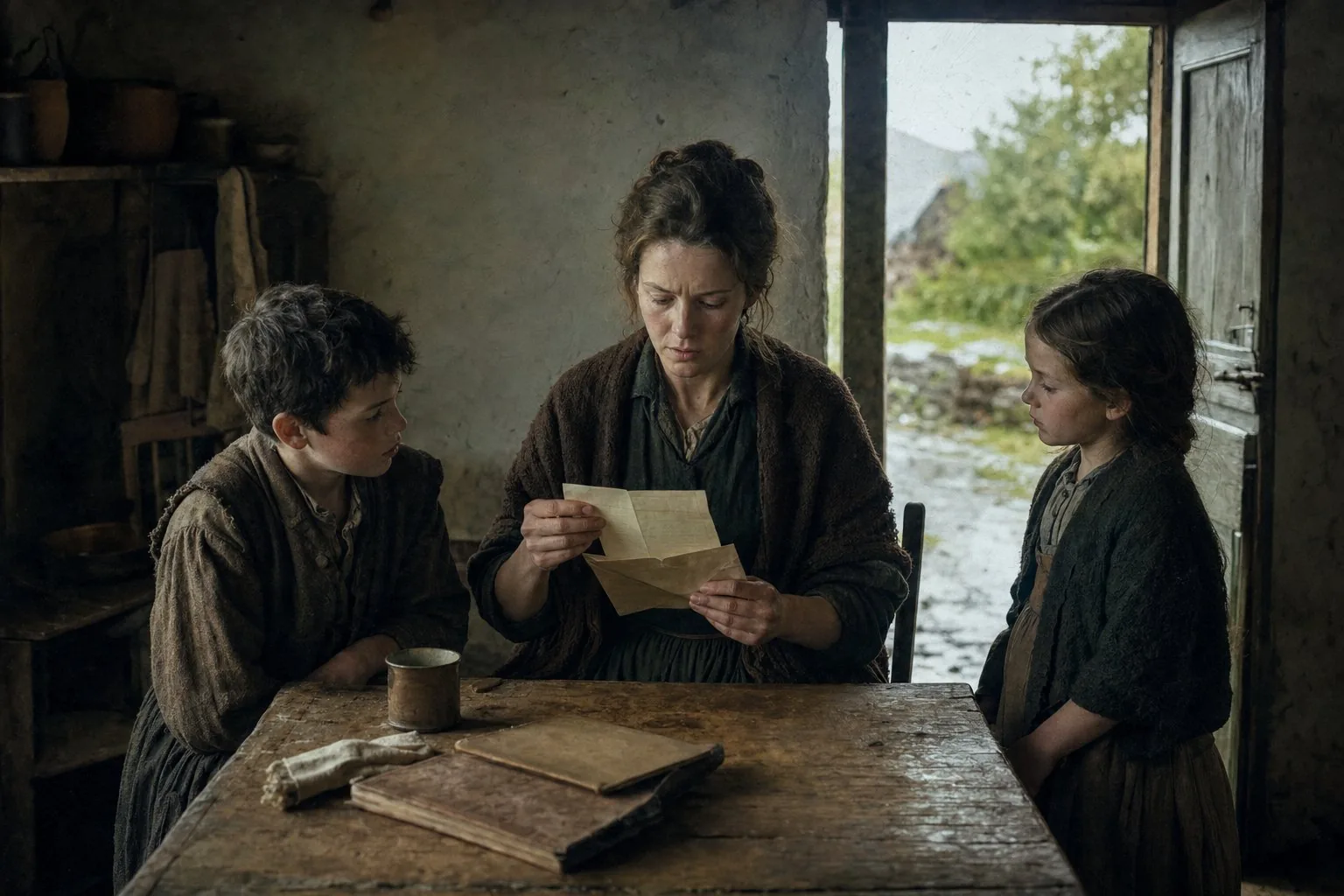
Arrival did not mean safety. A cholera epidemic struck Boston’s Irish tenement districts in 1849, only two years after the worst of the Famine crossings, and unskilled labour on the docks, in construction gangs and in domestic service was the entry point for most families regardless of what they had done in Mayo. Boston’s own Irish-American newspaper ran a long-running notice column through these decades in which readers searched for relatives who had emigrated and lost touch, a small but telling sign of how often the crossing broke contact rather than simply relocating a family.
Land, rent and a new word
The Famine did not end the pressure on Mayo tenants. Michael Davitt organised a mass protest against rents at Irishtown, County Mayo, on 20 April 1879, drawing a crowd estimated above ten thousand, and a Mayo Land League was formally established in Castlebar that August before the movement went national in Dublin in October. The following year, tenants on Lord Erne’s estate near Lough Mask House withdrew their labour and cooperation from his land agent, Charles Boycott, after he tried to evict rent defaulters. The campaign of isolation against him was widely reported, and by the end of 1880 his name had entered the English language as a verb. Agitation and emigration were two responses to the same shortage of land and income.
Emigration continued after the Land War won lower rents and, eventually, tenant purchase. Land reform slowed evictions but did nothing to enlarge Mayo’s smallholdings or the number of sons competing for them, so the county kept sending people abroad through the 1880s, 1890s and beyond, long after the political victories of Davitt’s movement had been secured.
What historians cannot know
The workhouse registers, ship manifests and parish records that survive are incomplete by nature. Many who left Mayo travelled without leaving a paper trail at the port of departure, especially those who crossed first to Liverpool before boarding an American-bound ship, and the exact number who died along roads like the one to Doolough was never precisely recorded at the time. Emigration and mortality figures from this period are almost always estimates built from partial returns, not full counts, and later historians have had to reconcile conflicting contemporary sources rather than simply read one authoritative number off a page.
Tracing a Mayo family
The surviving records are more workable than that gap suggests. Griffith’s Valuation, compiled for Mayo in 1856 and 1857, lists the occupier of almost every holding in the county and is often the only trace of a family that survived the Famine decade without leaving other records. Civil registration of births, marriages and deaths begins in 1864, and Catholic parish registers for many Mayo parishes reach back well before the Famine. From the American side, parish registers and city directories in Scranton, Cleveland and Boston can carry a family line back across the ocean to a single Mayo townland.
Related reading: genealogy sources for tracing a north Mayo family, the ships that carried Black ‘47 emigrants across the Atlantic, and Irish arrivals into Boston in 1847.
Sources and further reading
- Mayo County Council, Local Studies Library, “Crossing the Atlantic” and “The Great Famine in Co. Mayo,” mayo.ie and mayo-ireland.ie (accessed 2026).
- Mayo County Council, “Captain Boycott 1832 to 1897,” Great Battles and Conflicts, mayo.ie (accessed 2026).
- Boston College, Global Boston project, “Irish,” ethnic group history (accessed 2026).
- Global Cleveland, Ezra Ellenbogen, “Cleveland and County Mayo: A New Angle on Cleveland” (accessed 2026).
- Christine Kinealy, This Great Calamity: The Irish Famine 1845-52 (Gill and Macmillan, 1994).
- David M. Emmons, The Butte Irish: Class and Ethnicity in an American Mining Town, 1875-1925 (University of Illinois Press, 1989).