Counties and Ancestry
County Roscommon Emigration History
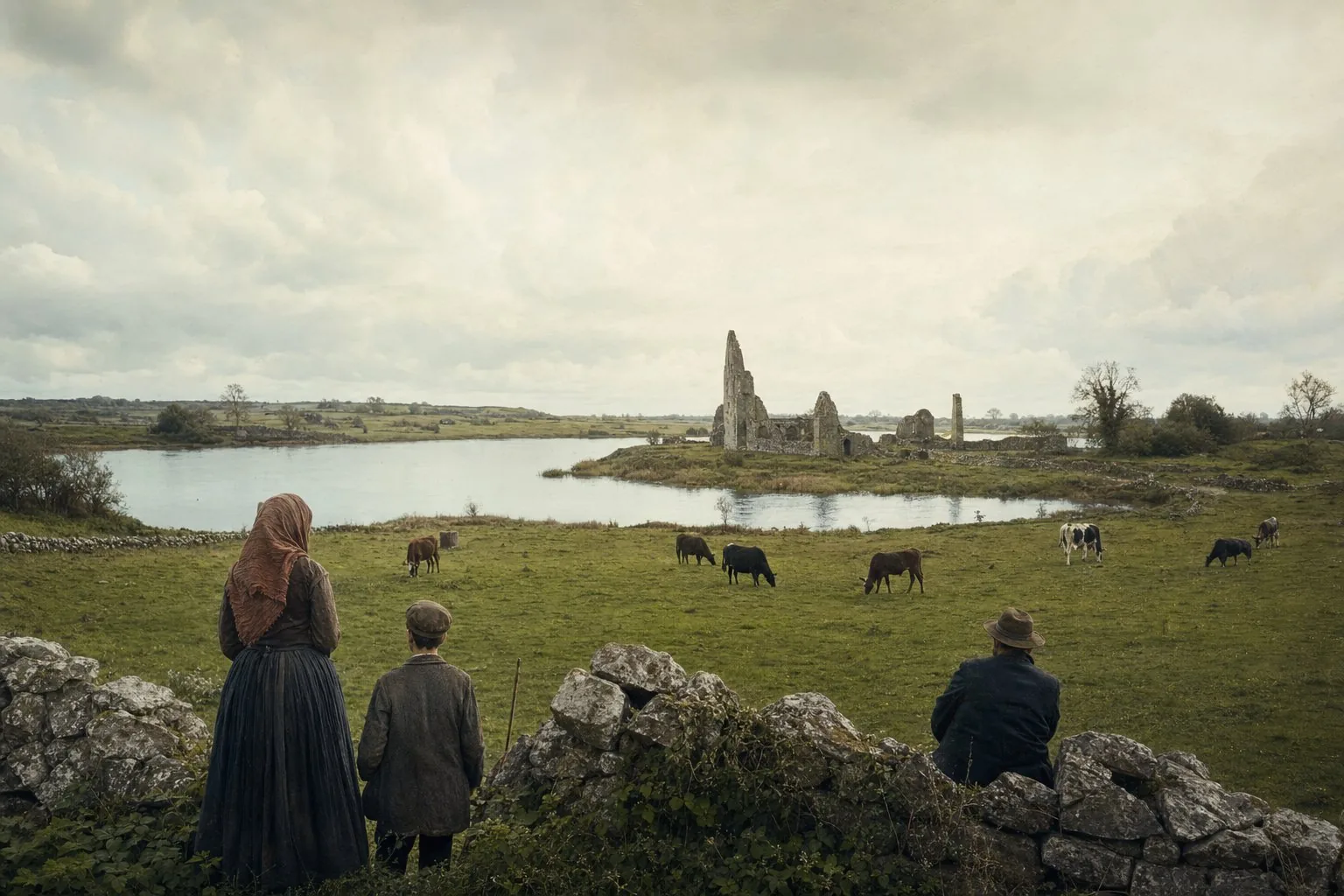
In 1841 the census counted close to 253,000 people in County Roscommon. Ten years later it counted under 174,000. Close to a third of the county was gone, to the grave or to the boats, inside a single decade, one of the heaviest proportional losses of any county in Ireland. Any county Roscommon emigration history has to begin in that gap, because the roads out, the ships to Quebec, the American money that followed, all of it flows from what happened here between 1845 and 1851.
If your family traces to Roscommon, this is the history that put an ocean through the middle of it.
Black ‘47 in Roscommon
Roscommon went into the Famine already poor. Small farms, many of them a few acres of bog and callow land along the Shannon, and a rural population that depended on the potato almost completely, the same as the rest of the west. When the blight took the crop in 1845, and took it again, worse, in 1846, there was no reserve of any kind behind it.
The worst year carried the name Black ‘47 everywhere it struck, and Roscommon was no exception. Fever moved with the hunger. The workhouses at Roscommon town and Boyle, built to hold a few hundred each, were soon holding several times that number, and admission to one was, for many families, closer to a last resort than a rescue. Landlords across the county faced the choice Famine landlords faced everywhere: keep tenants they could no longer afford to feed, or clear land they could no longer afford to carry. The county’s own famine dead were never fully counted, the way they never were anywhere the blight struck this hard, but the workhouse registers and the years of emigration returns that followed both point the same way: Roscommon paid as heavy a price, proportionally, as almost any county in Ireland. Some landlords chose clearance. One of those decisions became one of the most notorious episodes of assisted emigration anywhere in Famine Ireland.
The Strokestown evictions and the assisted passage to Quebec
South Roscommon held the estate that put the county’s name into the Famine’s national record. Major Denis Mahon inherited Strokestown Park in 1845, along with several thousand tenants and debts the estate had been carrying for years. By 1847, with the poor rate rising and the Famine into its second ruinous year, Mahon’s agents settled on clearance. Close to three thousand tenants were put off the estate’s smallholdings that year.
What happened next is the part that makes Roscommon’s emigration history more than a record of eviction. Rather than leave his former tenants to the workhouse and the road, Mahon paid to send a large number of them, close to a thousand, to Quebec. It was assisted emigration organised and funded by the landlord himself, on an estate-wide scale, and it stands among the best documented schemes of its kind anywhere in Famine Ireland.
It was also disastrous. Several of the ships Mahon chartered were badly provisioned and desperately overcrowded, and one of them, the Virginius, became one of the deadliest single crossings of the whole Famine emigration. More than a hundred of those aboard died before she ever reached the quarantine station at Grosse Île in Quebec, and more died in the weeks after landing.
On the second of November 1847, Major Mahon was shot dead in his carriage on the road near Strokestown, returning home from a meeting on the county’s relief. It was one of the small number of landlord killings during the Famine to draw sustained national and international attention, reported in the London press and discussed at Westminster. For a period, Roscommon’s name became attached in the public mind to the worst that landlord-driven clearance and assisted emigration could do to a tenant population already on its knees.
Strokestown Park is a visitor site today, and it holds Ireland’s National Famine Museum, built around a remarkable survival: a large archive of the estate’s own nineteenth century papers, found in the outbuildings when the house was restored in the 1980s, decades after the Famine had passed out of living memory. Among the papers are letters and petitions written by tenants themselves, a rare thing, since so few written records survive from the people who were hit hardest.
County Roscommon emigration history, era by era
The Famine set the pattern, and Roscommon kept following it for decades after the immediate crisis passed.
The 1850s and 1860s: paying for the next passage. Once one son or daughter had work and a wage in America, the next could follow. A ticket bought, a bed found, money saved and sent home, and the fare posted back for a brother or sister still standing at the Roscommon end of the correspondence. The American money that came back in envelopes, alongside the tickets, paid rent, cleared debts at the local shop and kept smallholdings going through seasons that would otherwise have finished them.
The late 1870s: hunger returns. A run of poor harvests brought the west of Ireland back to the edge of famine, and Roscommon answered as it had thirty years before, with another heavy wave of leaving. The same bad seasons fed the Land War that followed, tenants across the county organising against rents that two or three failed harvests had made impossible to pay.
Into the twentieth century. Independence did not close the road out of Roscommon. Small holdings, large families and a shortage of work at home kept people leaving through the 1920s, the 1950s and beyond, increasingly to English cities as much as to American ones. Census after census through the middle of the twentieth century recorded the same county, smaller again.
Where Roscommon’s emigrants went
Roscommon has no coastline, so anyone leaving first had to leave the county before they could leave the country. Tenants and labourers travelled by road or canal boat toward Dublin, or overland to Sligo, and from either port on to Liverpool, before an Atlantic crossing had even begun. It was one more leg of a journey than a Mayo or Galway emigrant faced, and one more chance for the journey to fail. For a family already selling what little they had to raise a fare, that extra leg, another few days on the road, another night’s lodging to find, was not a small thing.
Most Roscommon emigrants landed where the rest of Connacht landed, in Boston, New York and, from the 1850s on, the growing Irish parishes of Chicago. They travelled the same chain migration pattern as their western neighbours, one relation’s address doing the work of an introduction for the next, one paid ticket opening the road for the one behind it. County societies gathered emigrants and their children together in the big American cities for generations afterwards, the way a townland gathers itself back together wherever it lands. And a portion of the county’s leaving never crossed the Atlantic at all. Like emigrants from every county in the west, Roscommon people went in large numbers to England, to the factory cities and later the building sites, a shorter and cheaper crossing that left a thinner paper trail than the one to America.
Following your own Roscommon thread
If Roscommon is the county in your own family’s story, the records are more reachable than most people expect. Civil registration of births, marriages and deaths from 1864 onwards is free to search at irishgenealogy.ie. Catholic parish registers, many reaching back before the Famine, are digitised through the National Library of Ireland and searchable at RootsIreland. Griffith’s Valuation, carried out across Roscommon in the 1850s, names the head of almost every household in the county and is often the only surviving trace of a family in the Famine decade itself. From the American side, ship manifests and the parish registers of Boston, New York and Chicago can often carry a family line back across the water to a single Roscommon townland.
For anyone descended from a Strokestown tenant, there is a resource most Irish counties do not have. The Famine archive held at Strokestown Park includes correspondence, petitions and estate records naming individual tenants and townlands, a rare direct line back to people who otherwise left almost no written record of their own. For a county that lost so many of its people to the boats in a single decade, it is one of the few places where some of their own words survive.