Counties and Ancestry
County Sligo Emigration History
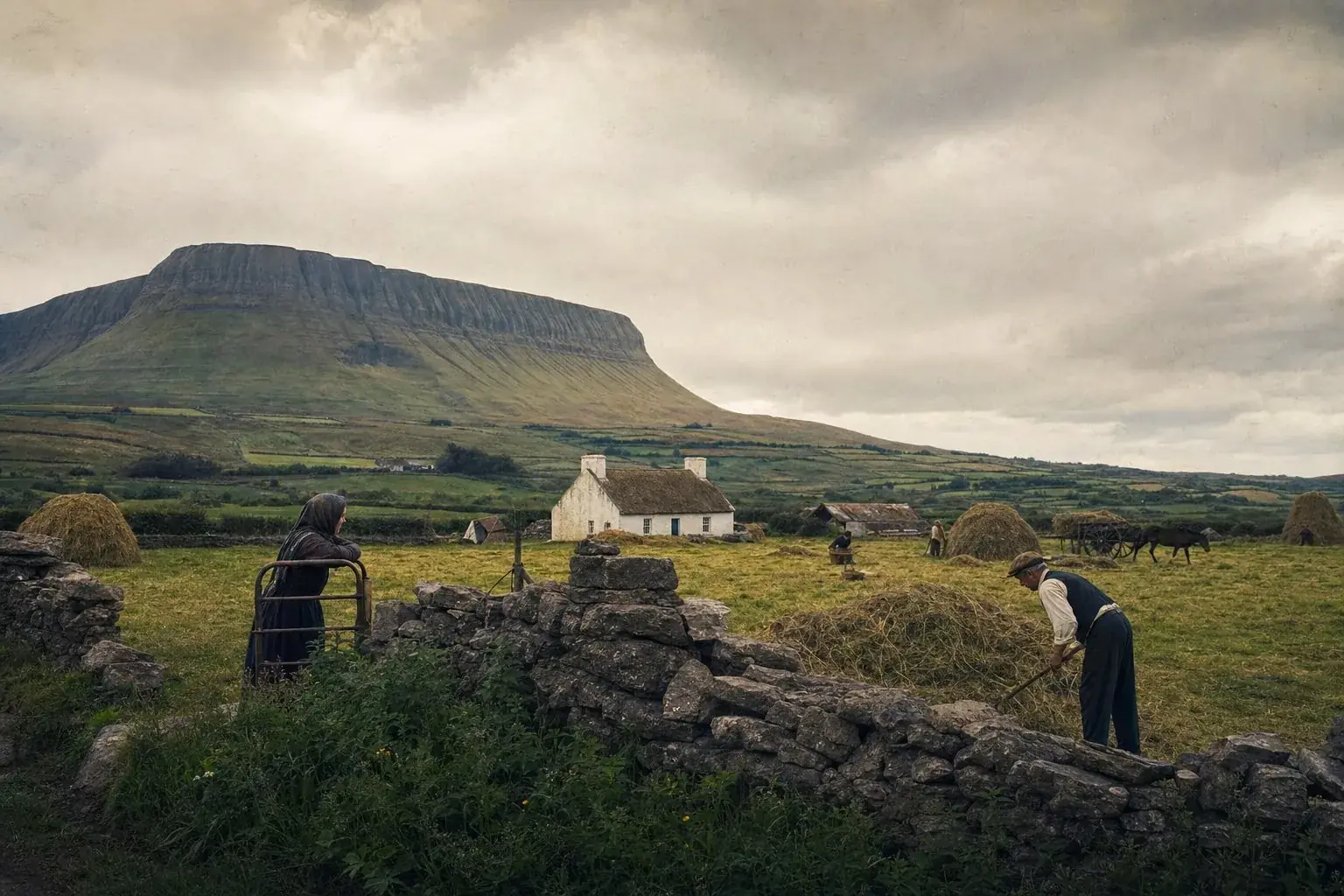
Sligo town did something most Irish county towns never had to do during the Famine. It put emigrants directly onto ships. People did not have to travel to Dublin or Liverpool to find a passage out of the country. They came down to the quay on the Garavogue river, in from Leitrim and north Roscommon as well as from Sligo’s own parishes, and sailed for Quebec straight out of Sligo harbour.
That fact sits underneath any real county Sligo emigration history. In 1841 the census counted close to 180,000 people in County Sligo. Ten years later it counted about 128,000. Close to three in every ten were gone, to the workhouse, to fever, or to the hold of a ship. If your line runs back to Sligo, this is the history that explains why the trail so often starts at a dock rather than a townland.
Black ‘47 in Sligo
Sligo depended on the potato as completely as any county in Connacht, and when the crop failed in successive years there was almost nothing standing behind it. The county workhouse filled far beyond the numbers it had been built for within the first Famine winter, and by 1847 it was turning people away for want of room. Fever moved through the town as fast as the hunger did.
One tragedy from that year stands for the whole terrible arithmetic of Sligo’s Famine emigration. In the spring of 1847 a ship called the Carricks of Whitehaven sailed out of Sligo for Quebec, carrying emigrants mainly from Ahamlish parish in the north of the county, the ground around Cliffoney and Grange. She never reached the St Lawrence. Caught in a storm off the Gaspé coast, the ship broke apart, and most of those aboard drowned within sight of land. It stands as one of the worst single losses of life among the Famine emigrant ships, and it happened to people who had already lived through the hunger at home only to lose everything on the crossing that was meant to save them.
Why the ships sailed from Sligo, not Liverpool
Most Famine emigrants left Ireland the long way round, overland or by coastal boat to Dublin or Cork, then on to Liverpool, and only from Liverpool onto an American or Canadian ship. Sligo emigrants often skipped that whole journey.
The reason was timber. Ships that had carried Canadian and New Brunswick timber across to Britain and Ireland made no money sailing back to Quebec empty, so owners filled the westward hold with passengers instead, at a fare well below anything a Liverpool packet charged. Sligo already had a working harbour and merchants trading grain and timber, and through the 1840s it became one of the busiest direct departure ports in the northwest, drawing people from well beyond the county boundary.
The ships those fares bought a place on were bound for Quebec, up the St Lawrence, and the quarantine station on the river at Grosse Île is where the true cost of the cheap fare showed itself. In 1847 alone, thousands of Irish emigrants who had survived the Atlantic died there or in the weeks after landing, of the same ship fever that had already emptied whole townlands at home. Sligo’s passengers were among them.
The landlords who paid the passage
North Sligo carries one of the country’s better documented cases of something that happened quietly almost everywhere: a landlord clearing an estate by paying for the tenants to leave it. Lord Palmerston, later a British prime minister, owned the ground around Ahamlish, Cliffoney and Mullaghmore, where his estate had already built a harbour and a planned village in the years before the Famine. During the Famine itself, his agents paid the passage of tenants off that same estate to British North America. Not far along the coast, at Lissadell, Sir Robert Gore-Booth ran a similar scheme on his own holdings, clearing tenants and paying their fares to Quebec and to Saint John, New Brunswick.
Both men were remembered afterward, by some, as landlords who spared their tenants a worse fate, and by others as landlords who cleared their ground the fastest way open to them. Neither telling changes what happened on the ground itself. The small farms went one way and the people went another, out through Sligo harbour toward Quebec and Saint John, the two ports where so much of north Sligo’s Famine emigration was aimed. Ahamlish, the parish that lost so many of its people when the Carricks of Whitehaven went down that same spring, sat in the middle of Palmerston’s estate.
County Sligo emigration history, era by era
The Famine did not close the road out of Sligo. It opened it, and the county kept walking that road for more than a century afterward.
The 1850s and 1860s: the remittance years. Once a son or daughter had a wage in America, the next fare home came easier, and the American money folded into letters paid rent and cleared debts on small Sligo farms the same way it did across the rest of the west. Each ticket sent home opened the road for the next brother or sister.
The same decades: the port itself starts to close. As steamships replaced sail on the Atlantic run, the big shipping lines concentrated their sailings at Liverpool and Queenstown, and Sligo’s direct crossings thinned out year on year. Later emigrants from the county increasingly took the coastal steamer or the train to Dublin or Derry first and sailed from there, a smaller version of the same shift that closed most of Ireland’s minor ports to transatlantic traffic.
The 1870s and beyond. Poor harvests late in that decade pushed another wave of Sligo families onto the boats, and the county’s population kept falling at every census long after the Famine generation had died. Independence did not close the road either. Small farms, scarce work and large families kept Sligo sending sons and daughters abroad well into the twentieth century, to America until the immigration laws tightened in the 1920s, and to England and Scotland after that.
Where Sligo’s emigrants ended up, and why the surnames still carry
A great many Sligo Famine emigrants technically landed in Canada rather than the United States, carried there on the timber ships and the landlord-paid passages to Quebec and Saint John. Fewer of them stayed in Canada than the ship manifests suggest. Entry there was cheaper and the crossing shorter, but the work and the wages, and very often the family already gone ahead, were in the United States, and a large share of the people who landed at Quebec or Saint John moved on again within months or a few years, overland or by coastal boat, into Maine, Massachusetts, New York and beyond. It is one reason Sligo surnames turn up so heavily in New England parish and census records despite how few Sligo ships ever sailed directly to an American port.
The surnames carry their own map of the county. O’Hara, O’Dowd, MacDonagh and O’Gara were the ruling Gaelic names of medieval Sligo, tied respectively to the ground around Collooney, the coast toward Easkey, the country around Riverstown and Tirerrill, and Coolavin in the far south near Gurteen. The genealogist John Grenham has written at length on how closely Irish surnames still map to their home ground in records like Griffith’s Valuation, and Sligo is a strong example of it, which makes these names unusually good anchors for tracing a line from an American parish register back to a specific townland.
Following your own Sligo thread
The records are more complete than most people expect. Civil registration of births, marriages and deaths from 1864 is free to search at irishgenealogy.ie. Catholic parish registers for Sligo, many of them starting before the Famine, are digitised through the National Library of Ireland and searchable at RootsIreland. Griffith’s Valuation, carried out across Sligo in the mid 1850s, names the head of nearly every household in the county and is often the only surviving trace of a family that did not come through the Famine decade intact. For the ones who sailed for Quebec, Canadian immigration and Grosse Île quarantine records can sometimes carry a line back across the water to a ship and a year, even where the Irish end of the trail has gone cold.
Sligo’s own story sits in two ports at once. There is the one people left from, and there is the one on the far side of an ocean that a great many of them only ever passed through on their way somewhere else.