Gift and Giving
DNA kit vs letter subscription gift: which one lasts?
A DNA kit vs letter subscription gift choice comes down to what your recipient actually wants from Ireland. A test returns a percentage and a list of possible cousins, checked once, on one afternoon. A letter subscription returns a story that keeps arriving, and keeps the country present in the house long after the DNA result has stopped being opened. Both are honest gifts. They are not the same gift, and the difference is worth setting out plainly before you buy either one.
What a DNA kit gets you today
AncestryDNA holds the largest consumer genealogy network by a wide margin. Genetic genealogist Leah Larkin’s tracking put the AncestryDNA database at more than 30 million tested people as of March 2026, based on company figures presented at RootsTech that month. 23andMe, by comparison, sat at just under 14 million total users, with roughly 11.1 million of those opted into relative matching. MyHeritage held 9.6 million kits available for matching, and FamilyTreeDNA just under 1.8 million, both well behind Ancestry’s scale.
Bigger networks find more cousins, and that is the real selling point of the market leader: a larger database improves the odds that a distant Mayo or Cork relative already tested and is sitting in the match list, waiting to be found. Price also moves more than people expect. AncestryDNA kits that list at $99 to $99.95 were tracked selling for as little as $29 during the November 2025 Black Friday period, a saving of more than 70%, with the following holiday sale advertising up to 80% off through the end of December. If price is the deciding factor, the kit rarely costs what its shelf price suggests.
The 2025 shake-up behind every 23andMe box
Anyone weighing 23andMe as a gift in 2026 is buying into a different company than the one that existed two years ago. 23andMe filed for bankruptcy protection in March 2025, after a 2023 data breach and falling test sales. Anne Wojcicki, the company’s co-founder, then formed a nonprofit, TTAM Research Institute, which won the bankruptcy auction with a $305 million bid and completed its purchase of 23andMe’s personal genome and research business on 14 July 2025.
TTAM’s published commitments include keeping the existing privacy policy, setting up a privacy advisory board, and providing two years of free identity theft monitoring to customers whose data was exposed in the breach. The nonprofit has stated an ambition to grow the tested user base toward 100 million people. Whether that history changes anything for a single gift recipient is a fair question to ask before buying, not after.
What historians cannot know
Two kinds of record fall short here, and both are worth naming rather than glossing over.
A DNA ethnicity estimate is only as good as the reference panel behind it, the pool of documented, multi-generation local families a company compares a sample against. Where that pool is thin for a region, the estimate is thin too. A 2020 study in Annals of Human Genetics that ran a single saliva sample through three consumer testing services found low overlap in the genetic sites each company reported back, meaning identical DNA can produce meaningfully different results depending on which company reads it.
Paper archives have their own gap. The National Archives of Ireland notes that it holds wills, census returns, land and estate records, and court papers rather than birth, marriage or death certificates, which sit with the General Register Office instead. Personal letters survive by accident, not by policy: a family kept them, or a museum collected them, or nobody did. The Irish Emigration Database at the Mellon Centre for Migration Studies, built from the Ulster American Folk Park’s collection since 1988, holds thousands of original eighteenth and nineteenth century emigrant letters precisely because someone chose not to throw them away. For every letter that survived, an unknown number did not.
What a letter subscription offers instead
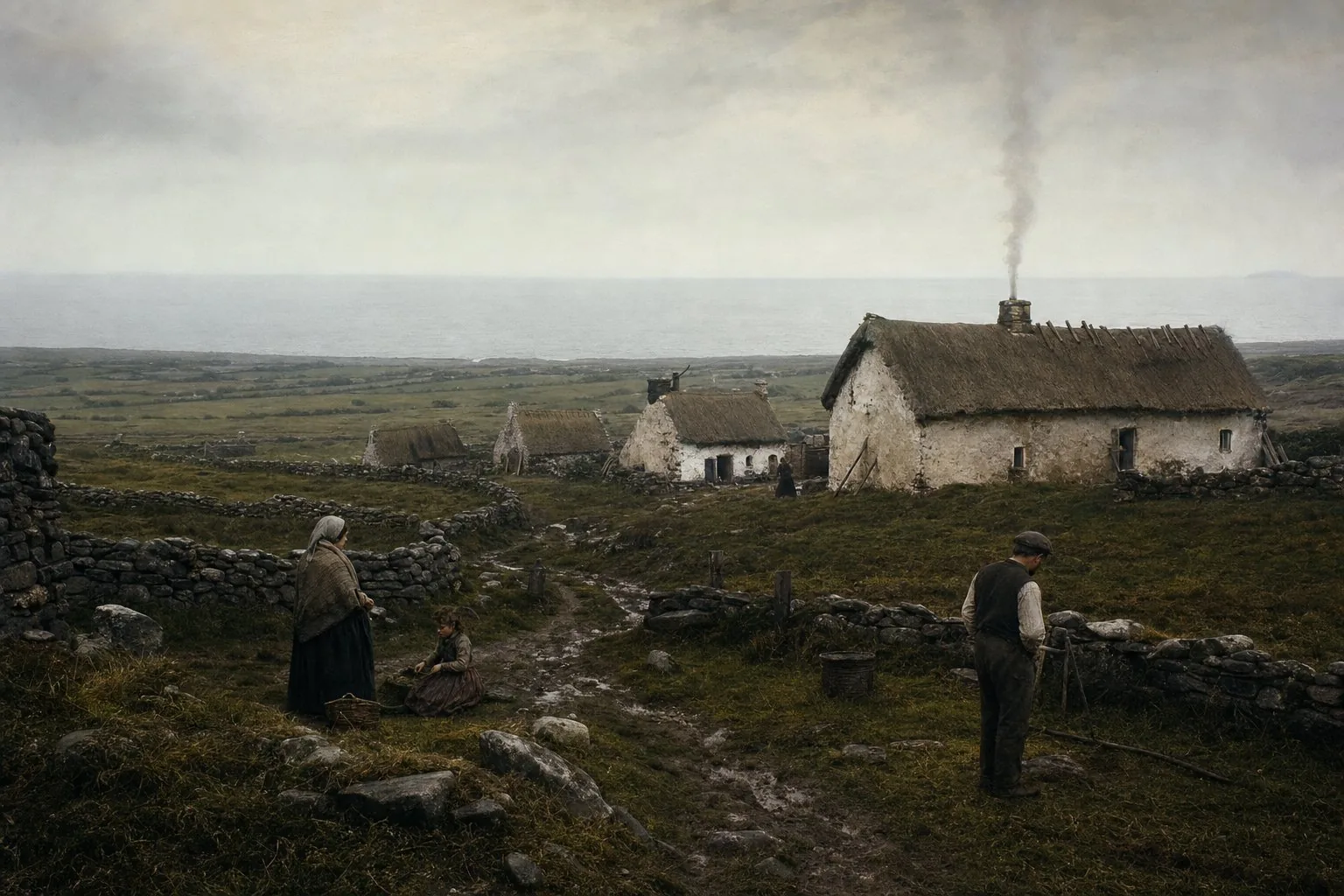
A subscription built on real historical correspondence works from the opposite end of the record. Rather than a data point about your recipient’s own ancestors, it offers a close reading of the world Irish emigrants left or stayed behind in during the Famine and emigration decades: the ships, the wages sent home, the parishes, the weather, the American wake held for someone leaving who might never be seen again. It is fiction, clearly labelled as such, but it is written from the same kind of primary material the Mellon Centre holds: real letters, real postal history, real dated events.
For a reader who wants an AncestryDNA gift alternative rather than a second gadget, this is the difference in kind. A test result asks the reader to do the work of interpretation alone. A letter does the opposite: it hands over a fully formed scene, addressed and dated, and it hands over the country, not a coordinate standing in for one. You can read the opening exchange for free and judge the voice for yourself.
DNA kit vs letter subscription gift: how to choose
Ask what your recipient actually does with information. A researcher who enjoys chasing down records, cross-checking cousins, and building out a family tree will get real value from a kit, and no amount of storytelling replaces that kind of project.
A parent or grandparent whose connection to Ireland is emotional rather than forensic, who tells the stories rather than files them, tends to get more from something built to be read than something built to be logged into. If a DNA result already sits unopened in an inbox somewhere in the family, that is worth noticing: it is a common outcome, and it is exactly the gap this kind of heritage gift comparison keeps surfacing. We have written before about turning a flat DNA result into an actual story for families in that position.
The two are not really rivals. A test can point to a county. A subscription can make that county feel inhabited again.
Which one lasts
A DNA result does not expire, but its use tends to end the day it is read, unless someone in the family keeps building on it. A subscription built on real archival research is designed to be revisited on paper, a format nobody has to log into a decade from now to still be able to read.
If you have decided which kind of gift fits your family, the full range of gift options sets out how to send one.
Sources and further reading
- Leah Larkin, “Database Sizes, March 2026,” The DNA Geek, 2026 (figures gathered at RootsTech, March 2026).
- TTAM Research Institute, press release on completion of its acquisition of 23andMe’s personal genome and research business, published via 23andMe’s press pages, 14 July 2025.
- Aparna Batra et al., “Genotype concordance and polygenic risk score estimation across consumer genetic testing data,” Annals of Human Genetics, 2020.
- National Archives of Ireland, “Family History Research,” nationalarchives.ie.
- Mellon Centre for Migration Studies, Irish Emigration Database, Ulster American Folk Park, Omagh.
- Genealogy Bargains, tracked AncestryDNA Black Friday and holiday sale pricing, November to December 2025.