Emigration History
Irish Christmas Traditions Families Still Follow
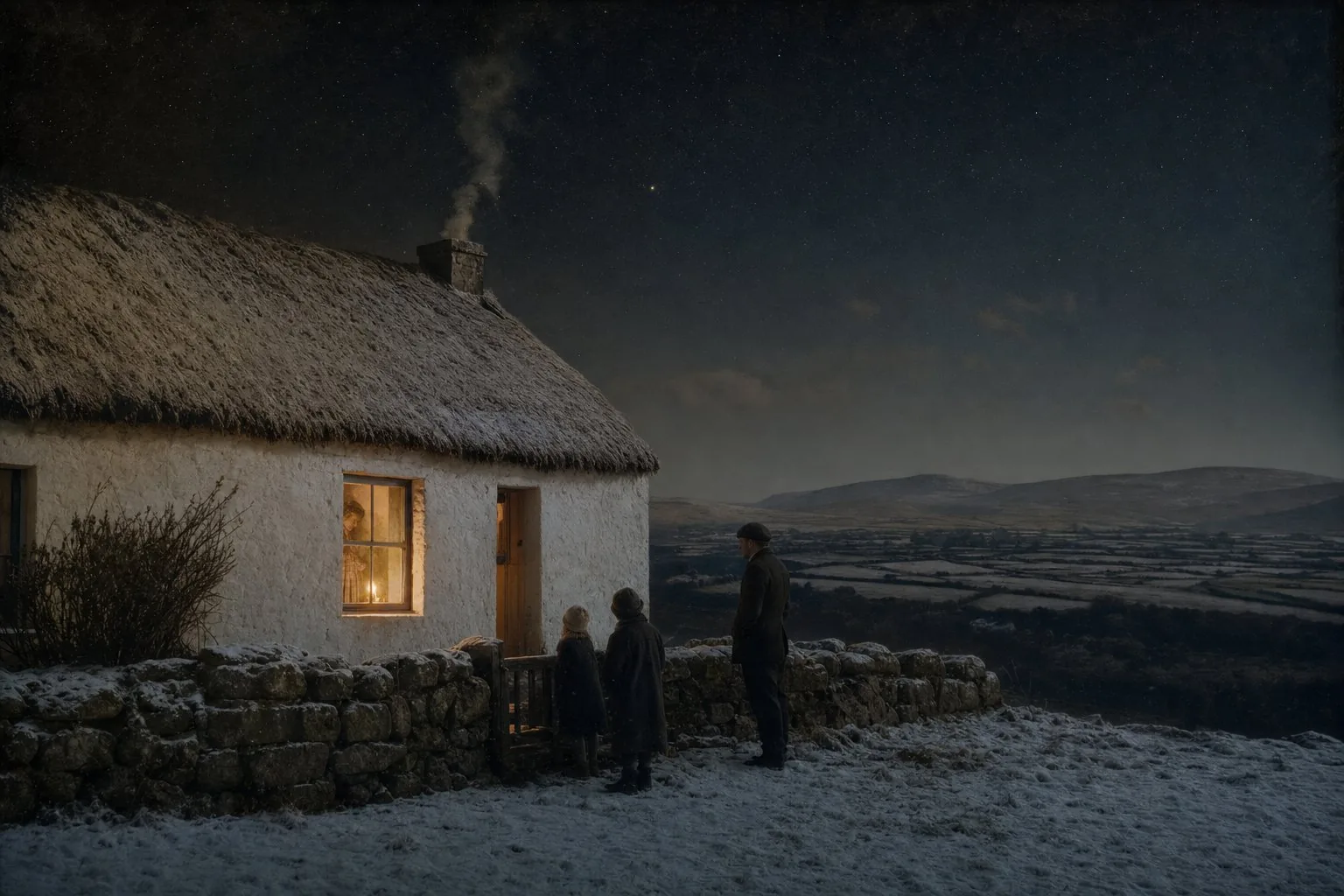
On Christmas Eve, in houses across Ireland, someone still sets a lit candle in the front window and leaves it burning long after the rest of the house has gone up to bed. It is one of the oldest Irish Christmas traditions still kept, and it is far from the only one. Follow three of them through, the candle in the window, the Wren Boys who take to the roads on St Stephen’s Day, and Nollaig na mBan a fortnight into the new year, and a fuller shape of an old Irish Christmas comes into view: what it asked of a household, who did the work, and who everyone was quietly hoping to see coming up the lane.
Why do Irish families light a candle in the window at Christmas?
The custom is simple to describe. On the evening of the 24th, a candle goes into the window that faces the road, usually the front window of the house, and it is lit as the light goes and left burning through the night. Where the older practice held, it was the youngest member of the family able to strike a match who lit it. In other households the task belonged to the woman of the house, and either way, it was rarely left to whichever man happened to be nearest the window.
Ask why a candle, and the custom turns out to carry more than one answer, laid down in layers over a long time.
The plain religious meaning comes first in most accounts: the light stands for Mary and Joseph, turned away from every door in Bethlehem, and a candle in the window says that this house, at least, has not shut its door on them. It is a small act of hospitality aimed backward at a story two thousand years old, replayed on a single night every year.
A second meaning sits just under the first. A lit window facing the road told any stranger, any neighbour with nowhere better to be, that the house behind it would not turn them away either. Families have long passed down a further version of this, that in the era when Mass had to be said in secret, a candle left burning was a household’s signal that it was safe to come in. That story has done more travelling by word of mouth than by written record, and it is worth holding a little loosely rather than repeating as settled fact. What is not in doubt is how long the custom itself has lasted: through the hardest years this island has known, through a century of families leaving it altogether, through electric bulbs replacing tallow and rushlight, a household that has let go of nearly every other old Christmas practice will very often still put a candle in the window on Christmas Eve.
And in the houses where it mattered most, a third meaning needed no explaining at all. A light left burning and facing the road was also, unmistakably, a sign to anyone walking up that lane in the dark that they had not been forgotten, whether or not anyone inside truly expected to see them.
Who were the Wren Boys, and why St Stephen’s Day?
St Stephen’s Day, the 26th of December, belonged to the wren. Lá an Dreoilín, the Day of the Wren, is the older name for it, and in parishes across the country groups of men and boys, known as Wrenboys or strawboys, dressed themselves for the occasion. Straw suits built up over a frame, old clothes turned inside out, ribbons, masks, faces blackened with soot, so that a neighbour walking behind one of them the next day would not easily put a name to who had been inside the costume.
They carried a decorated bush or pole from door to door, holly most commonly, and tied among the branches was a wren, a real bird in the old version of the custom, an effigy in every version still practiced today. At each house they sang, played music, danced a step in the kitchen or the yard, and asked for a coin or a drink for “the wren”, the collection going toward a dance or a night out for the group once the round of the parish was finished. It was, in the plainest sense, a mumming custom, ordinary neighbours made unrecognisable for one day and allowed a licence a small, watching parish did not usually extend.
Why the wren specifically is a question folklore answers more than once and settles for good on none of the answers, which is worth knowing rather than smoothing over. One version reaches back past Christianity, to an older midwinter custom in which a small bird stood in briefly for a king, hunted down at the darkest turn of the year. A Christian version, told at least as often, blames the wren for betraying St Stephen, its rustling in a bush waking the men who were hunting him while he hid. A third telling, heard in some parishes, moves the betrayal to a company of Irish soldiers, given away at the last moment by a wren’s chatter as they lay in ambush. All three versions were still being told well into the twentieth century, sometimes in the same parish, and none of them can honestly be called the original.
The custom faded almost everywhere over the course of that century, and it survived best where it had always run deepest, the southwest of the country. Dingle, in Co. Kerry, still holds one of the country’s best known Wren Day gatherings, straw suited groups from the town and the parishes around it filling the streets with music every 26th of December, kept going less by revival than by the fact that it was never quite allowed to stop.
What is Nollaig na mBan?
The sixth of January, the feast of the Epiphany, closed the Irish Christmas under a name of its own: Nollaig na mBan, Women’s Christmas, sometimes called Little Christmas. The reasoning behind the name is not hard to follow once you picture who had carried the fortnight before it. The baking, the cooking, the hosting, the washing up behind a house full of callers, had fallen, as it usually did all year round, to the woman of the house. Nollaig na mBan was the day a small part of that debt got repaid. Men and children took over the housework, however briefly and however badly, and women visited each other’s houses, sat down together, and were, for one evening, served rather than serving.
The custom held on more visibly in Cork and Kerry than almost anywhere else, and Cork especially still keeps it today, women gathering in one another’s homes or going out together for a meal or a drink on the evening of the 6th, a small holiday kept deliberately inside the larger one.
Nollaig na mBan also did the work of closing the season on the calendar. The holly and ivy that had dressed the house since Christmas Eve, cut from the hedges rather than bought, came down on or before the 6th, and a family that left it hanging past that date was, by the old belief, inviting bad luck into the year ahead. Twelve days or so ran from the candle in the window to the last of the greenery coming down, and inside that stretch sat an older, longer Irish Christmas that the modern version, packed away in a great many houses well before the new year, would barely recognise.
Christmas, and the ones who were far from home
Every one of these customs, in the households that kept them longest, was shadowed by a year when a face was missing from the table. Christmas has always been the season that counts who is absent as carefully as who is present, and in a country that sent so many sons and daughters abroad, that counting fell hardest in December.
It is part of why the candle in the window carries the weight it does. A light left burning for a stranger, or for the Holy Family, was also, in a house with someone gone to Boston or Liverpool or further off again, a light left burning on the small chance that the missing face might yet come up the road that night. It rarely did. The letters that arrived instead mattered all the more for it, each one standing in, however imperfectly, for the person who could not make the crossing home in time to see the candle lit.
Yours, From Ireland tells the story of one such household. In October 1847, Patrick O’Donnell, the second son of a family in Ballycastle, Co. Mayo, sailed for Boston, because the holding was always going to pass to his elder brother and there was no future in the parish with his name on it. Mary Cafferky, the girl he left behind, stayed. The youngest O’Donnell brother took the shorter, cheaper crossing to England instead. The family is invented, but the Christmas it kept was not. The candle in the window, the wren on St Stephen’s Day, the women’s small holiday in the new year, all of it was observed in Ballycastle exactly as it was observed in every parish around it, by a household that had, from that October on, one more reason than most to watch the road on a dark evening.