Counties and Ancestry
Cobh, Derry or Galway: The Port Your Family Left From
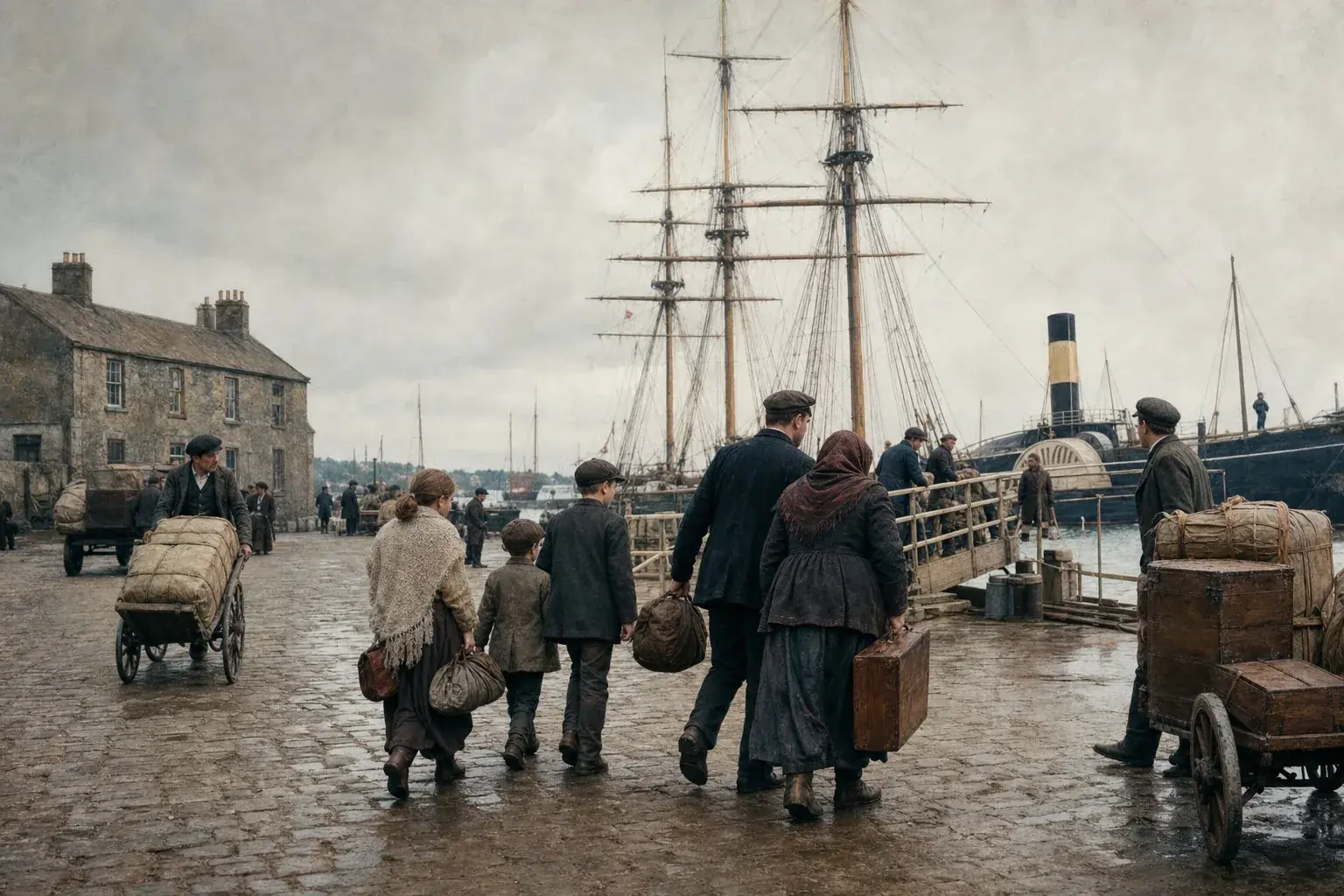
A passenger record rarely gives up much. A name, an age, sometimes a county, and one line that is easy to read straight past: the port. Queenstown. Londonderry. Liverpool. That line matters more than it looks, because the Irish emigration port a family left from was rarely just whichever harbour sat nearest their door. It was decided by which shipping company had built a route through that part of the country, and the route usually followed the county.
Cork sent its people out almost entirely through one harbour. Donegal and Tyrone used another, further north, that most family historians have never heard called by its old name. The west had a port that barely lasted a decade before it vanished from the record. And a huge number of Irish families, whatever county they started in, ended up funnelled through a British city that had nothing to do with Ireland at all. Here is which port served which county, and why.
Why the same county could leave from two different ports
Before the 1860s, Irish emigration ran through dozens of small harbours. A chartered ship might load in Westport, or a smaller harbour along that coast, because a local merchant with a hold of timber or grain needed a paying cargo for the return crossing. Fares were cheap for a reason. Some of the worst provisioned Famine-era sailings came out of exactly this kind of arrangement, small operators filling a hold however they could.
After the Famine, steam changed the arithmetic. A steamship cost too much to run as a one-off venture, so the trade consolidated into a small number of companies running fixed routes, built around a handful of harbours with the depth and the rail connections to support them. A county’s port, from the 1860s on, was less a question of geography than of which company’s rails or ferries had reached that county first. A family from north Mayo might have a record naming Sligo in 1849, and the same surname naming Liverpool in 1883. Both can be right. The country underneath them had changed.
Cobh, once Queenstown: the port for Munster, and eventually everyone
Cork’s harbour served the whole south. Cork itself, Kerry, Waterford, Tipperary and much of Limerick sent people out through the same stretch of water for the better part of a century. If a record shows Cork or Queenstown, Munster is the safest first guess for where the family began.
The name is worth knowing on its own, because it changed twice. The town was Cove until 1849, when it was renamed Queenstown to mark a visit from Queen Victoria, and it carried that name through the busiest decades of the emigrant trade. It is Queenstown, not Cork or Cobh, that appears on most nineteenth and early twentieth century paperwork. It was renamed again, to Cobh, the Irish spelling of the same word, in 1920.
By the later decades of the trade, the harbour’s reach went well past Munster. The big transatlantic lines running out of Liverpool called at Queenstown as their last stop before the open ocean, taking on passengers who had travelled down by rail from every county to catch them there. A Cavan or a Roscommon family could have a passenger record that says Queenstown without a single one of their people having Cork roots. By 1900, this one harbour was less a Munster port than the front door of the whole country.
Derry: Ulster’s door to the Atlantic, and Moville on the record
The north had its own harbour and its own shipping line, running an almost entirely separate trade from the one in the south. Derry sat on the River Foyle and served Donegal, Tyrone, Derry itself, Antrim and Fermanagh, along with a good share of Leitrim and north Sligo, whose roads led more naturally north to the Foyle than south to Sligo town or west to Galway.
The Anchor Line ran the best known Derry service for decades, and before it, in the years around the Famine, a Derry firm named J. and J. Cooke was already sending emigrant ships out. One detail trips up a lot of researchers here. The big ocean steamers on this route could not always reach the city’s own quays, so they anchored further down the Foyle at Moville, in Donegal, and tenders carried passengers out to meet them. A record naming Moville rather than Derry or Londonderry is naming the same trade, just the anchorage instead of the city.
Galway: the shortcut that only lasted a few years
For a short stretch in the late 1850s and early 1860s, Galway ran its own direct transatlantic service, and the pitch behind it was genuinely sound. Galway sits further west and further north than Cork or Liverpool, so a ship sailing from Galway Bay had a shorter stretch of open ocean to cross than one starting almost anywhere else in these islands. Liverpool investors put together the company, formally the Atlantic Royal Mail Steam Navigation Company and known to everyone as the Galway Line, and for a few years mail and passengers did leave directly from Galway for Boston and New York.
It did not last. A run of wrecks and near disasters along that stretch of coast damaged the line’s reputation faster than its finances could recover, and when the government mail contract underwriting the whole venture was withdrawn, the company folded within a few years. West of Ireland families who had a direct crossing available to them for that short window went back to doing what everyone else already did: travelling on to Liverpool.
Liverpool: the great indirect route
More Irish emigrants left through Liverpool than through any Irish port. Liverpool is in England, and that is the single most useful thing to understand about a record that names it, because on its own that line tells you nothing about where a family actually came from.
Liverpool ran the busiest, cheapest and most frequent transatlantic service in the world for most of the nineteenth century, with dozens of shipping firms sailing overlapping schedules from the same docks. An Irish port might offer a single sailing a month, if that. Liverpool offered several a week, at fares a smaller operator could never match. So a family from almost any county, whatever harbour sat nearest their own door, very often travelled first to Dublin, Belfast, Cork, Derry or Sligo, crossed to Liverpool on a short coastal steamer, and only then boarded the transatlantic ship.
That coastal crossing could take a single night. Weeks later, a clerk on the far side of the Atlantic wrote down the last port the ship had sailed from, which was Liverpool, and nothing on that form recorded the family’s actual county. Liverpool also held one of the largest Irish born populations of any city outside Ireland by then. A Liverpool port of departure is not evidence a family was English. For a great many Irish American and Irish Canadian families, it is close to the opposite, and it is the crossing the letters this site publishes send their own family down too, an invented Mayo family whose second son leaves Ballycastle for Boston by way of Liverpool, in October 1847.
Sligo and Limerick: the smaller doors on the west coast
Not every county’s traffic ran through one of those four ports. Sligo ran its own direct emigrant trade for a good part of the century, serving Sligo, Leitrim and the parts of north Mayo and Roscommon that sat closer to it than to Westport or Ballina. A good share of Sligo’s traffic went to Quebec rather than Boston or New York, because ships that had carried timber from British North America needed paying passengers for the return crossing, and a Quebec fare was often the cheapest berth going in a hungry year. That cheapness came at a cost. The Quebec crossing was longer and colder than the run to Boston or New York, and some of the grimmest Famine mortality figures on record belong to vessels that sailed it.
Limerick’s port sat on the Shannon estuary and served Limerick, Clare and north Kerry. It saw genuine transatlantic sailings, though never at Cork’s volume, and it did at least as much work as a collection point, gathering passengers from the mid west and sending many on again, by coastal steamer, to finish the crossing from Cork or Liverpool instead. A Limerick record does not always mean a Limerick departure. Sometimes it means a Limerick beginning.
What the port on your record tells you to search next
Once you know the port, you often know more than the harbour.
A Derry or Moville departure points toward the Anchor Line’s own passenger lists, since the company ran that route for decades under its own name. A Quebec landing means Grosse Île is worth searching, the quarantine station where every ship on that route stopped, and where the fullest surviving records of the worst Famine crossings are held today. A New York arrival raises its own question, which door, Castle Garden or Ellis Island, and the year of landing answers that more reliably than the port of departure ever will.
And if the record says Liverpool, do not stop there. Look for the Irish county in every other document you can find, the marriage record, the parish register, the death certificate, because Liverpool was very often the last stop on an Irish journey, and almost never the first.