Gift and Giving
The Retirement Gift for Tracing Irish Roots
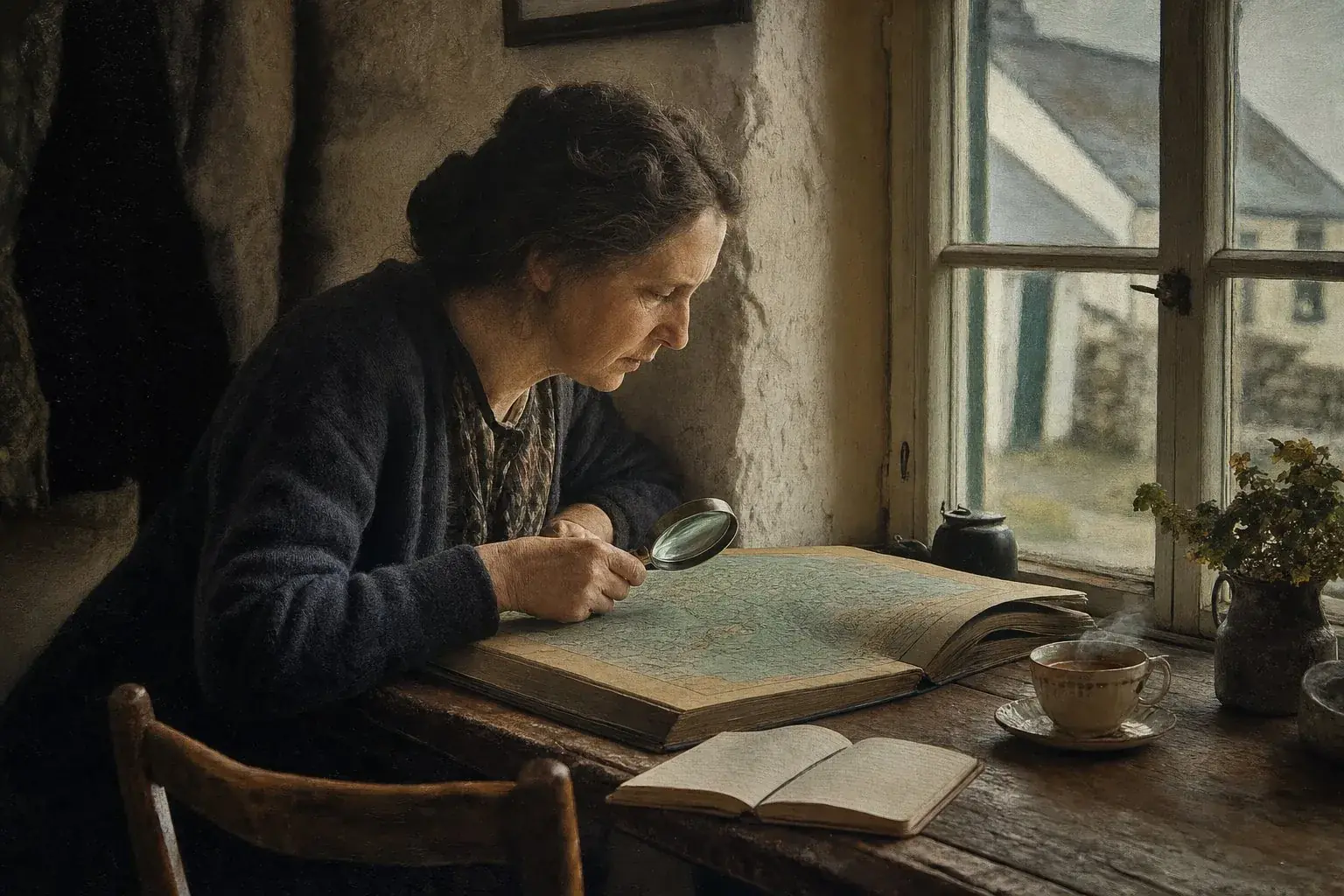
The leaving card is still on the mantelpiece, the desk has been cleared out, and for the first time in forty years there is a Tuesday with nothing written on it. This is, more often than any other point in a life, when someone finally sits down and asks where their people came from. Not because the interest in Irish ancestry was ever absent. Because there was never a clear stretch of hours to give it.
That is the fact an Irish heritage retirement gift has to answer. The person retiring has time now, in a shape they have not had since they were a child, and nothing yet to put in it. A gift that gets admired once and set on a shelf wastes that opening. A gift with a shape of its own, something to come back to across the weeks ahead, fits the moment they are actually standing in.
Why ancestry waits for retirement
Family history research does not move quickly, and it was never going to fit around a working life. A parish register has to be read line by line. One ancestor can take a full evening to place correctly, and a wrong guess can send a week of work down the wrong family entirely. That kind of attention does not survive a commute, a full diary, or a house that still needs feeding at six o’clock. It survives a retirement rather better.
There is also the matter of who is left to answer a question. Most people who take up Irish genealogy in their sixties or seventies are, for the first time, the oldest generation still living in their own family. The aunt who half remembered a townland, the uncle who knew which ship, are gone by then, or going. A question that was easy to put off at forty turns urgent at seventy. Retirement does not create the pull toward Irish roots. It removes the reasons that were holding it back.
There is a quieter reason too. Someone reaching their own retirement is standing at roughly the same distance from their grandparents that their grandparents once stood from the generation before them. That vantage point changes what feels worth doing. A name written once in a family Bible and never mentioned again can sit unnoticed for forty years and then, at sixty-five, become the thread someone finally decides to pull.
What the search itself actually looks like
Irish family history rewards patience more than most kinds of research do. Civil registration of births, marriages and deaths only becomes reliable from 1864 onward, so anyone reaching further back than that is working from parish registers instead, many of them handwritten, some of them lost outright. Griffith’s Valuation, taken through the 1850s, can place a family on a specific plot of ground, and is often the closest thing to a census that survives from the Famine decade itself. A single afternoon might turn up a townland. A single evening spent squinting at a scanned register might turn up nothing at all.
Somewhere in most families there is also a box nobody has gone through properly, old letters, a photograph with no name on the back, a passport stamped once in a country nobody ever mentioned again. Retirement tends to be the first time anyone has the patience to go through it slowly enough to notice what is actually in there.
None of that is a complaint about the work. For a lot of people newly retired, it is the appeal of it: a puzzle with real stakes, unfolding at exactly the pace they now have to give it. A gift chosen for this stage of life should respect that pace rather than fight it. Something meant to be finished in an afternoon has misjudged the person it was bought for.
What most retirement gifts get wrong
Anyone shopping for a parent or an aunt who has just retired already knows the standard shelf of options, and most of them share the same flaw. A framed family crest, the same shield printed under whatever surname the shop is given. A DNA kit that returns a percentage breakdown and a list of distant cousins, read once and then filed away with the results. A handsome book of Ireland photography, admired for a week and quiet on the shelf after that. A trip to Ireland solves a different problem again: it is a wonderful week, and then it is a wonderful week that is over, with the research questions it raised still sitting unanswered on the kitchen table back home.
Each of those answers one question and then it is finished. None of them gives a retired person a reason to sit down again next Thursday. What suits the moment better is something with a middle to it, a project that keeps asking to be returned to in the same way the research itself will.
The decade behind the records
Sooner or later, almost every Irish family tree runs into the same stretch of years: the mid to late 1840s, when the potato crop failed and kept failing. Historians differ on the exact toll, but the shape of it is settled. Close to a million people died, and at least as many left the country within about a decade. Record-keeping in the west of Ireland was thin even before the crop failed, so the true toll is almost certainly higher than anything written down at the time. Workhouses built to hold a few hundred people were overwhelmed within a season. Ships remembered afterward as coffin ships, for what the crossing cost in lives, carried people who had already buried someone before they ever reached the harbour.
That decade is usually where the paper trail a retiree ends up following actually starts. A parish register with baptisms that simply stop, without explanation. A workhouse ledger. A passenger list with a surname spelled three different ways across three different pages, because a clerk wrote down what he heard rather than what was meant. The historian Kerby Miller devoted an entire study, Emigrants and Exiles, to how deeply that sense of departure marked Irish-American life for generations afterward. It is also, not by accident, the decade Yours, From Ireland is set in.
One family’s letters, not anyone’s actual record
The site tells one story, about one invented family, the O’Donnells of Ballycastle, Co. Mayo. Patrick O’Donnell, the second son, has no land coming to him, since it will all go to the eldest, and so he sails for Boston in October 1847. Mary Cafferky, the woman he leaves behind, stays in Ballycastle. Their youngest brother takes the other road, to England. The story runs from 1847 to 1857, ten years on both sides of the Atlantic.
None of that stands in for a retiree’s own family, and it is not offered as though it does. The O’Donnells are fiction, and the site says so plainly rather than letting anyone assume otherwise. What it offers instead is something a passenger list cannot: a sense of what it might have felt like to be the one who sailed, or the one who stayed behind and waited on word, in roughly the years a retiree’s own great-great-grandparents were living through some version of that same choice. Research turns up names, ships and townlands. It rarely turns up what any of it felt like from the inside. A story set honestly in those same years, clear about what is invented and what is history, can sit alongside a family tree and give it a feeling the documents alone do not carry.
A project with a shape to it
A working life hands most people a structure they never chose and mostly complained about anyway: a Monday, a deadline, a reason to be up and dressed by a certain hour. Retirement takes that structure away and leaves the hours with nothing built into them. The people who settle well into retirement tend to be the ones who find something to replace the shape, not just something to fill the time.
A decade-long story told through an exchange of letters does that in a small way. It is closer to a book too long to finish in one sitting than to a keepsake taken in at a glance. There is always a next letter to find out about, the same way there was for the two people writing them, neither of whom knew yet how any of it would turn out. That is a different kind of gift than a thing fully understood the moment the wrapping paper comes off it, and a much closer match for someone who, for the first time in decades, finally has the time to sit with it properly.