Letters and the Craft
Irish Postmarks and Stamps, 1847-1946
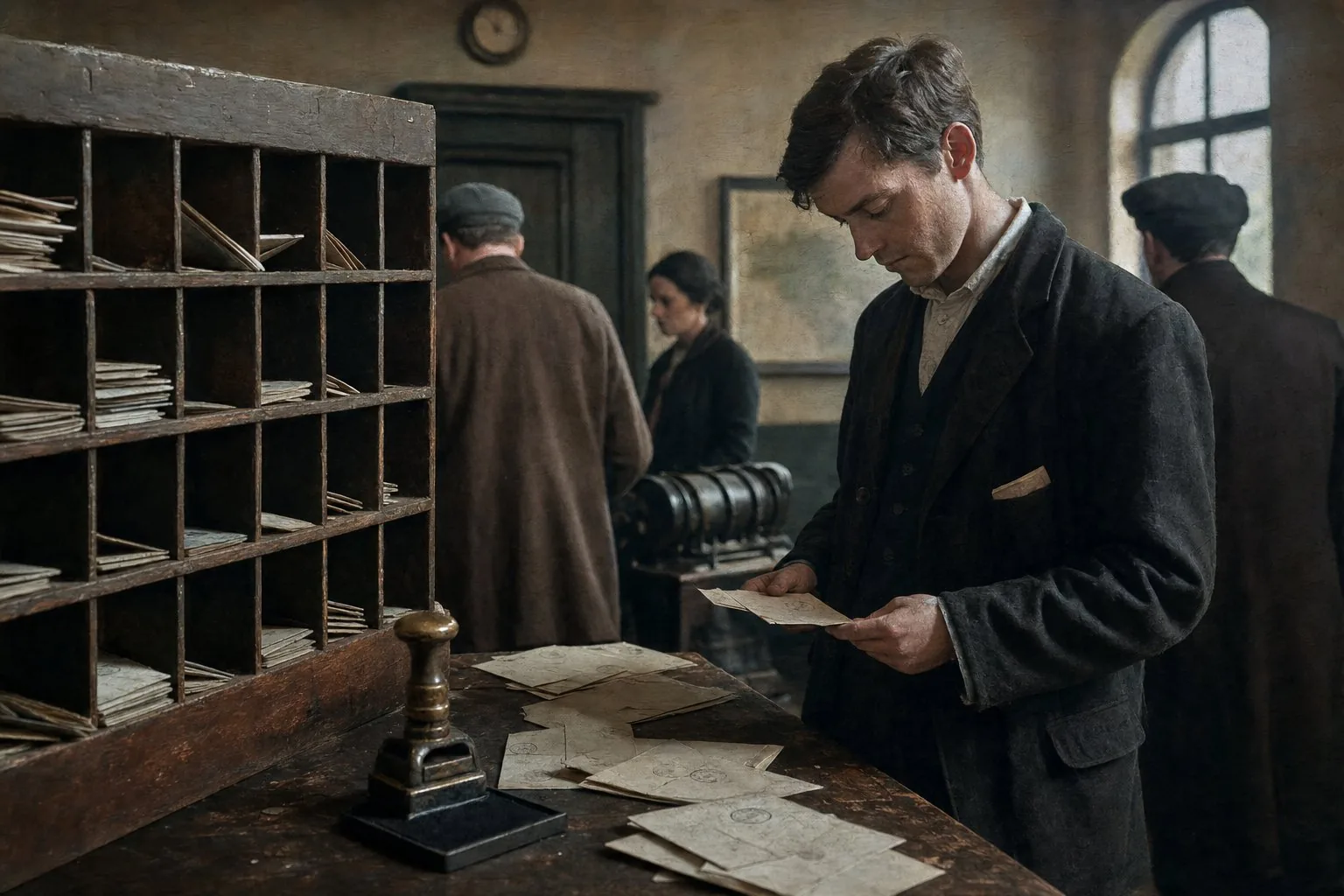
Walk into the post office at Ballina in 1847 and buy a stamp, and the clerk hands you the same small, red brown square sold that same week in Liverpool, Glasgow or London. Ireland has no postage stamp of its own, and will not have one until 1922. From the Uniform Penny Post of 1840 until the Irish Free State, every stamp used on an Irish letter is a British stamp, because for postal purposes Ireland was simply part of the United Kingdom.
That fact tends to surprise people, and it should not be softened. It is also, told plainly, more interesting than the version most people expect. The object worth looking at closely was never the stamp. It was the postmark struck over it, the ring of ink naming a town and a date, and everything that had to happen to carry a folded sheet of paper from a farmhouse in north Mayo into that ring of ink in the first place.
The stamps an Irish letter actually carried
The reason there was no Irish stamp is administrative, not accidental. Until the Irish Free State took charge of its own post offices in 1922, there was only the General Post Office, one authority for the whole United Kingdom, printing one set of stamps for every counter from Cork to Aberdeen.
So the stamps an Irish letter carried across this period are simply the story of British stamps. The Penny Black, the world’s first adhesive postage stamp, went on sale in May 1840, printed in black ink with a young Queen Victoria’s profile. Within a year it was replaced by the Penny Red, because a black cancellation mark barely showed on a black stamp, and a used stamp could too easily pass for a fresh one. On red, the black postmark stood out clearly, and the same stamp could not travel twice.
The Penny Red carried Irish letters for most of Victoria’s long reign. Her successors followed it onto the sheet in turn, Edward VII from 1902 and George V from 1911, and none of them was designed with Ireland in mind or pictured Ireland at all. A stamp bought at the counter in Ballina and a stamp bought at the counter in Bristol came off the same press.
How a letter travelled before the Penny Post
Before 1840, sending a letter was not the ordinary act it later became. Postage was charged by distance and by the number of sheets folded into it, usually paid by the receiver, not the sender. A family with little to spare could be handed a letter at the door and made to choose between the news inside it and the coin it cost to accept.
Getting a letter that far was its own undertaking. Ireland’s mail coach network, built on the British model from the late eighteenth century, ran fixed routes between the larger towns, Dublin to Cork, Dublin to Sligo. Away from those main roads, where north Mayo sat, the post depended on horse-drawn cars, local carriers, and often enough, someone walking, and from 1815 Charles Bianconi’s cars fanned a growing web of these routes across the south and west, carrying a letter its last stretch into a post town like Ballina. From there the road ran on to Dublin, across the Irish Sea by mail packet to Holyhead, and on by coach or, increasingly through the 1840s, rail, toward Liverpool. Only from Liverpool, if bound for Boston or New York, did a letter meet the part of the journey that made emigrant correspondence a different business altogether: the ocean.
What the Penny Post actually changed
The Uniform Penny Post, which took effect in January 1840, did two things at once. It set a single flat rate, one penny, for an ordinary letter travelling anywhere inside the United Kingdom, whatever the distance. And it shifted payment from the receiver to the sender, prepaid and provable with a stamp, so a letter reaching a door in Mayo cost nothing to open.
Postage charged by distance had made regular letter writing a luxury of the comfortable. A flat penny, paid in advance, put it within reach of a tenant farmer or a labourer, and letter writing stopped being rare that year.
None of this touched the cost of a letter crossing the Atlantic, which sat outside the Uniform Penny Post and stayed expensive for another two decades. But it did mean that the domestic leg of any Irish letter, the walk to the post town and the stamp bought at the counter, had become cheap and ordinary by 1847, the year the story on this site opens.
Getting a letter as far as Boston
A letter to Boston was a different transaction, and for most of this period a far more expensive one. Before steam, transatlantic mail travelled by sailing packet, boats under contract to carry post alongside cargo and passengers, and a letter could spend a month or more crossing the ocean before it reached a sorting office on the other side.
That changed with Samuel Cunard, who won the British Admiralty’s contract to carry the North American mails by steamship, putting the first ship on the route in 1840. His ship, the Britannia, sailed out of Liverpool and made land at Boston, cutting the crossing to under a fortnight. Boston remembered it. The Britannia’s arrival that year was met with days of celebration, because a city that lived on the packet trade understood exactly what a fast mail contract was worth to it.
None of this made a letter cheap. Well into the 1840s, postage across the Atlantic was charged separately from anything the Uniform Penny Post covered, and a formal agreement standardising the rates and the exchange offices between the two countries was not settled until close to the end of the decade. Until then, plenty of emigrant letters travelled only partly paid, the sender covering what they could at the Irish end and the person on the far side settling the rest before the letter was handed over. A family in Boston short of a few cents that week sometimes had to leave a letter at the post office and call back for it.
What a genuine period cover actually looks like
If you ever hold an actual letter from this era, envelope is the wrong word for it. Through the 1840s an ordinary letter was its own envelope: a single sheet, written on, folded down to a small rectangle, and sealed shut, usually with a blob of wax, the address written straight onto the blank outer panel. Machine-made envelopes existed but were a newer habit, and did not become ordinary until later in the century.
On the outside of a genuine cover from this period, you would expect a British stamp, whichever issue was current that year, cancelled in the corner. Beside it, a postmark: a circle of ink giving a town name and a date, applied where the letter entered the system. A letter crossing the Atlantic often collected more marks along the way, a transit mark from the port it left through, sometimes another from the American office that took it in, and a rate mark, in pence or cents, sometimes struck through and corrected. Read in order, these marks amount to a small travel diary, each one a place the letter genuinely, physically, was.
What such a letter would never carry is a stamp that looks distinctly Irish: a harp, a national emblem, the word Éire. Before 1922 that stamp does not exist, on any letter, from any post office, in any county. A reproduction, or a description, that puts one on a letter from this period has stepped outside the history, however convincing it looks. The postmark can be entirely genuine to a townland. The stamp above it, right up to 1922, belongs to Britain.
1922, and Ireland’s first stamps
When the stamps finally changed, they did not change cleanly, and that is worth telling honestly. The Irish Free State needed stamps the moment it took charge of its own post offices in 1922, long before anyone could design and print a new Irish issue from nothing. So the new government did the practical thing. It took the British King George V stamps already sitting in Irish post office stock and overprinted them with Irish wording announcing the Provisional Government, dated 1922, across the same portrait Irish counters had been selling for a decade.
The first stamps of an independent Ireland, in other words, were British stamps with Irish words printed over the top of them. That is not a detail to soften or leave out. It is the honest shape of a state standing itself up in a hurry, using what was on the shelf while something better was prepared, and it is a far more interesting fact than the tidier version would allow.
The something better followed within the year. By December 1922 the Free State had its own designed definitive series in circulation, a new set of stamps carrying a map of Ireland and symbols of the four provinces, the first stamps this island had ever issued that were not simply Britain’s. After the new constitution of 1937, the wording changed again, Saorstát Éireann giving way to Éire. By the 1940s a stamp reading Éire, cancelled on a letter posted from an Irish town, was no longer a novelty worth remarking on. It had simply become what an Irish stamp looked like, a hundred years after Ballina sold exactly the same stamp Liverpool did.