Letters and the Craft
Letters That Never Arrived
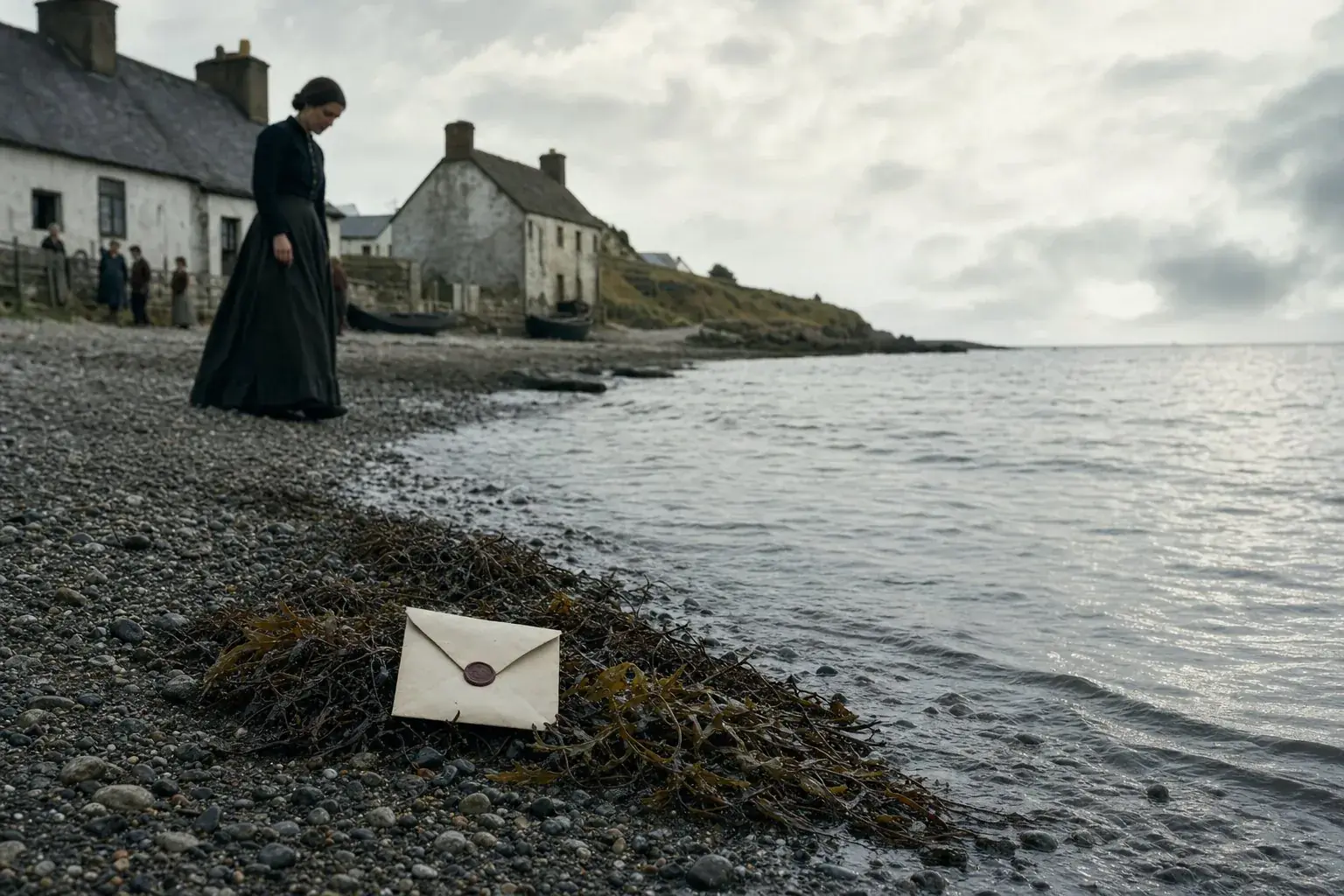
In September 1854 the steamship Arctic sailed out of Liverpool for New York carrying her passengers, her cargo, and that week’s mail, sealed in canvas sacks below decks. Off the coast of Newfoundland, in thick fog, she struck a smaller French vessel and went down within hours. Most of those aboard drowned, among them the wife and children of the shipping line’s own founder, and, infamously, not one woman or child on board survived the sinking. The Arctic ran the same Liverpool crossing that carried Irish mail all that decade. Whatever letters were in her hold that week, a son’s news from Boston, a mother’s from Mayo, went down with everything else, and no one waiting on an answer was ever told why it did not come.
So how many letters like those simply never arrived? Nobody kept a count, and that is worth sitting with. Across the whole span of Irish emigration, a letter crossing the Atlantic, or the Irish Sea, or the width of a single county, travelled with no guarantee at all of getting there. Ships went down. Wars closed the sea, or opened every envelope that tried to cross it. And far more often than either of those, the post simply failed at some ordinary, unglamorous point along the way: a wrong address, a reader who had died, a hand that could not write back. None of it was rare. All of it was final, in a world with no way to resend a letter by pressing a key.
Lost at sea
The Arctic was not the only one. Her Collins Line running mate, the Pacific, left Liverpool in January 1856 on the very same crossing and was never seen again. No wreckage, no survivors, no confirmed cause, only a ship that sailed into the ordinary business of a winter Atlantic and did not arrive. Whatever she carried, letters among it, simply stopped existing somewhere out there, and for the families waiting on word, not knowing was, for a long time, the only fact anyone had to hold on to.
A letter did not need to cross the whole ocean to be lost this way. Coastal and packet steamers went down in storms, ran aground in fog, and burned at their moorings, and every one of those losses took its mailbags down with the rest of the cargo, the way a lost coat takes whatever was folded into the pocket. In September 1857 the steamship Central America went down in a hurricane off the Carolina coast, carrying passengers, mail under a United States contract, and enough gold from the California fields that historians count her loss among the sparks of the financial panic that swept the country that autumn, the same Panic of 1857 that marks the last year of the decade these letters cover. A mail steamer could go down a thousand miles from Ireland and still be felt, months later, in a Mayo kitchen reading American news that had turned suddenly harder.
What war did to the post
War did the rest of the damage that shipwreck did not. A country at war treats its own mail as a resource to be commandeered and everyone else’s as a risk to be opened.
Irish-born soldiers filled a large share of the British army’s ranks through the middle of the nineteenth century, the Crimean War among them, and their letters home travelled through the same military supply chain that was, by the winter of 1854, notoriously failing to get food, medicine or dry boots to the men who wrote them. A letter from the Crimea could sit for weeks behind the same chaos that filled the hospital at Scutari and brought Florence Nightingale there to answer it. The envelope said Ireland. The delay belonged to the war.
By 1914 the interruption had a name and a stamp of its own. An estimated two hundred thousand men from Ireland served in that war, and every letter a soldier sent home was read by an officer before it left camp, censored for anything that might tell an enemy where a unit stood or how it felt about standing there. Lines were struck through in black pencil or cut from the page entirely, and for however many days a letter sat waiting to be read, a family had no way to know whether the silence meant a censor’s desk, a delayed post, or worse. Some soldiers were issued a printed card instead of a letter: a short list of set phrases, I am quite well among them, with everything untrue struck out and nothing else permitted to be written at all. It said almost nothing, and it was often the fastest way that news of survival could travel.
The ordinary ways a letter simply failed
Most letters that never arrived were not lost to any single dramatic event at all. They failed the ordinary way, in an ordinary place, for reasons nobody thought worth recording at the time.
A letter depended, first, on somebody able to write it and somebody able to read it, and in the Ireland of the 1840s and 1850s that could not be assumed. Where the sender or the receiver could not write, the letter passed through another person’s hand, a priest, a schoolmaster, a literate neighbour, and every extra hand in that chain was one more place a letter could be delayed, garbled, or simply not got around to that week. The very first letter this site’s own family sent was written this way, dictated at a priest’s table because the young woman sending it could not yet write it herself.
An emigrant himself was a moving target. Irish labourers followed the railway and canal work across America the way their brothers followed the harvest across the English counties, a season in one place and gone to the next before a reply could catch them, and a letter addressed to a boarding house already emptied simply sat, then went nowhere. Post offices on both sides of the Atlantic kept a Dead Letter Office for exactly this problem, a department whose entire job was opening what could not be delivered, hunting for a name and a place a clerk could match to somewhere real.
Cost did its own quiet damage before the postal treaties settled it. In the earliest years, before Britain and the United States agreed a fixed transatlantic rate in the late 1840s, a letter’s postage was a matter of negotiation between ports and shipping lines, and a family that could not find the coin when the postman called sometimes had no choice but to let the letter go back unread. A ship held in quarantine over fever, as so many were in these years, held its post with it. A letter could cross the entire ocean intact and then sit a further fortnight in a locked mailbag on a ship anchored off Deer Island, arriving safely and arriving late, which to a family checking the post every week amounted to nearly the same thing as not arriving at all.
Waiting, and not knowing why
None of this was abstract to the people living inside it. A household with someone gone to Boston, or to England for the harvest, learned to organise itself around post day. Someone walked to the town whether a letter was expected or not, because asking was the only way to find out.
And when nothing came, there was no way to know why. The ship might have been delayed by weather, which was nothing. It might have gone down entirely, which was everything. The letter might be sitting, perfectly safe, in a mailbag on a quarantined ship, or in a Dead Letter Office an ocean away with no name a clerk could match to a townland in Mayo. Or the person who was meant to write it might, this month, be too sick, too broke, or too ashamed of bad news to pick up a pen. A silence carried every one of those explanations at once, and a family had no way to sort a bad crossing from a bad month from the worst news of all, until, one way or another, they found out.
The O’Donnells of Ballycastle, the fictional family whose letters this site follows, are set inside exactly this uncertainty. Patrick sails from Liverpool for Boston in October 1847, promising to send for Mary Cafferky once he has the price of her passage, and a younger brother takes the cheaper, harder road to England instead. What a household like theirs lived with was never only the news inside a letter. It was the arithmetic of the post itself: the ships, the wars, the quarantines, the clerks, the sheer number of ordinary ways an envelope could fail to complete a journey that, when it worked, looked so simple.
That is what made an arriving letter so much more than paper. Every envelope that actually reached a kitchen table had beaten a shipwreck, a war, a quarantine, an illiterate mile and a careless clerk, any one of which could have kept it at sea, or in a depot, or in a drawer marked undeliverable, forever. People of the nineteenth century did not open their post the way we open ours. They opened it the way you open something that was never guaranteed to arrive at all.