Gift and Giving
How to Ask Your Parent About the Family Story
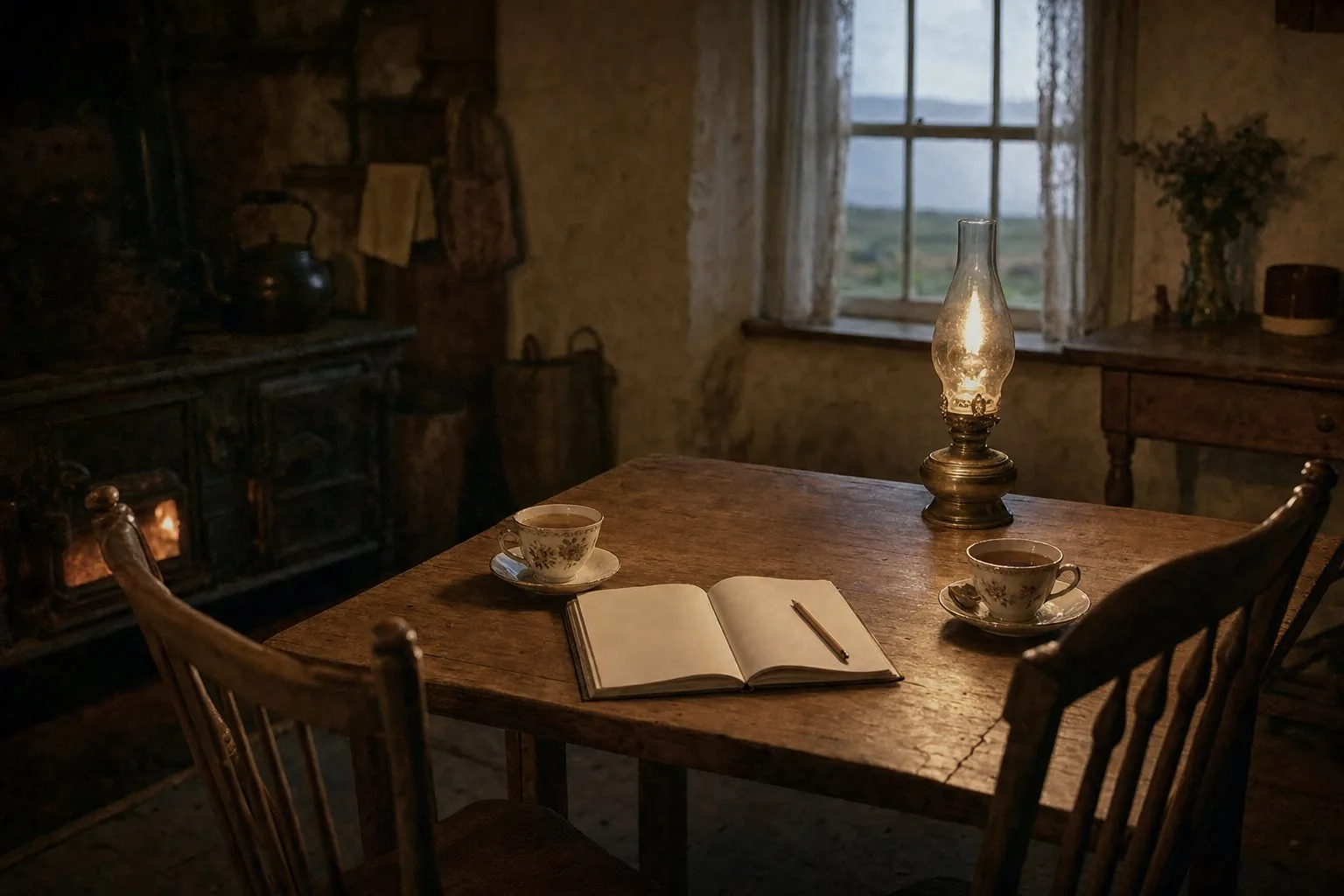
Ask a parent “tell me about growing up” and you will get one of two answers. Either a shrug and “sure it was fine, nothing to tell,” or a summary so smoothed by retelling that it could belong to anyone’s mother. Neither one is a memory. Both are what a person hands over when a question is too big to answer.
The fix is not a longer conversation. It is a smaller question.
Why “Tell Me About Ireland” Doesn’t Work
“Tell me about Ireland” is the question almost everyone asks, and it is the one most likely to get a rehearsed answer back. It is too large to hold. Asked to summarise an entire country, or an entire childhood, most people do what anyone does with an impossible question: reach for a line that has already survived a hundred family dinners. “It was a different time.” “We didn’t have much, but we didn’t know it.” True, probably. Also worn smooth from handling, which is what happens to any line repeated the same way too many times.
“Who taught you to cook that” is a different kind of question. It names one dish, one skill, one person. Nobody keeps a rehearsed line ready for it, so the parent has to go and actually look for the person standing at that particular stove. Once they are back in that kitchen, the rest tends to arrive with them: what the room smelled like, who else was in the house, what was said while the pot was watched.
This is not a new discovery. In the 1930s, Ireland sent schoolchildren home with copybooks and a list of exact topics, cures, games, local heroes, the old crafts, never “the old days” as a heading on its own, and had them write down what their grandparents said. It is digitised now as the Schools’ Collection, still searchable, because a specific question got a specific answer where a vague one would have gotten a shrug.
What a Good Question Looks Like
Every strong family history question names something small and lets the person find their own way back to it, rather than asking them to hold an entire era in two hands.
Trade the general for the particular.
Not “what was it like growing up poor,” but “what did you eat on a Tuesday.”
Not “tell me about your mother,” but “what did your mother do with her hands while she talked.”
Not “was it hard leaving,” but “what did you carry in the case, and what did you leave behind that you still think about.”
Not “what was the house like,” but “where did you sleep, and who slept next to you.”
Each version gives the other person a door to walk through instead of a field to cross. A door only needs one true answer. A field needs a summary, and a summary is exactly what you are trying to get past.
Questions to Ask About a Person
Ask about one person at a time, named, not “the family” in general. A specific face held in the mind produces specific answers.
- What did they smell like, when you were small.
- What were they like angry, and what set it off.
- What is one thing they said so often you can still hear it.
- What work did their hands do all day, and did they like it.
- Who were they afraid of, or afraid for.
- What is something about them that nobody else living still knows.
Questions to Ask About a Place
A place holds a memory the way an object does. Ask about the rooms, the roads and the fields before you ask about the feelings, and the feelings tend to arrive anyway, unasked.
- Draw the house for me. Where was the fire, and where did you sit.
- What was the walk to school, and who did you walk it with.
- What did the place smell like in summer, and in winter.
- Where did bad news arrive at, and who carried it.
- What road, or what shop, is gone now that you still look for out of habit.
Questions to Ask About Leaving, or Staying
Irish family history is full of kitchens where one person left and another stayed, often from the same table on the same night. If that shape sits somewhere in your own family, ask both sides of it, not just the side that makes the better story.
- Who left first, and who was left standing at the road.
- What was said the night before someone sailed, and what went unsaid.
- Did word ever come back after they left, and who read it aloud when it did.
- Who never came home, and who still does not talk about that.
- What was kept, all these years, from someone who went. A ring, a cup, a name given to a child.
Let the Object Ask the Question
A direct question can feel like an interrogation, even asked gently. An object does not. Put a photograph on the table, or a rosary, a medal, a recipe card in a dead relative’s handwriting, and ask about the object first. Who is this. Where was this taken. Who wrote this down, and did they measure anything or just know it by feel.
The object does work a direct question cannot. It gives the person something to hold and look at instead of you, and that matters more than it sounds like it should. Someone who will not meet your eye and talk about their own father will often talk for twenty minutes about a photograph of him, because the photograph is doing the asking now, not you. This is going at a memory second-hand, through the thing rather than straight at the person, and it works more reliably than any question on this page. A box of photographs with nobody’s name on the back is not a problem for later. It is the best set of questions you already own.
How to Record It Without Making It Strange
Ask permission first, every time, even with your own mother. “I want to remember this properly, is it all right if I record it on my phone” is enough. Most people say yes, and most people forget the phone is there within a few minutes, as long as you are not glancing at it.
Sit beside the person, not across a table from them, the way you would for a drive or for washing up, not the way you would for an interview. Let silences run longer than feels comfortable. The best line often comes after the pause, when they were about to move on and then didn’t. Ask what happened next rather than reaching for your next prepared question, and let one story lead to the one after it instead of working down a list. Say the date out loud at the start, and who else is in the room, because in twenty years that detail will matter as much as the story does.
Do not correct them. If their account does not match what a cousin told you, or what is on a certificate, let both versions stand. You are not building a court record. You are recording what one person remembers, which is its own kind of true.
When They Go Quiet
Some questions will land on a year nobody talks about: a death, a hard passage, a child who did not survive, a decision made out of hunger rather than choice. If the room goes quiet, let it stay quiet. Do not fill the silence for them, and do not push past an “I don’t want to go into that.” Go back to an object, or to a smaller and later question, and try the hard year again another day, if at all. These questions are meant to open a door, not force one. Some doors stay shut for a good reason, and the person you are asking gets to decide which.
When to Ask
Do not wait for a big occasion. The best answers rarely come from a sit-down interview booked for a Sunday afternoon. They come from the car, from peeling potatoes side by side, from a photograph that happened to fall out of a drawer while you were looking for something else. Ask one question, get one answer, and let it sit. Ask another one another day. A family history gathered this way, in pieces, over time, ends up fuller and truer than anything collected in a single afternoon with a list in hand.
Ask sooner than you think you need to. Every question on this page costs nothing and takes five minutes. The people who can still answer them do not have an unlimited supply of those.