Letters and the Craft
The Real Emigrant Letters That Survive Today
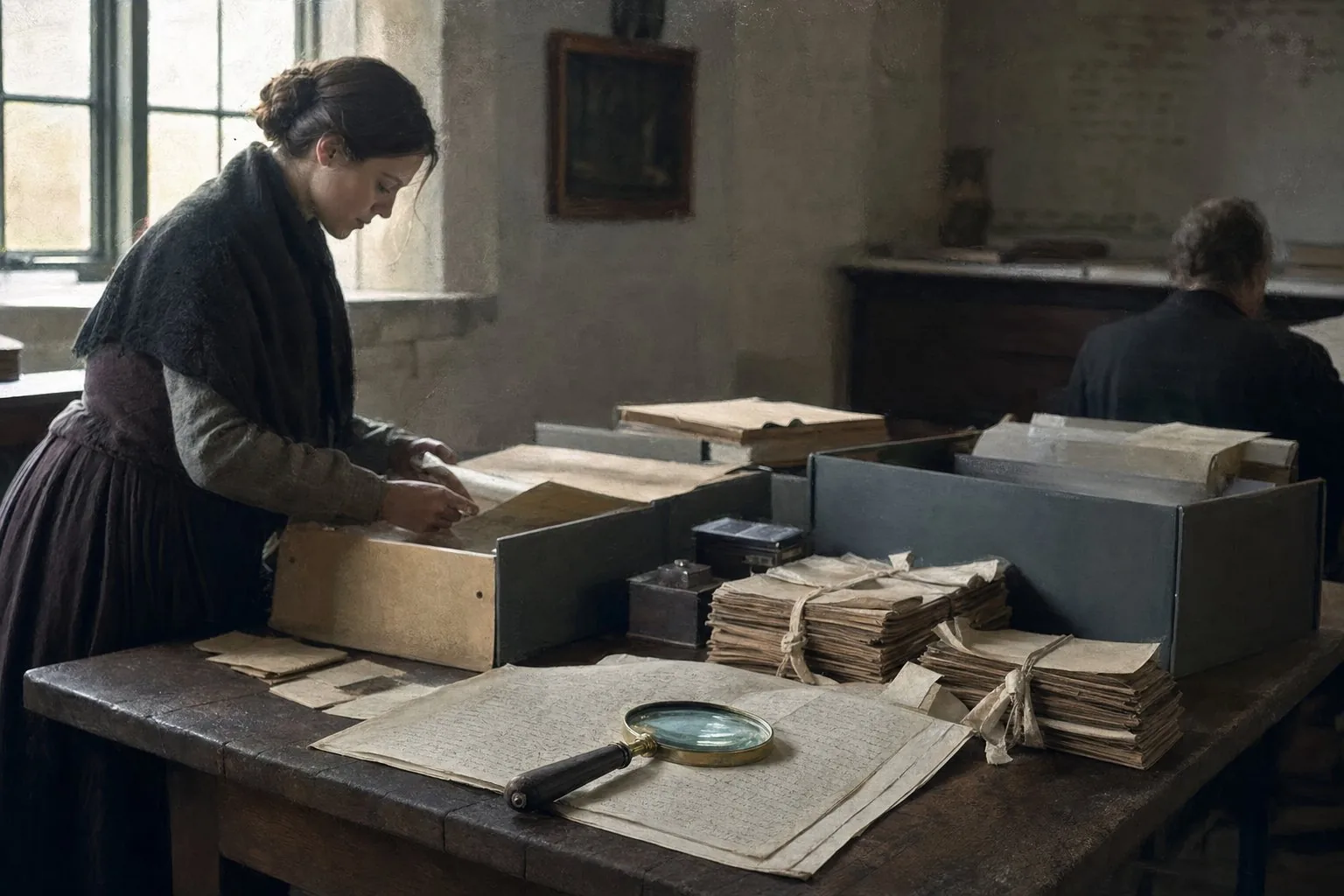
Most of what we actually know about how ordinary Irish emigrants felt does not come from a newspaper column or an official register. It comes from letters nobody outside one family was ever meant to read: folded small, carried in a coat pocket or kept at the bottom of a trunk, taken out and read aloud at a fire by people who had no idea a historian would ever want to see them. A real Irish emigrant letters archive, wherever one exists, is built almost entirely out of paper like that. Not documents created to be kept. Documents that simply were not thrown away.
Three things are worth knowing if that is what you are actually looking for: the real institutions that hold this material, the historians who spent careers turning boxes of it into evidence, and what a letter like this tends to actually say once you read past the opening line. Yours, From Ireland is built out of exactly this record, and the most honest place to start is the plainest fact: the family in it never existed.
Where the real archive lives
Ask a genealogist or a migration historian where the letters actually are, and you get a short, specific list, not a shrug toward archives somewhere. The Public Record Office of Northern Ireland, in Belfast, holds major collections of correspondence sent home by Ulster emigrants, gathered over decades from families willing to deposit or copy what had survived in a drawer. The Irish Emigration Database, built at the Mellon Centre for Migration Studies at the Ulster American Folk Park in Omagh and made searchable online through a digitisation partnership with Queen’s University Belfast, holds more than 33,000 records pulled from public and private archives, among them thousands of personal letters.
Then there is the newest of the major collections. In 2021 the historian Kerby Miller donated the letters, diaries and family papers he had spent fifty years assembling to the University of Galway, which built the material into a searchable online archive called Imirce, the Irish word for migration, launched in 2024. Imirce holds roughly 7,000 letters among more than 150,000 documents in total, running from the late 1600s to the mid-twentieth century. None of this sits behind a research fellowship or a paywall. Anyone can search it from a browser.
Smaller collections sit outside these three. County libraries, diocesan archives and diaspora museums hold more again, usually a single family’s donated bundle rather than a systematic collection. For every letter catalogued and searchable online, more still sit in a filing box somewhere, waiting for someone to ask about them.
The historians who turned letters into evidence
A pile of old correspondence is not automatically history. Someone has to read all of it, work out what is typical and what is one family’s oddity, and argue for what it adds up to. Two names come up whenever that work has been done properly and at scale.
Kerby Miller’s collection, the same one now held at Galway as Imirce, is what produced Emigrants and Exiles: Ireland and the Irish Exodus to North America, a study built on letters, diaries and memoirs from Irish emigrants of every background, Catholic and Protestant, Ulster and the rest of the island alike. Reading emigrants in their own words, Miller argued that Irish emigration was very often described and felt as a kind of exile forced on people rather than an opportunity freely chosen, a reading other historians have pushed back on ever since. That disagreement is worth knowing about in itself. Even a huge body of real letters does not settle an argument on its own. It opens one.
David Fitzpatrick’s Oceans of Consolation took a narrower, rarer kind of source: complete exchanges, letters surviving from both directions of a single correspondence, sent between Irish emigrants in Australia and the family they had left behind. That completeness is unusual. Most surviving bundles are one-sided, kept by whoever received them, with the other half of the conversation lost to distance, house moves and the emigrant’s own unsettled life. A matched pair, years of replies still sitting together on both sides, is close to the rarest thing the real archive has to offer.
What these letters actually contain
Read enough of the real record and a pattern emerges, less dramatic than most people expect and more moving for it. Many open with some version of the same convention: a hope that the letter finds its reader as well as it leaves its writer, a piece of throat clearing so common across thousands of surviving letters that historians read it less as feeling than as a genre marker, the letter announcing what kind of document it is before it says anything else.
After that, the content stays practical almost to a fault. Money, counted out in pounds, shillings and pence, and later in dollars. Work, and whether it had held. Weather and the state of a crop, on either side of the ocean. Who else from the parish had gone, and where, because a letter home was often the fastest way a family learned that a neighbour’s son had sailed too. Illness, named plainly, without much comment made of it. Real feeling appears, but usually at the edges, a closing line or a postscript that breaks the practical rhythm of everything around it and lands harder for how rarely it comes.
A good number of these letters were not written in the sender’s own hand. Literacy in nineteenth-century Ireland grew steadily but unevenly across the century, weakest in the poorest and most Irish-speaking districts, and it was entirely ordinary for a letter to pass through a literate neighbour, a schoolteacher or a parish priest before it ever reached the page. That alone is a reason to be careful about reading any single surviving letter as one person’s private voice. Often it is at least two.
Why so much of it never survived at all
For every letter that made it into an archive, uncountable others did not. Ordinary correspondence was not written to last. It was practical mail, read at the fire, passed around the kitchen, and then reused for kindling or simply thrown out by a later generation who did not recognise what they were holding. Emigrant life added its own losses on top of that: a lodger who moved on from a boarding house and left nothing behind him, a death far from any family who might have kept his papers, a house cleared in a hurry.
What changed this was not a change in how people valued their own letters at the time. It was later generations of archivists, folklorists and historians, working across the twentieth century and into this one, who went looking for family bundles on purpose and asked whether an attic trunk still held what everyone assumed was long gone. The Irish Emigration Database, the Ulster collections at PRONI, and Kerby Miller’s own fifty years of collecting all exist because someone eventually went and asked. A surprising amount of it was still there.
Where the O’Donnells come from
None of this is where Patrick O’Donnell and Mary Cafferky come from, and that is worth saying as plainly as possible. No family by those names sailed from Ballycastle in October 1847. No archive holds their letters, because their letters were never written by anyone but us, researching the pattern this record leaves rather than lifting a page from it.
What the real archive gives a project like this is not a family to borrow but a shape to be honest to: the kind of thing an emigrant actually wrote about, the restraint real letters tend to show, and the unevenness of who could write and who could not. Every year the O’Donnells live through, the Hunger, the Boston tenements, the nativist backlash of the 1850s, the Panic that closed the decade, is checked against exactly the kind of sources named above, the same reading rooms and the same named scholarship any historian of Irish emigration would use.
That is the honest version of where a story like this comes from. Not a discovery, and not a transcription, but research, turned afterwards into a family who never existed, so that the record they walk through is real even though they are not.