Emigration History
What Is Actually Irish About St Patrick's Day
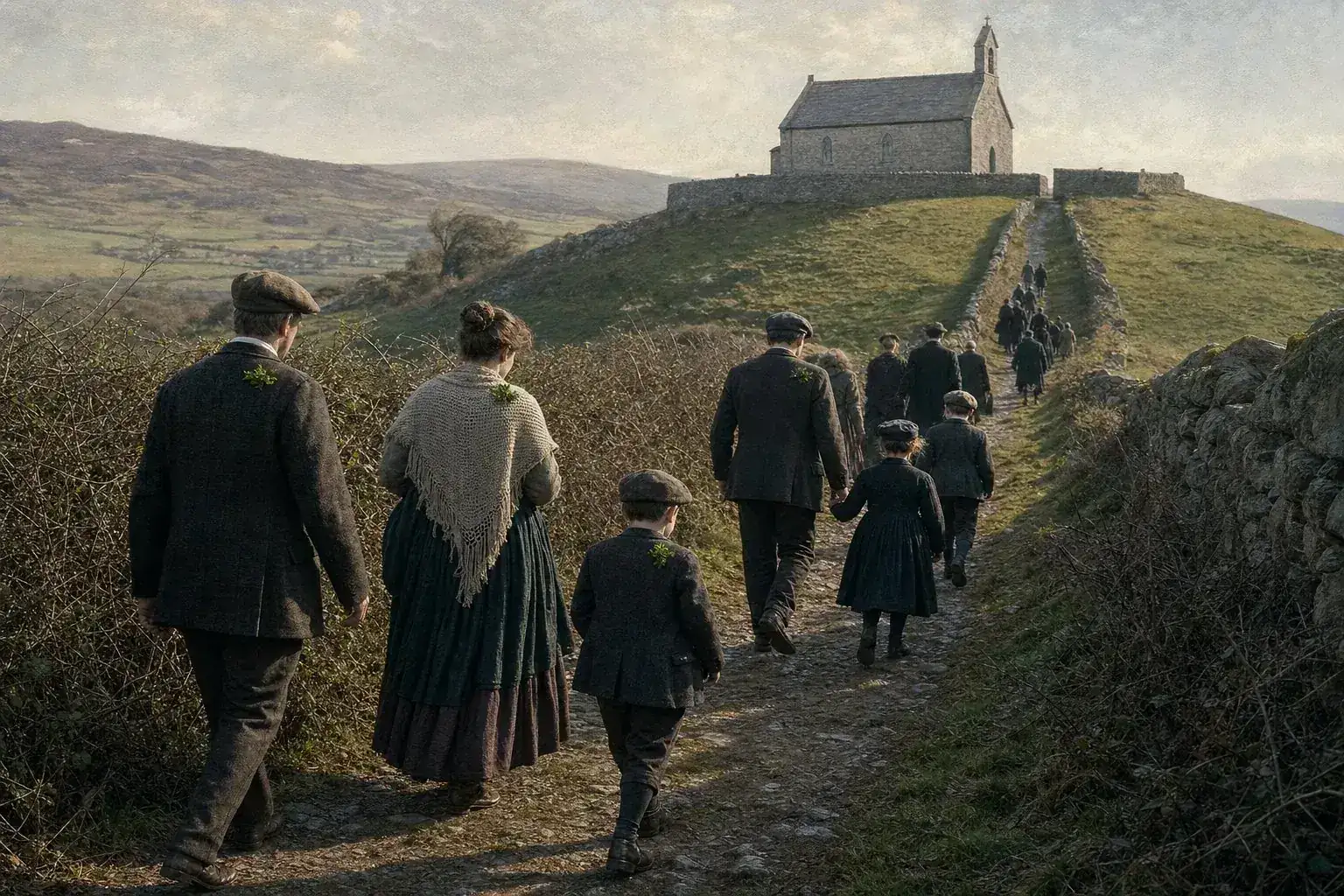
For most of the twentieth century, the surest thing about the seventeenth of March in Ireland was that the pubs would be locked. Not by custom. By law. On the same date, a parade moved up Fifth Avenue in New York, pipe bands playing for hours, and the bars along the route did the best trade of their year. Two countries, one saint, one date, and almost nothing else in common.
So what is actually Irish about Saint Patrick’s Day? Less than most people assume, and what remains is better than the postcard version. The parade started in America. The colour changed within Ireland’s own history, not in some distant century. The pubs, on the day itself, mostly stayed shut. None of that makes the day any less Irish. It means the real story is worth telling straight, instead of the one that gets sold back to us every March.
Where did the St Patrick’s Day parade actually come from?
The first Saint Patrick’s Day parades were organised by Irish soldiers and Irish charitable societies in colonial and early federal America, in cities like Boston and New York, from the middle of the eighteenth century onward. They were not a folk custom carried over from the old country. They were closer to a claim staked in a new one: a way for an unpopular immigrant community to walk down the middle of the street in daylight, in numbers, and be seen.
Ireland had nothing like it for a very long time. At home the day was a religious feast, marked at Mass, not on a parade route. Dublin did not hold its first proper state parade until 1931, and the version the world now flies in for, days of music and crowds several deep along the route, is newer again: a modern tourism festival built up from 1996 onward. The parade the whole world now associates with Ireland is, in the order things actually happened, an American invention that Ireland imported back more than a century and a half later.
The habit of exporting the day has only grown since. Landmarks from the Sydney Opera House to Niagara Falls now turn green every 17 March, a marketing campaign run by Ireland’s own tourism board, not a survival of anything old.
Why is the colour green, and not blue?
Green feels so obviously Ireland’s colour that it is strange to learn it was not always so. The older colour, the one tied specifically to Patrick himself, was blue, a pale shade still known today as Saint Patrick’s blue. It was the colour of the Order of Saint Patrick, founded in 1783, and it still appears on the presidential standard, largely unnoticed.
Green won for a different reason: politics, not heraldry. Through the 1790s the shamrock and the colour green became attached to Irish republican and nationalist movements, worn as a badge of allegiance rather than a decoration. After the failed rising of 1798, wearing green was treated by the authorities as a provocation in itself, which only cemented the association. A colour that gets a person into trouble is a colour that gets remembered. By the time large numbers of Irish emigrants were building new lives, and new parades, in America through the nineteenth century, green was already doing the work blue once did. It was easier to spot in a crowd and easier to print on a banner, and it carried a charge that blue never had. Blue did not disappear. It simply lost the argument.
Were pubs really closed in Ireland on St Patrick’s Day?
Here is the part that surprises people most. For decades, a locked pub on the seventeenth of March was not a custom in Ireland. It was the law. Temperance campaigners in the young Irish state argued that a saint’s feast day should not be marked with drink, and by 1927 the law agreed with them: publicans were required to keep their doors shut on 17 March, the same as on Good Friday. The rule held for more than forty years.
There was a well known way around it, all the same. The Royal Dublin Society’s spring show, held in Ballsbridge, kept a bar open on its own grounds, and a ticket to the show bought a legal pint while the rest of the country’s pubs stood locked. Dubliners with no particular interest in livestock or farm machinery found their way to the show gate on the seventeenth of March for exactly that reason.
The law was not changed until 1970, and only then did the pub become the centre of an Irish Saint Patrick’s Day. It had not even been a national holiday for very long by that point either. Ireland only made 17 March an official bank holiday in 1903, decades after Irish communities in Boston and New York had already turned it into their biggest public celebration of the year. For most of the century, in other words, the version of the day now sold to the world, pints and singing until closing, was happening in Boston and New York and Sydney, while Ireland itself kept something closer to a solemn Sunday.
Was Saint Patrick even Irish?
Even the man at the centre of the day complicates the story. Patrick was born a Romano-British teenager, most likely somewhere on the west coast of Britain, and he did not come to Ireland by choice the first time. He was taken by raiders as a boy and spent years herding sheep as a slave before he escaped and made his way home. He returned to Ireland only afterward, by his own decision, as a missionary bishop, which is the part of his life he chose to write about in his own hand.
Two short pieces of his own writing survive, a confession and a letter of complaint to a British warlord, and together they are the only reliable window into his life. Everything else people now picture, the snakes he supposedly banished, the fire lit in defiance on a hillside, was added long after him, by people who wanted a better story than the plain one he told about himself.
The shamrock story, the three leaves standing for the Trinity, does not appear anywhere in what Patrick actually wrote either. It surfaces centuries later, part of a folk tradition that grew up around him long after his death, and it stuck because it is a clear, teachable image, not because there is any record of him using it. None of this makes Patrick less central to the day carrying his name. It only means the day has always held more legend than fact, added to by each generation that kept it, which is a very Irish thing to do to a story.
What Irish St Patrick’s Day traditions are actually real?
Strip away the parade, the exported colour scheme and the pub trade, and a few things remain that are genuinely, quietly Irish, older than any of the above, and mostly invisible to anyone outside the country.
Wearing an actual sprig of shamrock, picked or bought fresh rather than printed on a hat, is older than the parade and older than the politics of green. People were describing Irish crowds wearing shamrock on the day well before America had any parade to speak of. Some still practise what is called drowning the shamrock at the end of the evening, dropping the sprig from a lapel into the last drink of the night, a small private gesture rather than a public spectacle.
For most of Irish history the day itself was primarily religious: Mass in the morning, then a family dinner, and because the date usually falls within Lent, a licensed exception to whatever had been given up for the season. A season of penance handed back, for one date on the calendar, the small permitted pleasure of a proper dinner. That mixture of solemnity and quiet indulgence sits closer to how Irish people actually marked the day for generations than anything on a modern parade route.
Children once made their own badges for the day, too. Paper crosses and ribboned rosettes, put together at home rather than bought, a custom collected from schoolchildren across the country in the 1930s and now largely gone. It cost nothing, passed from one kitchen table to the next, and asked for no audience at all. That, more than the parade or the pint, is closer to what the day actually was before anyone thought to sell it back to us. None of it needed a crowd to mean something. That may be the most Irish detail of all.