Emigration History
What the Crossing Actually Cost
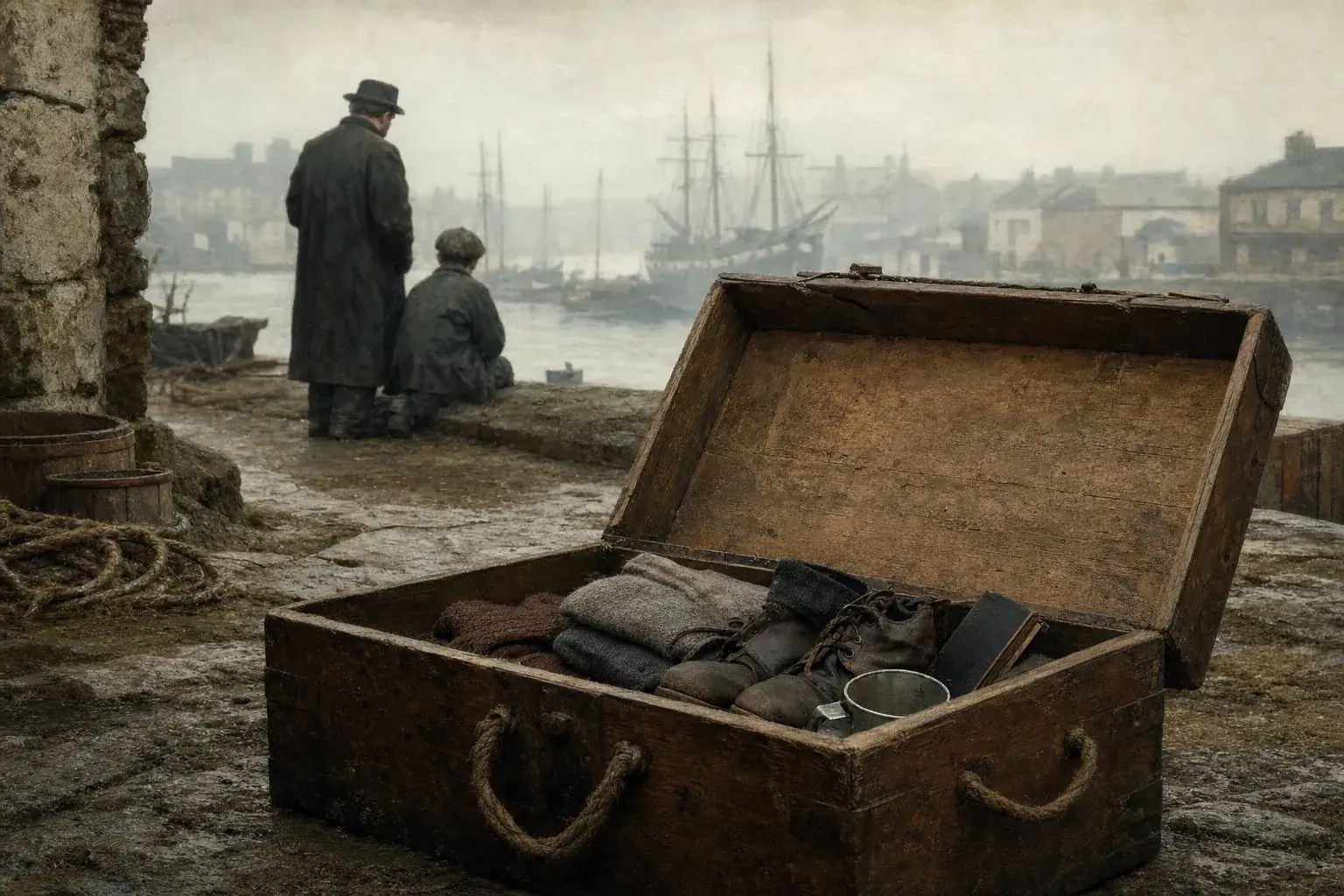
Somewhere between three and six pounds sterling bought a berth in steerage on the crossing from Liverpool to Boston or New York in the late 1840s. For a small tenant farming family, that sum never came out of savings, because there were no savings to draw on. It came from selling something. A pig fattened for exactly this purpose. A cow the family could not really spare. Wages an uncle in America had already sent home, folded into a letter months before anyone dared book a passage.
The number itself moved with the year, the port and the shipping line, and that needs to be said plainly before anything else. Nobody can hand you one true price for the Famine crossing, because there was never only one. What the fare bought, and what it did not, is where the real story sits. A ticket bought a passenger a space below deck and very little else. The food, the bedding, the cup to drink from: all of it had to be found, packed and carried aboard by the passenger, and that is usually the part of the story left out.
How much did a steerage ticket actually cost?
The Liverpool route was the cheaper one, relatively speaking, and it was cheaper because it was crowded with competition. Dozens of shipping firms ran the Liverpool to North America trade by the late 1840s, and a passenger who could get themselves to Liverpool, no small journey in itself from a place like north Mayo, could shop between agents and lines for the best price on offer that week. A passage booked directly from a smaller Irish port, where sailings were rarer and a single firm might hold the trade, generally cost more for the same berth.
The other variable was who paid, and when. Early in the Famine years, most fares were raised at home, scraped together from whatever the family had left to sell. As the 1850s went on, a growing share of tickets were prepaid, bought in Boston or New York by someone who had already crossed, and sent back across the Atlantic for a brother, a sister, a sweetheart. That habit, money and tickets crossing eastward to carry the next family member west, became one of the great engines of Irish emigration through the decade.
Prices moved as well as varied. Demand for berths through the worst Famine years pushed fares up in some seasons even as shipping lines added capacity, and a family pricing a passage in 1847 was not looking at the same market as a family pricing one in 1855. Anyone who offers you a single fixed number is being tidier with the history than the history actually was.
How long the Atlantic crossing took
A sailing ship out of Liverpool generally took somewhere in the region of five to eight weeks, and that was the good outcome. Ships ran against prevailing westerly winds for most of the route west, so the return crossing, eastward, was reliably the faster of the two. A passage could run well past eight weeks if the weather turned against it, and passengers who had packed food for six weeks with nothing to spare sometimes found themselves rationing on open water with no way to buy more.
Steam was beginning to change this by the 1850s, and a steamship could cross in under two weeks. But steam passage cost far more than sail, and stayed out of reach for most emigrating families through the Famine decade. For the people this crossing actually carried, the ship was still a sailing ship, and the crossing was still measured in weeks, not days.
What food a passenger had to bring
British law required shipping lines to carry a minimum ration for every steerage passenger, but in 1847, the worst year of the Hunger, that requirement was thin on paper and thinner in practice. Ships sailed overloaded and under-provisioned, and passengers who boarded already weakened by a year of hunger at home did not have the strength to survive weeks on what little the law obliged a captain to give them.
Parliament tightened the rules in the years after, requiring more food and cooked rations rather than raw stores a passenger had to prepare alone. Enforcement stayed patchy for years afterward, and most emigrant families packed as though the ship would give them nothing at all, because for a long stretch of the Famine crossing, that was close to true.
So the food went into the luggage with everything else. Oatmeal, because it kept and cooked easily. Ship’s biscuit, hard enough to survive the journey without spoiling. Tea and sugar, if the family could stretch to them. A little bacon or salted meat, wrapped and kept apart from everything else. Whatever they carried had to last the whole crossing, cooked a batch at a time on a single galley stove shared by however many hundred passengers were travelling steerage, which meant a rota, a wait, and a fire that went out long before everyone had been fed.
What went into the trunk
Most ships supplied nothing beyond the berth itself, so a passenger travelling steerage packed for a voyage of five to eight weeks as though setting up a small, temporary household in a space barely large enough to lie down in.
Into a single trunk or chest, often built by the family rather than bought, went a straw tick or bundle of bedding to sleep on, since ships rarely supplied any. A change of clothes, folded around whatever else needed protecting. A tin cup, a plate, a knife and spoon, since a passenger who forgot cutlery went without. A cooking pot, for a turn at the shared stove. The food, packed dry and packed to last.
Often a small prayer book went in too, small enough to fit a coat pocket rather than the trunk itself. And, sewn into a hem or folded into an inside pocket where a thief could not easily find it, whatever coin the family could spare beyond the fare, because a passenger who landed in Boston or New York with nothing left and nowhere to sleep that first night was not a rare story. It was closer to the ordinary one.
What steerage was actually like below decks
Steerage was one shared space below the main deck, low enough that a grown man often could not stand upright in it, lit by whatever daylight came down the hatches when the weather allowed them to stay open. Bunks were built in tiers along the walls, shared, with no partition between a family and the strangers sleeping a few feet away on either side. There was no real privacy on a steerage crossing, at any point in it.
Seasickness set in within the first days for nearly everyone. In a storm, with the hatches battened against the weather, the same enclosed space that held several hundred people held the smell and the sickness of all of them at once, with nowhere for the air to go. Fresh water was rationed and often turned foul before the voyage ended.
In a bad year, and 1847 was the worst of them, passengers who had boarded already weakened by hunger and fever at home carried both onto the ship with them, and disease moved through a crowded steerage deck fast. Some of the ships that sailed that year lost a shocking share of their passengers before they ever reached the quarantine station, which is the plain reason that year’s crossings earned the name history still remembers them by, the coffin ships.
Arrival was not the end of it either. Ships bound for Boston anchored in the harbour for inspection before anyone was allowed ashore, and a passenger showing signs of fever could be held on Deer Island, in quarantine, rather than walking straight into the city. For a passenger who had survived weeks at sea on ship’s biscuit and salted meat, the last obstacle between them and dry land was one more wait, on a ship, with the city close enough to see.
This is the crossing that lay behind the October sailing from Liverpool to Boston that opens the story this site publishes: the O’Donnells of Ballycastle, an invented Mayo family, sending their second son, Patrick, out along the road toward a ship he had never seen and a city he could not picture, in 1847. The fare, the food, the trunk, the weeks below decks: none of it is particular to one family, invented or otherwise. It was the plain, physical shape of what leaving Ireland actually required, for anyone who left it that way, in that decade.