Letters and the Craft
Why paper only letter subscription mail matters
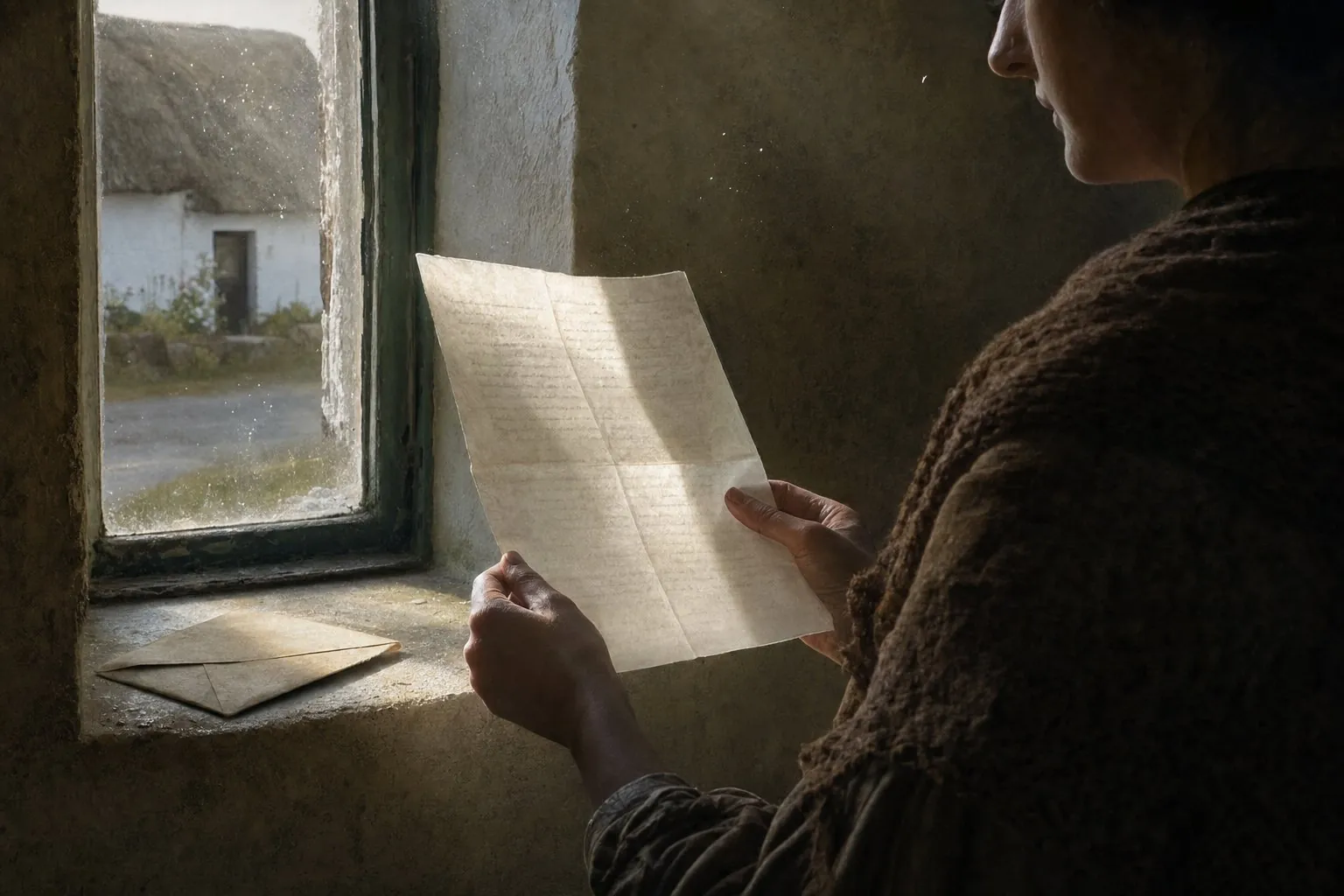
Why paper only letter subscription mail stays exactly as the name promises, paper and nothing else, sealed in one envelope, is a deliberate choice, not a cost-saving one. It keeps a personal letter classed as correspondence rather than as a parcel of goods, and it sits closer to how a real nineteenth-century Irish emigrant letter travelled than a padded gift box with a keepsake tucked inside ever could.
Why paper only letter subscription mail skips the trinkets
The reasoning is not sentimental. It is regulatory, and it changed in 2025. On 29 August that year the United States suspended the duty-free de minimis exemption that had let low-value international parcels cross the border without a formal customs entry. The order behind it, Executive Order 14324, “Suspending Duty-Free De Minimis Treatment for All Countries,” states plainly that the exemption “shall no longer apply to any shipment of articles… regardless of value,” and it draws no line for gifts, keepsakes, or personal items. U.S. Customs and Border Protection followed with its own notice confirming enforcement was ready from that date.
International mail still runs on a separate, older framework. The World Customs Organization and the Universal Postal Union sort cross-border post into four categories: correspondence and documents, low-value consignments that attract no duty, low-value consignments that do, and high-value consignments. A letter that is only words on a page sits inside that first category, the one the 2025 rule change did not touch. Add an object, an accessory, or a souvenir, and the same envelope moves into the merchandise categories, the ones now facing a duty calculation at the door regardless of what the object cost.
What historically travelled in an Irish emigrant envelope
Real letters were not always this restrained. Research collected by Mayo County Library’s EMILE project, drawing on the Public Record Office of Northern Ireland and the Centre for Migration Studies at the Ulster American Folk Park, records that emigrant letters home commonly carried remittances, prepaid passage tickets for relatives still in Ireland, and later, once the technology existed, photographs. The library estimates that emigrants sent roughly €260 million home to Ireland over the course of the nineteenth century, much of it folded into ordinary letters rather than sent by any separate channel, which is part of what made chain migration possible at all.
Historian David Fitzpatrick’s study of the correspondence, published in History Ireland in 1994, describes a two-way traffic: money and instructions went one direction, news and requests went the other, and a good number of letters were written or read aloud by an amanuensis on behalf of a sender or recipient who could not write. None of that was free to send. Fitzpatrick documents a ship letter in the late 1830s costing over half a crown, several days’ wages for an Irish labourer, falling to sixpence by 1854 and to fourpence by 1889. Paper itself, before anything was added to it, was already a real expense.
How weight decided the price
The 1848 postal convention between the United States and Britain, which took effect in February 1849, set the first agreed reciprocal rate for a transatlantic letter between the two countries after decades of inconsistent, often punitive, ship-letter charges. Rates under conventions like it were set by weight. A single sheet paid one rate; a second sheet, or anything folded inside it, pushed the letter into the next band and the next charge.
That is the direct ancestor of the distinction that matters today. Weight and contents decided the postage rate on a nineteenth-century emigrant letter, and weight and contents decide the customs category on an international letter now. The mechanism changed. The logic, that what is inside the envelope determines what you owe to send or receive it, has not.
Why paper versus a subscription box is not a style choice
A subscription box model bundles a keepsake alongside the reading, tea, a trinket, a small object meant to feel like a piece of the country in the hand. Once that object is in the envelope, current customs rules treat the whole packet as a consignment of goods rather than correspondence, and since August 2025 that consignment is assessed for duty at the door no matter how small or inexpensive the object is. What arrives in the envelope, when it stays paper only, is by design exactly what the postal customs framework defines as correspondence: words, not a shipment.
It is also, separately, closer to what emigrants actually sent home in remittances and instructions than a modern gift box is: a letter that did its work as a letter, not as packaging around an object.
What historians cannot know
The surviving record is not a representative sample. Letters that reached archives such as the National Library of Ireland, PRONI, or the Centre for Migration Studies tend to be the ones a family judged worth keeping, often because they were unusual, dramatic, or later attached to a well-documented descendant. The ordinary run of letters, the plain ones with nothing remarkable in them, were read, passed round the townland, and lost to damp, house clearances, or simple indifference. What proportion of Famine-era correspondence carried an enclosure and what proportion was paper only cannot be reconstructed from what remains, because what remains was never a fair cross-section to begin with.
The same gap affects postage. A precise rate paid on any single family’s letter can only be read from the cover itself, the postmark and rate marks stamped on the outside, and those are exactly the parts most likely to have been trimmed off, faded, or discarded once the letter was safely home. How transatlantic postage actually worked through the 1850s can be reconstructed from postal treaties and surviving covers in specialist collections, but any single family’s exact cost is, for most families, simply gone.
None of this settles what any one household chooses to put in an envelope today. It explains why staying to paper, and only paper, still reads as the plainer and the more accurate kind of post: not a smaller gift, but one with nothing in it that a customs officer, or a nineteenth-century postmaster weighing a letter by hand, would need to stop and price separately. For a sense of what that looks like in practice, a single paper letter, posted from Ireland, makes the case better than any explanation of the rule.
Sources and further reading
- The White House, Executive Order 14324, “Suspending Duty-Free De Minimis Treatment for All Countries,” 30 July 2025.
- U.S. Customs and Border Protection, “CBP Ready to Enforce End of De Minimis Loophole, Securing Borders and Strengthening Trade Enforcement,” national media release, August 2025.
- World Customs Organization and Universal Postal Union, Postal Customs Guide, final edition, 2024.
- David Fitzpatrick, “Emigrant Letters: ‘I take up my pen to write these few lines,’” History Ireland, vol. 2, issue 4, Winter 1994.
- Mayo County Library, “Letters in Ireland” (EMILE project), drawing on the Public Record Office of Northern Ireland and the Centre for Migration Studies, Ulster American Folk Park.
- Smithsonian National Postal Museum, “Transatlantic Mail,” online exhibition, About Philately: Covers and Letters, Land and Sea.