Emigration History
American letters Irish emigrants: the envelope that held families together
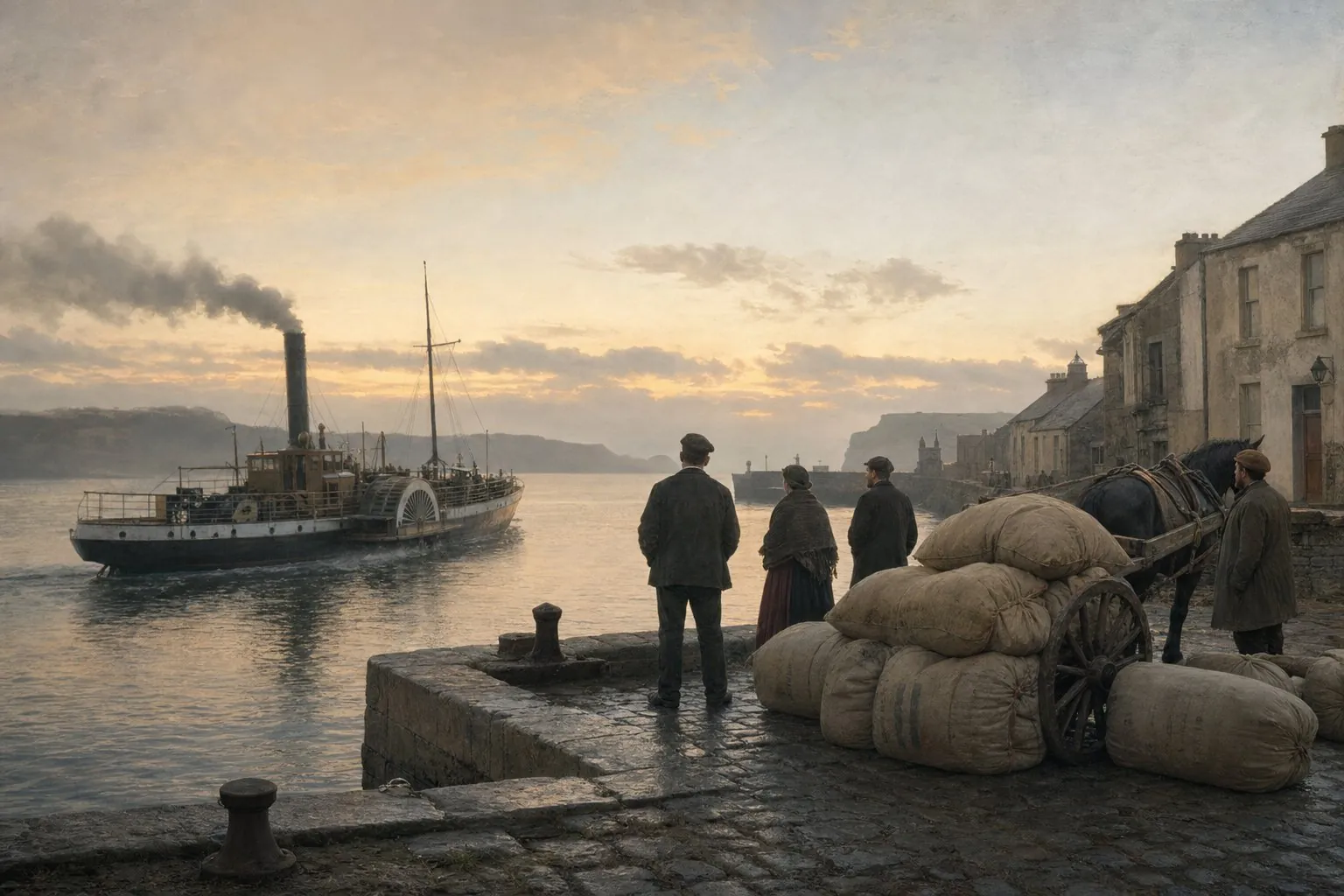
American letters Irish emigrants sent home were the personal correspondence that passed between the United States and the families they had left behind in Ireland, usually folded around a little money, sometimes a prepaid passage ticket, and always the news of a townland. Between the Famine and the end of the century, this exchange was, for most rural Irish households, the only working line of contact with relatives abroad. Everything that mattered had to fit inside one envelope.
American letters, Irish emigrants, and the correspondence that survived
Most of it is lost. Paper kept in a damp cabin for decades rarely lasted, and once the person who valued a letter died, the next generation often did not. What survives is scattered and partial, but it is not small. The Irish Emigration Database, built by the Centre for Migration Studies at the Ulster American Folk Park in Omagh, holds more than 33,000 transcribed and digitised documents drawn from the Public Record Office of Northern Ireland and from private donors, covering emigration to North America from 1700 to 1950 across seventeen categories, letters among them.
A separate and more recent addition came in 2021, when the American historian Kerby Miller donated his research archive to the University of Galway. Miller had spent decades gathering the material for his study of Irish emigrant thought, and the collection holds more than 7,000 complete letters, part of some 150,000 digitised pages spanning the late 1600s to the later twentieth century. Digital archivist Marie-Louise Rouget and historian Breandán Mac Suibhne have overseen its cataloguing at the university since the donation. Miller’s own stated aim, in building the collection, was to find out “what ordinary Irish emigrants thought about life in the United States, about leaving home, the struggle for housing and employment.”
The university opened that archive to the public on 8 March 2024, under the name Imirce, an interdisciplinary project led by Professor Daniel Carey with the library’s head of digital research, Cillian Joy. It let anyone, for the first time, search several thousand of Miller’s letters directly rather than through a scholar’s summary of them. One correspondent in the collection, writing from America decades after this period, put a complaint that recurs across the archive in blunt terms: “old people are very little thought of in this country, not even there own families have any regard for them when they become played out from age,” a line that survives with its own spelling intact.
Smaller but locally rich collections sit elsewhere. The Cork Archives Institute holds more than 120 letters from one Cork family, the Hurleys, writing home from Nevada in the early 1870s, a single family’s correspondence detailed enough to trace year by year. The National Archives of Ireland and the National Library of Ireland each hold further emigrant material, generally in smaller, uncatalogued clusters donated by individual families rather than gathered as a dedicated collection. None of these archives is complete, and none was assembled with an eye to statistical balance. Each is a fragment of a correspondence that, in its own time, ran into the millions of letters a year, and each survives because one household, in one generation, decided a particular letter was worth keeping.
How Irish emigrants wrote home
Not every emigrant, and not every parent left behind, could write. Through the 1840s and 1850s, before the national school system had fully reached the west of Ireland, a letter was frequently composed by someone other than its sender: a literate son or daughter, a hedge schoolmaster, occasionally the parish priest, taking down words dictated at a kitchen table. The reply at the far end might be written the same way, so a single exchange could pass through several hands before its news finished travelling.
This did not make a letter less personal. It made the writing itself a small local event, one more thing a townland did together, and it meant that a letter’s wording sometimes belonged as much to the scribe as to the sender, a fact worth remembering when reading tone into a nineteenth-century line. As the national schools expanded through the second half of the century, more of that writing came to sit directly with the family, in a hand the recipient could recognise as belonging to a particular son or daughter rather than to whoever in the parish held a pen.
The same division of labour applied on the American side. An emigrant who had left school young, or never attended one, might dictate a letter to a fellow lodger, a workmate or a priest at the nearest Catholic parish, particularly in the first months after arrival, when the pressure to send reassuring word home was greatest and the emigrant’s own hand was often the least practised part of the exchange.
What emigrant letters contained
Money came first, and it came in enormous volume. The historian Arnold Schrier, in his 1958 study Ireland and the American Emigration, 1850-1900, calculated that Irish emigrants sent home more than 260 million dollars over the second half of the nineteenth century, a transfer of wealth later historians have called the greatest transatlantic philanthropy of its era. In the worst famine years alone, between 1845 and 1854, Schrier put the figure at roughly 19 million dollars, much of it not cash but prepaid tickets bought in America and posted home so a brother, a sister or a cousin could follow.
The mechanics of sending it improved as the century went on. The Irish Emigrant Society of New York founded the Emigrant Industrial Savings Bank in 1850 specifically to make remittances easier to send, and by 1860 that one institution alone was handling more than 600,000 dollars a year in transfers back to Ireland. A single Mayo emigrant’s letter, held among the county’s local history collection, gives a flavour of what those dollars were meant to prove: writing home from Minneapolis, he told his family, “This is a splendid country, I can sit at a table as good as the best man in Belmullet thank God that I left that miserable place.” The money was evidence, not just help, and so was the boast.
Beyond money, the letters carried the ordinary texture of two lives running in parallel: who had married, who had died, how the harvest and the wages had gone, and, as the century wore on, small enclosures such as a photograph or a sprig of shamrock sent out for the seventeenth of March. Chain migration, one relative sending for the next, was built letter by letter and ticket by ticket on the back of this correspondence.
Letters between Ireland and America: the cost of the crossing
The traffic these letters travelled on was itself young. The Uniform Penny Post began on 10 January 1840, charging a flat penny for a prepaid letter of up to one ounce anywhere within the United Kingdom, Ireland included, and the Penny Black, the world’s first adhesive postage stamp, followed on 1 May that year. Ireland used British stamps throughout this correspondence’s setting and for decades after it. The first stamps issued under an Irish government did not appear until February 1922, so nothing posted in the 1840s or 1850s carried an Irish stamp; it carried a British one, whatever direction it travelled.
Crossing the ocean was a separate and costlier matter, and for years the two governments simply argued about who should charge what. That ended with the Postal Convention with Great Britain, signed on 15 December 1848 and brought into force early the following year, which set a uniform transatlantic sea rate and, with inland postage added at each end, brought a half-ounce letter to one shilling from the Irish or British side and twenty-four cents from the American side. It was real money against a cabin income, and it is one reason the earliest letters of the Famine years sometimes travelled by hand, entrusted to a neighbour heading for the port, rather than through the post at all.
The ships mattered as much as the rates. Samuel Cunard’s steamer Britannia left Liverpool on her maiden voyage on 4 July 1840, calling at Halifax before Boston, and inaugurated a fortnightly mail service under contract to the British government. Steam did not just move passengers faster; it made a transatlantic letter a monthly rhythm rather than a matter of whatever sailing ship happened to be leaving next, and it held that rhythm for the whole of this period.
Reading a letter at the fire
An American letter rarely stayed private for long once it arrived. Accounts of the period describe a familiar scene in rural Ireland: the envelope opened at the table, the contents read aloud by whoever in the house could manage it, and neighbours drawn in to hear the news, because a letter from a local family’s emigrant was public information in a townland as much as private news in a kitchen. It was then folded away and kept, sometimes for years, in a chest or dresser drawer.
By the middle of the 1850s the volume moving through this system was substantial. Mayo’s own local history record puts the number of letters sent from Ireland to America in 1854 alone at one million, in a single year, from one country. The habit long outlasted the Famine generation. When the Titanic called at Queenstown on 11 April 1912, her last port before the open Atlantic, dockers loaded 194 sacks of mail there to join the 3,170 already taken on at Southampton and Cherbourg, the same correspondence, sixty-five years further on. Five postal clerks, two British and three American, sorted that mail in a shipboard post office and stayed at their sorting tables when the ship went down three days later.
What historians cannot know
The archive is generous but it is not complete, and it skews in a particular direction. Letters that survive tend to be the ones a family judged worth keeping: good news, useful news, proof that someone still held. Letters reporting failure, shame, illness or a fall into destitution were less likely to be written at all, and less likely again to be kept if they were. Historians working from these collections generally acknowledge that the archive over-represents steady correspondents and under-represents everyone whose story ended in silence rather than in a kept letter.
Tone is harder still to read at this distance. A newly arrived emigrant boasting of American opportunity in a first letter home might have been exaggerating for a nervous family’s benefit, telling the plain truth, or doing both at once, and the sources rarely allow a reader a century and a half later to tell which. What the surviving letters can show is what people chose to say and how they said it. What they cannot show, except by absence, is everyone who stopped writing, and why.
Sources and further reading
- Arnold Schrier, Ireland and the American Emigration, 1850-1900 (1958), the founding study of remittance volumes and their effect on Irish emigration.
- Centre for Migration Studies, Ulster American Folk Park, Omagh: the Irish Emigration Database, a digitised archive of more than 33,000 emigration-related documents, 1700-1950.
- University of Galway: the Kerby Miller Collection of Irish emigrant correspondence, donated in 2021 and opened to public search in March 2024 as the Imirce digital repository, more than 7,000 letters and 150,000 digitised pages.
- Mayo County Council, “Letters in Ireland,” Mayo local history and emigration collection.
- Yale Law School, The Avalon Project: “Postal Convention with Great Britain,” signed 15 December 1848.
- Smithsonian National Postal Museum, “Fire and Ice” exhibition record on the Titanic disaster, on the ship’s mail clerks and cargo.
Read the opening exchange these letters are modelled on, see how transatlantic postage worked in the 1850s, or visit the archives where letters like these survive for more on tracing the originals.