Gift and Giving
Irish heritage gift box alternative: letters instead of a hamper
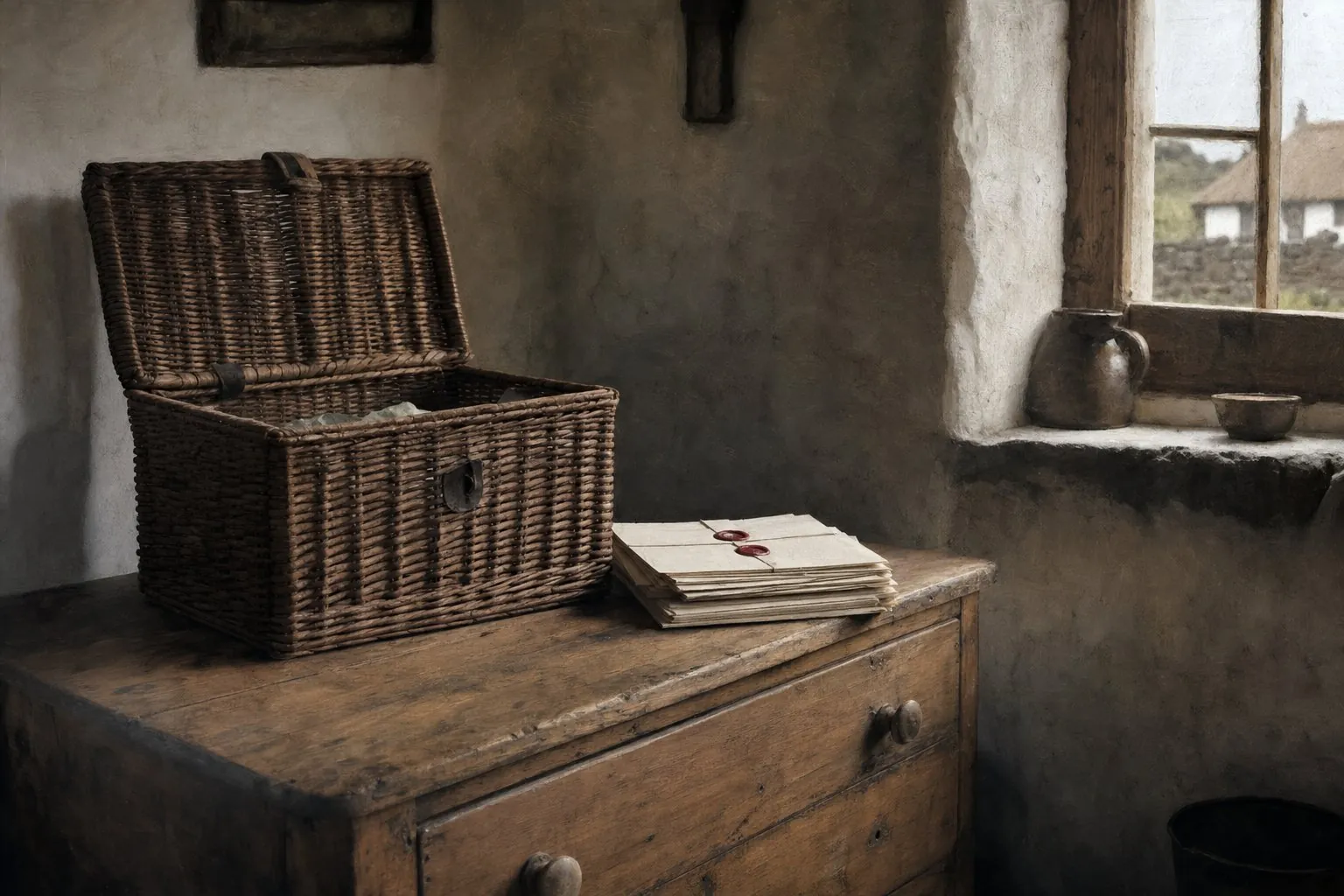
The most useful Irish heritage gift box alternative is not another box: hand-finished letters, posted from Ireland, that leave a story behind rather than another parcel for the shelf. A hamper delivers a new object on a schedule. A letter delivers part of a story, which changes what is left in the house a year later.
Here is a straight Irish subscription box comparison between the two, covering what each one actually costs to keep, to ship, and to leave.
What a heritage hamper delivers, and what it costs later
A good heritage hamper has real charms. Tea, a woollen throw, a jar of something local, wrapped and posted on a schedule: the unwrapping is a genuine pleasure, and for a parent who loves a monthly surprise, that pleasure is not nothing.
The costs show up later, and they are worth naming plainly. Objects gather. A tin and a candle are a treat once; the fourth or fifth of each becomes a task, one more thing to find a shelf for and, eventually, carry out. For anyone weighing an alternative to an Irish hamper, that slow accumulation is usually the real complaint, more than anything printed on the box itself.
There is also a cost that changed very recently. Since 29 August 2025, the United States has suspended the de minimis exemption that used to let parcels worth under 800 dollars enter the country duty-free, following an executive order signed on 30 July 2025. Duties are now collected through carrier-based remittance rather than waved through, and a box of goods crossing the Atlantic as merchandise sits squarely inside that change. A box of tins and textiles and an envelope of paper are not treated the same way at the border, and that gap has just become more expensive to ignore.

Why letters have already outlasted a century and a half of gift-giving
Paper correspondence between Ireland and its diaspora has a track record gift boxes do not. Mayo County Council’s local history service puts the volume at around 1 million letters sent from Ireland to America in 1854 alone, part of a nineteenth-century remittance flow the same record totals at roughly 260 million euro. Whatever else changed decade to decade, writing home was the thing people actually did.
Enough of it survived to build real archives. The University of Galway’s Imirce project, launched in March 2024, holds more than 7,000 letters and 150,000 digitised pages from the collection the historian Kerby Miller gathered over five decades and donated to the university library in 2021. The Irish Emigration Database at the Mellon Centre for Migration Studies in Omagh holds more than 33,000 records spanning 1700 to 1950, drawn from letters, shipping notices, and family papers. The National Library of Ireland separately holds manuscripts among the 12 million items in its care. None of that exists because a family kept a nice tin.

What historians cannot know
The record is not as complete as those figures suggest. Mayo County Library’s own history notes that most nineteenth-century letters did not survive at all, undone by the fragility of paper and, as the record puts it, by later generations who often disposed of them with little thought. The archives searchable online today are a kept fraction of a much larger correspondence, not the whole of it, and the 1854 figure of 1 million letters says more about what was sent that year than about what anyone can still read now. A gift built to be used up leaves even less behind by design, which is a different kind of honesty about what lasts and what does not.
The cancellation problem regulators have not solved yet
The subscription industry’s easiest habit, quietly renewing until the customer intervenes, is currently unregulated at the federal level in the United States, and that is a recent and specific gap rather than a settled one. The Federal Trade Commission finalised its Click-to-Cancel rule in October 2024, requiring cancellation to be at least as easy as signing up. It was due to take effect on 14 July 2025. Eight days before that, the Eighth Circuit Court of Appeals vacated the rule, calling parts of the FTC’s rulemaking process arbitrary and capricious, and the agency has fallen back on older enforcement powers instead.
For a buyer, the practical result is that nothing currently forces a subscription box to make leaving as easy as joining. That is exactly the friction an honest Irish gift box vs subscription comparison should weigh: a rolling charge you must remember to stop is, for now, still entirely your job to manage, not the seller’s.

Choosing an Irish heritage gift box alternative
If the person you are buying for loves the ritual of a fresh parcel each month and does not mind the shelf it leaves behind, a hamper is a fine and honest gift. Buy it without a second thought.
If what you actually want is something that arrives from Ireland without becoming a duty bill, a storage problem, or a subscription you forget to cancel, letters posted from Ireland are built for exactly that gap. It is worth reading before you decide either way: the opening letters are free to read in full, and the honest case for paying for correspondence at all is worked through separately in whether a letter subscription earns its price.
Either gift can be the right one. The only mistake is buying the ritual without weighing what it costs to store, to ship, and eventually to stop, and letters from one Mayo family are one way to sidestep all three at once.
Sources and further reading
- Mayo County Council Library Service, “Letters in Ireland” (Emigration from Mayo local history collection), for the estimate of roughly 1 million letters sent from Ireland to America in 1854, the nineteenth-century remittance total of about 260 million euro, and the note on why most letters did not survive.
- University of Galway, Hardiman Library, “Imirce is LIVE”, and RTE News, “Online archive showcases 400 years of Irish emigrant letters” (8 March 2024), for the Kerby Miller collection, its 2021 donation, and the archive’s more than 7,000 letters and 150,000 digitised pages.
- Mellon Centre for Migration Studies, Ulster American Folk Park, Omagh, “Irish Emigration Database (IED)”, for the collection of more than 33,000 records spanning 1700 to 1950.
- National Library of Ireland, “Our Collections”, for the library’s holdings of over 12 million items, including manuscripts.
- GHY Trade Compliance, “U.S. Ends De Minimis Exemption for Low-Value Imports”, for the 29 August 2025 suspension of duty-free treatment under Executive Order 14324 and the shift to carrier-based duty collection.
- Federal Trade Commission, “Federal Trade Commission Announces Final Click-to-Cancel Rule” (16 October 2024), and Eighth Circuit vacatur reporting (July 2025), for the rule’s finalisation, its intended 14 July 2025 effective date, and its vacatur.