Letters and the Craft
What Is a Letter Subscription? The Story-by-Mail Format
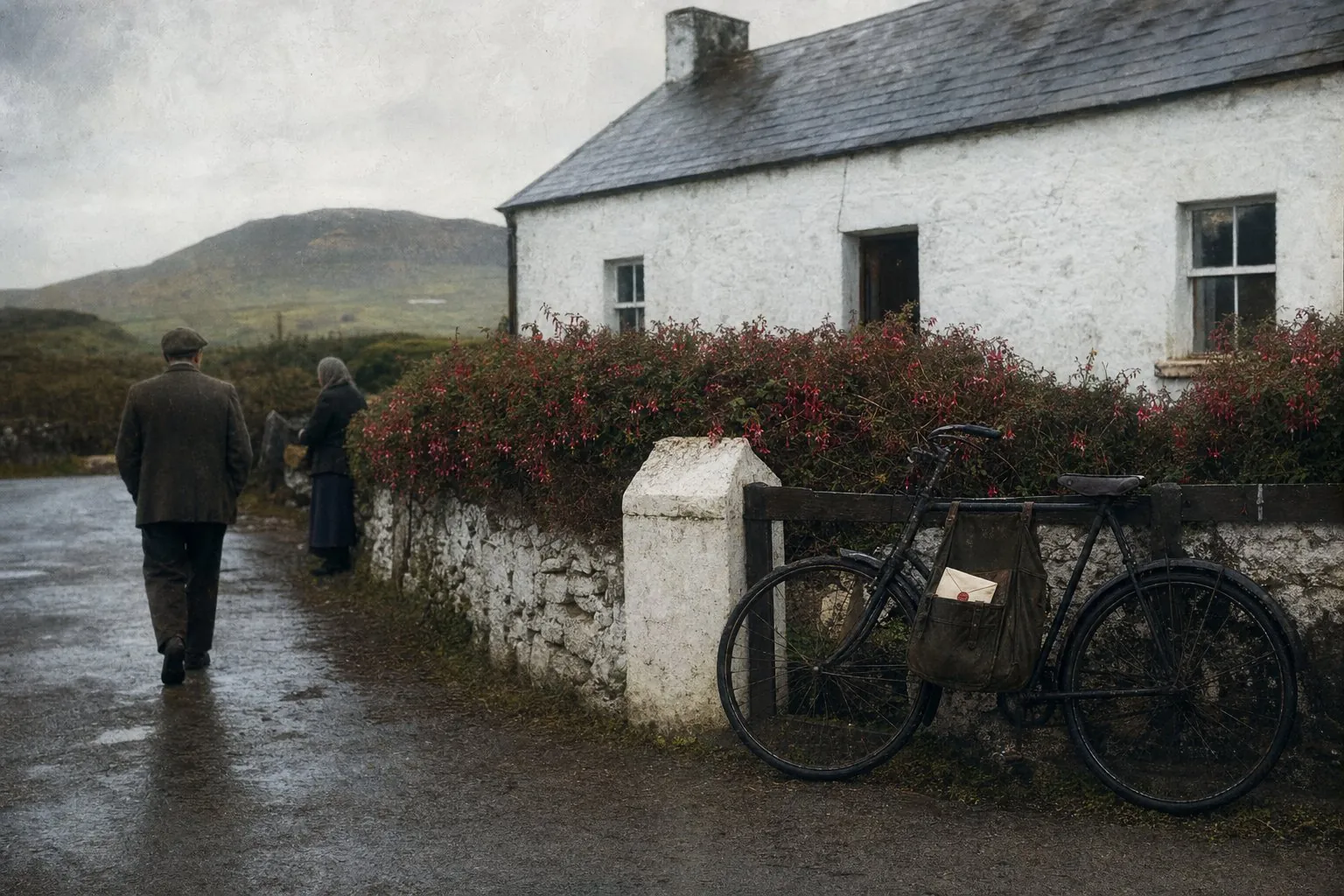
A letter subscription is a service that mails you a physical letter, on paper, through the ordinary post, on a repeating schedule rather than all at once. Some send facsimiles of real historical letters with an article explaining their context. Others send letters written as fiction, so a story unfolds one envelope at a time. Both are read with a cup of tea, not a phone.
What is a letter subscription, exactly?
Strip away the branding and a letter subscription has three fixed parts: paper, the postal system, and a schedule. You give an address, and letters arrive there through the post rather than through an inbox. That is the whole mechanism. What varies is the content of the letter itself, and that is where the format splits into two distinct traditions.
The word “subscription” here means the same thing it means for a magazine: you arrange in advance to receive instalments rather than a single item. What makes a letter subscription unusual next to a magazine or a subscription box is that the object itself, a letter, already had a fixed cultural meaning before anyone sold it as a product. A letter was never a product. It was how people who could not be in the same room stayed connected, and every letter subscription borrows that weight, whether it earns it or not.

The two kinds of letter subscription
Under one name sit two quite different products, and it helps to know which one a given service is selling.
The first kind reproduces real letters from history. Letterjoy, a US service, mails a facsimile of a historic letter each week, printed on stationery designed to resemble the original, along with a companion article it calls the Postscript that explains who wrote it and why. History By Mail works on a similar model but monthly, sending a museum-style replica of an actual historical document with a note on its context, drawing on documents from named archives. In both cases you are holding a copy of something a real person once wrote. The pleasure is the pleasure of an archive delivered to your door.
The second kind is fiction, written in the voice of characters and released in instalments, in the old epistolary tradition of telling a story entirely through letters. Dear Holmes, for instance, sends clue letters addressed to a Victorian detective and lets the reader work toward a solution before the final letter of a case arrives. Nothing here claims to be a real historical document. The letters are invented, but the form, paper, envelope, a wait between instalments, is identical to the first kind.
Yours, From Ireland belongs to the second category: an invented correspondence, set against a real and heavily documented decade of Irish history, the years an Irish emigrant story like this one crosses.
Where the story-by-mail format comes from
The idea of telling a story only through letters is old. The first English novel built entirely from correspondence is generally traced to Love Letters Between a Nobleman and His Sister, published anonymously in 1684 and credited to Aphra Behn. The form did not become a major current in English fiction until the mid-eighteenth century, when Samuel Richardson’s Pamela (1740) and Clarissa (1748) turned letter-by-letter storytelling into one of the most widely read forms of its day. A subscription that mails a story in instalments is, structurally, that same idea: readers of Clarissa waited for each new instalment much as a subscriber now waits for the next envelope.
The postal side of the format has its own, separate history. Before 1840, sending a letter across Britain and Ireland was expensive and complicated: postage was usually charged by distance and by the number of sheets in the letter, commonly more than four pence, and it was normally the recipient, not the sender, who paid on delivery. That changed with the Uniform Penny Post, championed by the reformer Rowland Hill and introduced in January 1840, which set a single flat rate of one penny for any letter under half an ounce, prepaid by the sender, anywhere in the United Kingdom, Ireland included. According to Wikipedia’s account of the reform, the number of letters sent across the UK more than doubled in the first year alone and doubled again within a decade. Cheap, predictable postage is what made ordinary families, not just the wealthy, able to write regularly in the first place. The format a modern subscription revives did not exist as an affordable habit until that reform made it one.
How letter subscriptions work, in practice
However the content is chosen, the mechanics of how letter subscriptions work stay close to the three-part shape above. An address is registered, letters are prepared in advance of their due date, and each one travels through the regular postal network rather than a courier or a digital channel. Because these are ordinary letters, not parcels, they can cross a border as normal correspondence rather than as a dutiable package, which is part of why the format stays paper-only wherever it is done properly.
The scheduling itself is the one deliberate piece of friction the format keeps. An email newsletter can be read, or more often skimmed and deleted, in the same second it lands. A letter cannot. It has to be carried, sorted, delivered, and then physically opened, which puts a small, unavoidable gap between the letter existing and the letter being read. That gap is not a flaw in the format. For an epistolary subscription in particular, it is closer to the point: a reader who is left wondering what the next letter will say is behaving exactly as a reader of Clarissa did in 1748, arranged for by month rather than by penny post.
The letter as it was actually used
Story-by-mail subscriptions did not invent the idea that a letter could carry an entire relationship. Nineteenth-century Irish emigration did that first, on a scale the record only partly captures.
The Mellon Centre for Migration Studies at the Ulster American Folk Park in Omagh holds an Irish Emigration Database of more than 33,000 records drawn from public and private archives, among them thousands of emigrant letters, alongside major related holdings at the Public Record Office of Northern Ireland. In March 2024, University of Galway launched a separate archive, Imirce, built from the Kerby A. Miller Collection, a body of material the historian Kerby Miller assembled over five decades and donated to the university in 2021. Imirce holds roughly 7,000 letters running to more than 150,000 documents in total, spanning the late 1600s to the mid-twentieth century.
The scale of the correspondence itself, while it was happening, is documented too. According to research summarised by The Irish Story, more than 60 million letters travelled from the United States to the United Kingdom between 1854 and 1875, well over half of them addressed to Ireland, and the annual volume reaching the UK from America climbed from roughly 2 million letters in 1854 to more than 6 million a year by the 1870s. The historian Arnold Schrier’s figures for recorded remittances sent home in the same period show them rising from around 725,000 dollars in 1847 to 2.3 million dollars in 1848 and 8.7 million dollars in 1854, much of it, per the historian Hasia Diner’s research, in the form of prepaid passage tickets that funded the next family member’s crossing. None of this is the plot of any particular story. It is the ordinary traffic the format is drawing on.
What historians cannot know
The archive is generous, but it is not complete, and it is worth being honest about the gap.
Letters survive because someone decided to keep them, which means the record is skewed toward families literate enough to write, prosperous enough to have somewhere dry to store paper, and lucky enough that nobody later threw a bundle out. Many emigrants dictated their letters to a scribe or a more literate neighbour, which means the voice on the page is not always, strictly, the sender’s own. Postmarks fade, dates go missing, and a great deal of correspondence is one-sided: the reply survived but the letter it was answering did not, or the reverse. Historians working from these collections are reconstructing a conversation from the half of it that happened to last.
Why the physical version still holds up
None of this history requires a screen, and that is a large part of what a modern letter subscription is selling back. An app wants attention now, and again in ten minutes. A letter asks for nothing until there is a free half hour, and it rewards that half hour with an object that can go in a drawer and turn up again years later. It needs no password, no charger and no update, which matters more than it sounds for an older reader, and it carries a signal that a screen cannot fake: someone went to the trouble of a stamp.
Readers curious what actually arrives in an envelope like this, rather than how the category works in general, can see the opening letters at the sample letter for this particular story, or read the real, non-fictional letters emigrants sent home.
Sources and further reading
- Mellon Centre for Migration Studies, Ulster American Folk Park, “Irish Emigration Database” (record description via RASCAL, Repository of Assessed Subject Collections and Links), accessed 2026.
- University of Galway, “University of Galway launches Imirce database of Irish American emigrant letters,” news release, 8 March 2024.
- The Irish Story, “The Irish Girl and the American Letter: Irish immigrants in 19th century America,” 17 November 2018, citing research by historians Arnold Schrier and Hasia Diner.
- Wikipedia, “Uniform Penny Post,” accessed 2026, on the 1840 postal reform and its effect on UK letter volume.
- Writer’s Digest / EBSCO Research Starters summaries of the epistolary novel, on Love Letters Between a Nobleman and His Sister (1684) and Samuel Richardson’s Pamela (1740) and Clarissa (1748).
- Letterjoy, History By Mail and Dear Holmes, publisher websites, consulted 2026, for current descriptions of each service’s format and schedule.