Emigration History
What Was an American Wake? The Irish Farewell
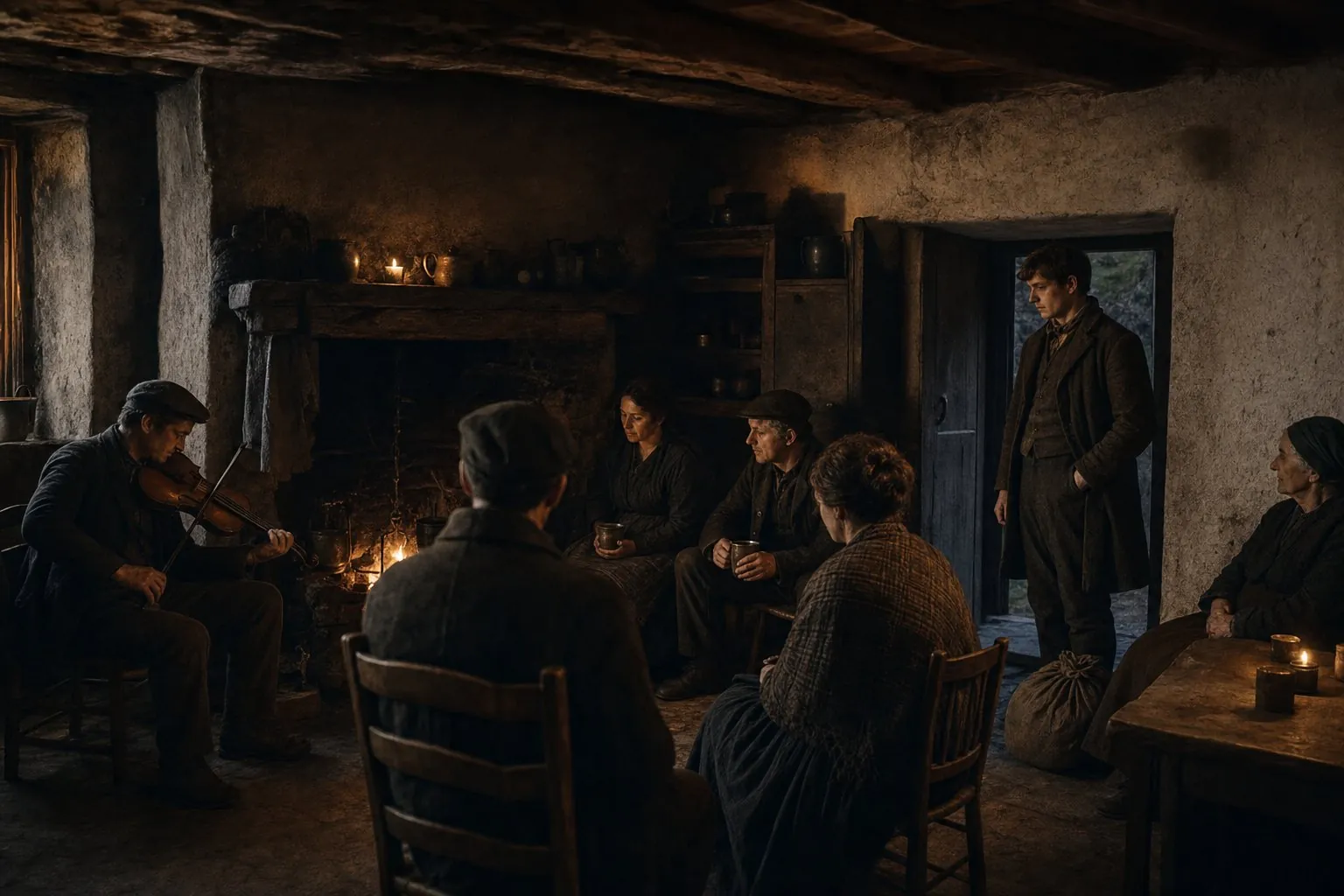
An American wake was the all-night farewell rural Ireland held for someone about to sail for America, staged like a funeral because the parish did not expect to see the person again. Neighbours came with food and drink, there was music and dancing, and as the night wore on the mourning turned real: women keened over a person still sitting upright at the fire.
So what was an American wake, in practical terms? It was a household’s answer to a departure it had no other ritual for. Ireland already knew how to sit up all night with a death. When emigration became the parish’s main way of losing people, communities borrowed that same shape, food, drink, prayer, story, and turned it toward the living.
What was an American wake called, and where
The custom carried several names depending on the district: the live wake, the farewell supper, in places the bottle night. The name that survived tells you most about how people understood it. This was recognised at the time as death’s equivalent, a permanent breaking of ties with the community left behind, according to the historian Kerby A. Miller’s account of the ritual in Emigrants and Exiles (1985).
The practice predates the Great Famine, but most of the detailed, firsthand description of it comes from much later, the late 1800s and early 1900s, when the custom was still current chiefly among Catholic families in the west of Ireland, where older communal rituals held on longest. A large share of what is known today about the American wake as lived practice was gathered decades further on again, in the National Folklore Collection’s Schools’ Collection, compiled between 1937 and 1939 by schoolchildren who wrote down what elderly neighbours told them. By the time those accounts were recorded, the emigrations they described were already the folk memory of a much older generation.
A funeral staged for someone still living
The logic was economic as much as emotional. An Atlantic passage cost more than a labouring family could easily raise twice, the crossing itself took weeks, and a letter home took weeks more in each direction. For most families, once a son or daughter boarded a ship, the parting was, in every practical sense, final. Holding a wake was the community doing the one thing it already knew how to do with a loss of that size.
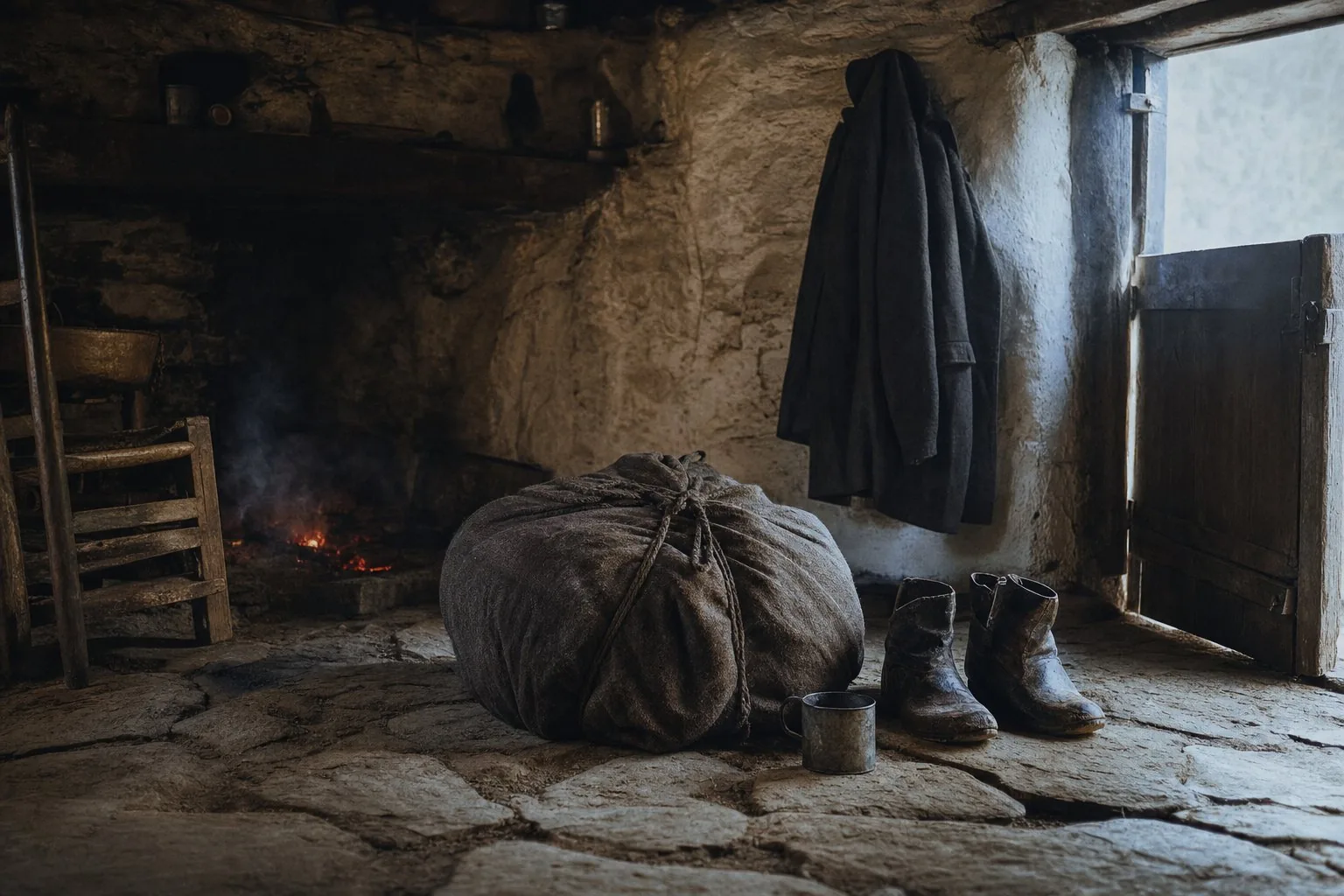
In the days before the sailing, the emigrant went house to house through the townland, calling on neighbours in person to ask them to come, an invitation delivered the same way news of an actual death travelled. On the night itself the family cleared the kitchen. Women baked for a crowd larger than the house usually saw, guests added what they could bring, and the men arrived with drink, beer and often poitín.
Inside the night: food, music and the turn toward keening
The gathering had a double character that struck outside observers and later folklore collectors alike. There was music, dancing, card games and story after story, all understood as being for the one leaving, a last night in the only kitchen that would feel like home to them again. As the hours passed toward morning, the songs slowed and turned to laments.
This is the point at which an Irish emigrant farewell tradition crossed fully into the language of death. Keening, the caoineadh, was Ireland’s formal ritual lament for the dead, a structured tradition of women’s oral poetry rather than spontaneous crying, according to the scholar Angela Bourke’s study of the form. At an American wake, that same lament was turned on someone who was, by every physical measure, still in the room, listening to their own community mourn them in advance.
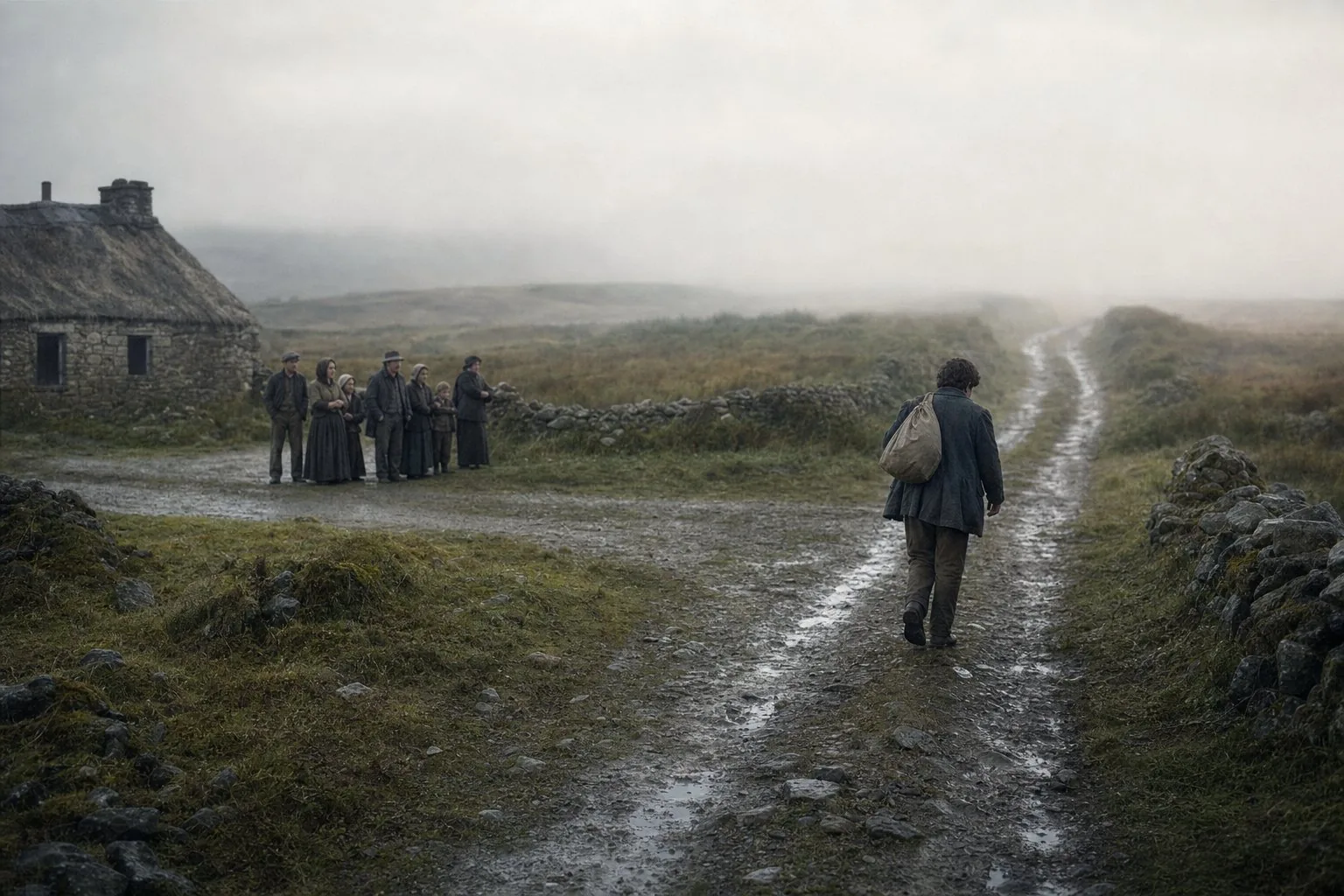
In the morning came the part survivors of the custom seem never to have forgotten: the convoy. Family, friends and neighbours walked the emigrant along the road, sometimes for miles, toward an agreed crossroads or the turn of a boreen. The oldest people could go no further. They said their goodbyes there and stood watching the road until the walking figure was out of sight, in many cases the last look they would ever have of that son or daughter in this life.
Keening for the living: grief with a known shape
Keening for the living only makes sense once you understand what keening normally was. It followed recognisable stages and conventions, praise for the dead, the story of the death, the loss to those left behind, performed aloud by women who took the lead in public grief at an actual wake. Borrowing that structure for someone not yet dead was not a loose figure of speech. It was the deliberate use of a known ritual form to carry feelings the culture had no other formal outlet for.
There is a further, harder layer to this. The Famine years that drove the heaviest emigration also fell hardest on the rural poor, the same class that supplied most of Ireland’s traditional keeners. The catastrophe that filled the roads with emigrants also thinned the ranks of the women who knew how to keen properly, which means the tradition being used to mourn the living was, at the same historical moment, losing the people who carried it.
Black ‘47 and the workhouse at Ballina
In 1847, Black ‘47, the number of farewells in Mayo stopped being individual family occasions and became the ordinary business of the parish. The Poor Law union built around Ballina, formed in July 1840 and covering 792 square miles under a board of 44 guardians, had built its workhouse for 1,200 people. During the famine crisis it admitted 200 more than that capacity, turned away hundreds more for want of room, and recorded 1,138 deaths inside its walls; the workhouse’s own medical officer was among those the fever carried off. The union finished the crisis roughly £2,000 in debt. You can read the fuller record of that year in the Ballina workhouse.
Emigration and starvation were not separate stories that year. A wake held in a Mayo townland in 1847 sent someone out toward a ship that, in that particular season, was itself a serious danger, the overcrowded, under-provisioned crossings that gave the coffin ships their name. Families keening a son or daughter at the fire understood, more than in most years, that the road ahead held its own risk before America was ever reached.
Boston, and what waited at the end of the road
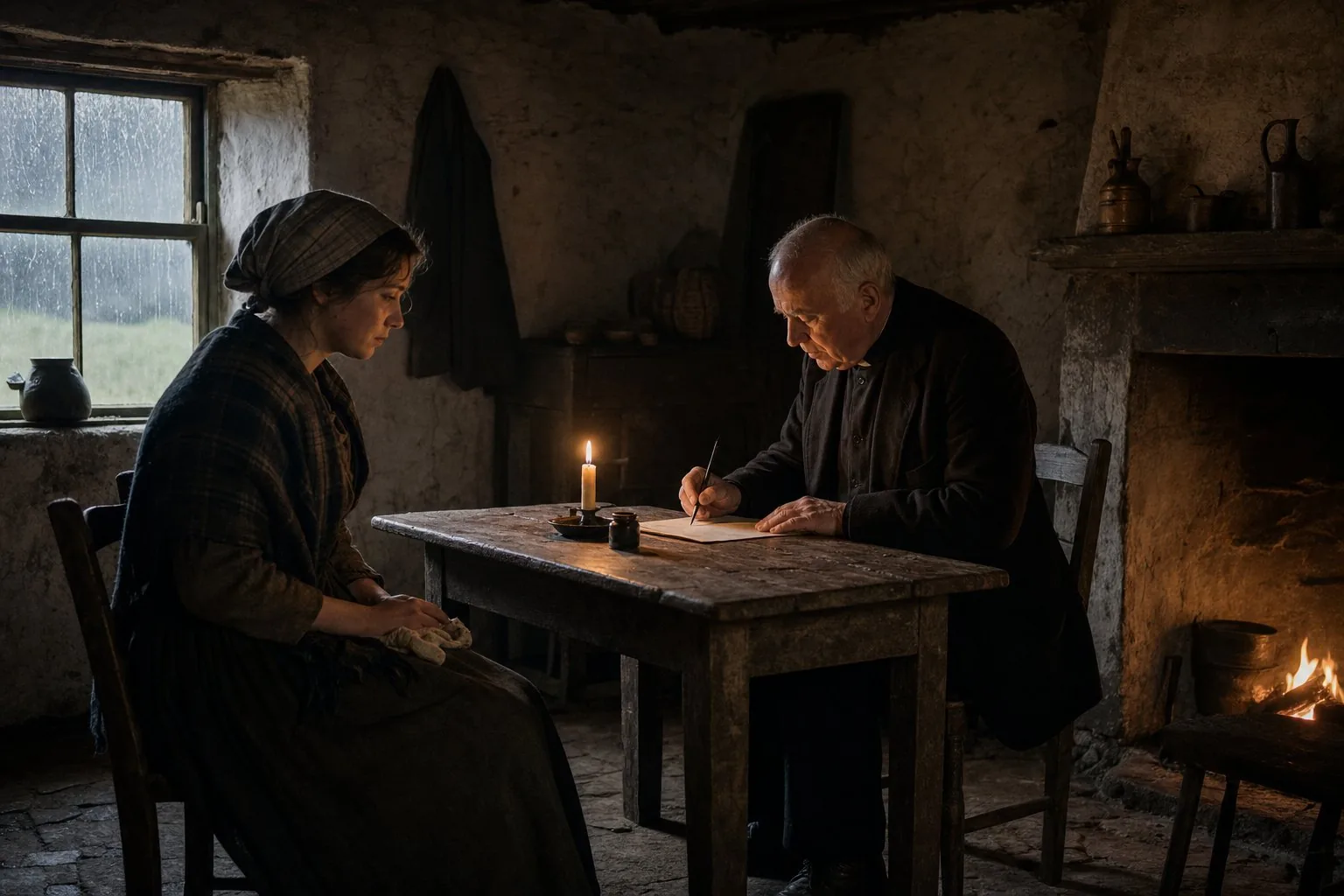
The people who walked away from these gatherings were part of an exodus large enough to reshape an American city within a decade. Boston’s own population stood at 93,383 at the 1840 census and 136,881 by 1850, and a substantial share of that growth was Irish. The historian Oscar Handlin, in his study Boston’s Immigrants, put the number of Irish passengers landing at the port of Boston between 1841 and 1851 at 121,381, a wave concentrated most heavily in the Famine years at the middle of that span.
None of those arrival figures record who among the passengers had been keened for at home, walked to a crossroads, or seen off with a bottle night rather than a quiet parting. The port ledger and the parish wake were two entirely different kinds of record, kept by different people for different reasons, and nothing survives that connects a named wake to a named arrival.
What historians cannot know
The gap between the custom and the record is real, and worth stating plainly. The American wake was already old by the 1840s, but the fullest descriptions of exactly what happened on the night, who spoke, what was sung, come from the National Folklore Collection’s Schools’ Collection of 1937 to 1939, gathered from elderly parishioners recalling a much earlier world. That is close to a century after the Famine emigrations, filtered through the memory of people who were themselves often recounting what their own parents or grandparents had told them.
No civil or church body counted American wakes, so there is no reliable figure for how many were held in any given year, nor any way to know what share of 1840s and 1850s emigrants received one rather than a plainer send-off. Government emigration and port statistics, and the Poor Law union’s own admissions ledger, tell you how many people left the workhouse system or landed at Boston. They say nothing about which of those departures had been mourned the night before at somebody’s fire.
The custom after the crossing
Easier travel and, later, the telephone and cheaper transatlantic passage eventually made the American wake’s core premise less certain: a departure was no longer quite so reliably final. The custom faded through the twentieth century as the journey it mourned stopped being irreversible. What it leaves behind is a clear record of how one community chose to mark an unbearable kind of leaving, treating a live wake in Ireland’s emigration story with the full formal grief usually reserved for death, because to the people in that kitchen, it was close enough. Anyone curious about the wider forces that filled so many of those kitchens with mourners in the first place can follow Mayo’s broader emigration history from the same years.
Sources and further reading
- Kerby A. Miller, Emigrants and Exiles: Ireland and the Irish Exodus to North America (Oxford University Press, 1985), for the American wake’s function as a symbolic death ritual and its role in sustaining ties to Ireland.
- Arnold Schrier, Ireland and the American Emigration, 1850-1900 (University of Minnesota Press, 1958), cited alongside Miller for the geographic and social spread of the custom.
- National Folklore Collection, University College Dublin, the Schools’ Collection (dúchas.ie), compiled 1937-1939, for the surviving firsthand descriptions of American wake customs recorded from elderly informants.
- Angela Bourke, “The Irish Traditional Lament and the Grieving Process,” Women’s Studies International Forum, vol. 11, no. 4 (1988), pp. 287-291, for the structure and gendered practice of keening.
- Peter Higginbotham, “The Workhouse in Ballina, Co. Mayo,” workhouses.org.uk, for the Ballina Poor Law union’s formation, capacity, admissions and deaths during the Famine.
- Oscar Handlin, Boston’s Immigrants: A Study in Acculturation (Harvard University Press, revised edition), for the count of Irish arrivals at the port of Boston, 1841-1851.