Gift and Giving
Gifts for an Irish Grandparent Who Misses Home

The best gift for an Irish grandparent who misses home is not a thing at all. It is something that keeps arriving, and carries a little of the actual place with it, a county name rather than a shamrock, a stamp posted from Ireland rather than a gift-shop shelf. Objects get put away. Arrivals get looked forward to.
Picture the shape of it: a kitchen in Boston, or Chicago, or Sydney, decades on from the crossing, and an accent that still thickens the moment a sister rings from home. A radio still finds the county final. A parish newsletter still turns up somehow, describing a townland that has changed almost beyond recognition since anyone in the room last stood in it. None of that is unusual. It is what missing home tends to look like once the leaving is fifty or sixty years behind a person, and it is why finding a gift for an Irish grandparent who misses home is harder than it looks. What they miss is a place. You cannot wrap a place.
This is about what you can do instead.
The missing is not a rare condition
It helps to know the scale of what you are shopping for. According to the U.S. Census Bureau’s 2026 Facts for Features release, drawing on the 2024 American Community Survey, 32.4 million people in the United States, 9.5% of the population, claimed Irish ancestry that year, and 116,641 residents reported Ireland itself as their birthplace. Cook County, Illinois, alone recorded 436,577 people, 8.4% of its population, claiming Irish roots.
That is a great many kitchens with a radio tuned to Irish news, a great many people for whom “home” is a specific parish rather than a general idea. Your grandmother or grandfather is one household inside a very large pattern, which is worth remembering the next time a shop assistant hands you a tin of shortbread with a harp on it and calls it Irish enough.
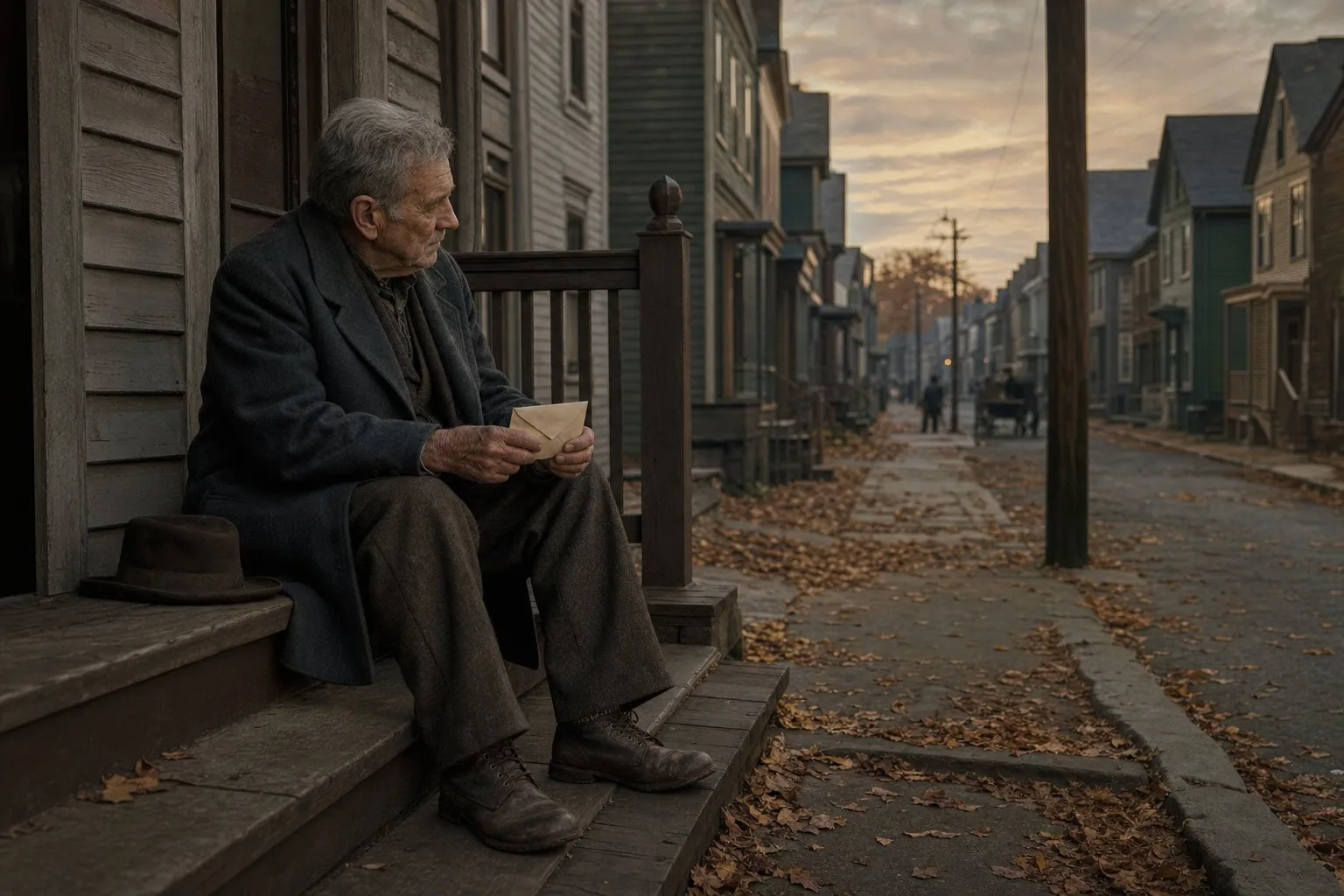
Why the souvenir shelf falls short
He or she has likely been given decades of shamrock mugs and Aran-patterned everything, and each one is somebody else’s idea of Ireland. It reads as a costume version of the country, generic to any Irish person anywhere. What an emigrant grandparent misses is Ireland as a place that knew them specifically, not Ireland as a category.
A gift cannot be the place. But it can come from the place, addressed and posted rather than manufactured and shipped, and that distinction turns out to matter far more than price.
Choosing a gift for an Irish grandparent who misses home
Four questions separate the gifts that land from the gifts that gather dust on a shelf.
Does it come from Ireland, or is it merely about Ireland? There is a real difference between a book about Mayo printed wherever books happen to be printed, and an envelope that was physically posted in Ireland and carried an Irish postmark on its way across the Atlantic. One is information. The other is contact.
Does it arrive once, or does it keep arriving? Homesickness of this kind is not a one-day condition. A single gift gives one good afternoon. Something that comes back gives a date to look forward to, repeatedly, and the waiting is part of what helps.
Is it paper, or is it a screen? The generation that emigrated in the middle of the twentieth century wrote letters home and waited for the reply, often for weeks. For them the post is not a novelty. It is the original technology of staying close, and the hands still know it. Screens ask something of an older person that paper never does.
Is it their county, or is it generic? “Ireland” is an idea. Mayo, or the parish, or the townland names, belong to them specifically. The closer a gift gets to the particular, the more it reads as meant rather than assumed.

A note if it’s your grandmother, granny or nana
Buying for a grandmother tends to carry its own particular pressure, because so much of what is marketed as an Irish gift for grandparents is aimed squarely at her: floral tins, framed blessings, jewellery with a claddagh on it. None of it is wrong, exactly. It is simply aimed at “grandmother” as a category rather than at the specific woman who left a specific place.
Ask what your granny actually talks about when Ireland comes up. It is rarely the country in the abstract. It is usually a person, a road, a dance hall, a particular Christmas. A nana who left as a young woman, often alone, and built a household on the far side of an ocean carries that leaving differently again, and a gift that only she could recognise, tied to her own county rather than a generic Irish one, tends to mean more than anything glittering under wrapping paper.
Why the post office mattered more than any gift shop
For well over a century, the whole relationship between Ireland and its emigrants ran through the post. The scale of what survives is striking: the University of Galway Library now holds the Kerby A. Miller Collection, over 150,000 pages including roughly 7,000 letters and memoirs from Irish emigrants and their families, gathered over five decades of research and made freely searchable online from 2024 as the Imirce digital archive. Read even a handful of them and the pattern repeats: news going out, money and reassurance coming back, a whole family held together on paper and postage.
Before departure itself, that same community built an entire ritual around the leaving. The American wake, held the evening before an emigrant’s departure and named for its resemblance to a wake for the dead, mixed grief with music, prayer and dancing, because for a family in the nineteenth or early twentieth century, a departure to America so often was permanent. Emigration from Ireland to the United States had in fact slowed considerably by the mid-twentieth century: roughly 27,500 Irish emigrants arrived in the U.S. between 1941 and 1950, and around 40,000 between 1951 and 1961, a fraction of Famine-era numbers, with most emigrants of that later period choosing Britain instead. But the emotional weight of the leaving, and of the letters that followed it, did not shrink with the numbers. You can read more about the ritual that saw emigrants off and what it tells us about why the post, once it started arriving, mattered so much.

What historians cannot know
The archives are large but they are not complete, and it is worth being honest about the gap. The Miller Collection runs to thousands of letters, yet it represents a small fraction of the millions who emigrated from Ireland across three centuries; most correspondence was never kept, especially from emigrants who could not write easily themselves or who lost touch with family at home. The American wake itself is documented mostly from folklore collections, newspaper accounts and interviews recorded well after the fact, so the exact words spoken at any single gathering, or how a specific family felt walking home from one, are not something the record can supply. What survives tells us the shape of the custom. It cannot tell us any individual grandparent’s private experience of it, then or now.
A quiet suggestion
This is the need we built Yours, From Ireland around, so take the recommendation with that declared. It is correspondence between one fictional but carefully researched Irish family from Ballycastle, Co. Mayo, written across a decade of real Irish history and posted from Ireland: aged paper, a wax seal, a genuine Irish postmark, script sized for older eyes. If a gift for someone who misses Ireland is what you are weighing up, have a look at Yours, From Ireland, and if the person you have in mind is closer to your own mother than your grandmother, we have written separately about a meaningful gift for an elderly Irish mother.
Sources and further reading
- Kerby A. Miller, “American Wakes,” Encyclopedia of Irish History and Culture (Encyclopedia.com).
- Kerby A. Miller, “Migration: Emigration, 1850 to 1960,” Encyclopedia of Irish History and Culture (Encyclopedia.com).
- University of Galway Library, Imirce digital archive of Irish emigrant letters and memoirs, the Kerby A. Miller Collection, launched 2024.
- U.S. Census Bureau, “Irish American Heritage Month and St. Patrick’s Day: March 2026,” Facts for Features, released 17 February 2026, citing the 2024 American Community Survey.